
Fact Checking Wikipedia (one more time)
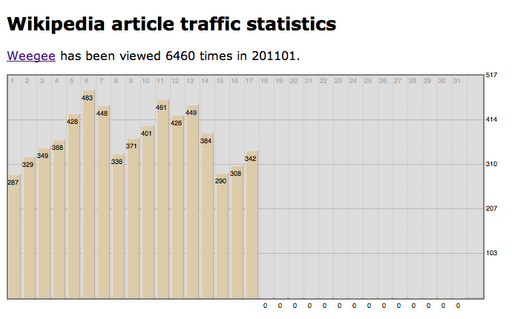
The 10th anniversary of Wikipedia brought us back to the Weegee Wikipedia page…
Wee did this over two years ago, that can be read here…
“Weegee worked in the Lower East Side of New York City”
-Not really. As my Weegee map indicates, he worked all over Manhattan, few photos were made in what we now call the Lower East Side. Sure many were made in “Lower Manhattan” and there is a concentration of photos made with-in a few block radius of his apartment, across from police headquarters, 5 Centre Market Place…
“Much of his work depicted unflinchingly realistic scenes of urban life, crime, injury and death”
-Nope. That could be said of his first several (and intense) years of photographing, say 1936-1941. In the early 1940s he stopped. And the last 25 years of his very productive years as a photographer were spent very far removed from crime and violence, in fact, if there’s an opposite of crime and violence (cheesecake and comedy perhaps), that is how he spent doing “most of his work.”
“Weegee published photographic books and also worked in cinema, initially making his own short films and later collaborating with film directors such as Jack Donohue and Stanley Kubrick.”
-Well, he only published six or seven books and a little brochure in his over 35 years as a photographer. In 1950 Weegee contributed, (and played a photographer as an extra) to Donohue’s “Yellow Cab Man” and took stills on the set of “Dr. Strangelove”… calling this a collaboration, is an exaggeration…
“He maintained a complete darkroom in the trunk of his car, to expedite getting his free-lance product to the newspapers. Weegee worked mostly at nightclubs; he listened closely to broadcasts and often beat authorities to the scene.”
-Nope, no darkroom in his trunk, a nice story, but untrue… In his most productive and well documented years, 1940-1945, there was no need to expedite his images to PM….
On page 52 of Weegee by Weegee, Weegee writes:
“My car became my home. It was a two-seater, with a special extra-large luggage compartment. I kept everything there, an extra camera, cases of flash bulbs, extra loaded holders, a typewriter, fireman’s boots, boxes of cigars, salami, infra-red film for shooting in the dark, uniforms, disguises, a change of underwear, and extra shoes and socks.” Surprisingly there’s no mention of a 4 x 5 enlarger, easel, several photo-processing trays, timers, thermometers, running water, and a safe-light… and a place to dry prints and/or negatives…
Nope, didn’t work mostly in nightclubs.
“Weegee experimented with 16mm filmmaking himself beginning in 1941”
-1941 seems a little early, definitely 1946 (with a borrowed Bolex)…
“and worked in the Hollywood industry from 1946 to the early 1960s, as an actor and a consultant.”
-He was in Hollywood from 1947-1950. Maybe the word Hollywood is misleading. He was making movies and “consulting” on movies, many were not in Hollywood.
“In the 1950s and 1960s, Weegee experimented with panoramic photographs, photo distortions and photography through prisms”
-Panoramic photos? Not really. The only images that are “panoramic” were created for the Windjammer (1958) film, in Cinemiracle…
“Weegee’s images are loyal to the tabloid tradition of fast, “hot”, sensationalized crime scenes and acts of vulgarity, but they also transcend the tabloids in terms of their aesthetic and powerful visions of the underbelly of the Great Depression.”
-According to Wikipedia, the timing of the “Great Depression varied across nations, but in most countries it started in about 1929 and lasted until the late 1930s…” Weegee was not actively making photographs and having those photographs published in the Newspapers (tabloid and otherwise) until the late 1930’s (after leaving Acme darkrooms) when, perhaps not coincidentally, the Great Depression was winding down…
“More than this: they create worlds of time that whilst, on one hand, manipulate and deceive a viewer, also create a subjective experience that is perhaps more believable than that of his contemporaries.”
-?????
“Weegee developed his photographs in a homemade darkroom in the back of his car. This provided an instantaneous result to his work that emphasized the nature of the tabloid industry and literally gave the images a “hot off the press” sensation.”
-Nope. No darkroom back there. “Hot off the press” – please.
“Voyeuristic scenes of murder and mayhem established for the mass audience of the newspapers were Weegee’s specialty and his occupation. Their popularity reveals a culture at once desperate to be distracted from the barbaric acts of World War Two and also curious to witness the same brutality. By tuning in to the darker desires of humanity, Weegee’s crime images provide voyeuristic worlds in which the veracity of time is crucial in their reception and effect.”
-Dunno what most of that means, but the timing is wrong. Weegee wasn’t significantly (only a very few here and there) photographing crime scenes during America’s involvement in WWII. He was making many, many photographs of New York’s war effort (recycling, Civil Aid, etc.)
“All of Weegee’s images relish in their impression of spontaneous, unframed action: whether the subjects are completely unaware of the camera, or they are captured unexpectedly by the camera, or they are already posing for another photograph. The fact that the majority of his scenes are those of the emergency also aids in the simulation of spontaneity- his subjects are simply so absorbed and frantic in the action happening around them that they have no interest in the camera.”
All of Weegee’s images…? Absurd…
01/18/2011
 WEEGEEWEEGEEWEEGEE