New York Times, November 10, 1944, p.21
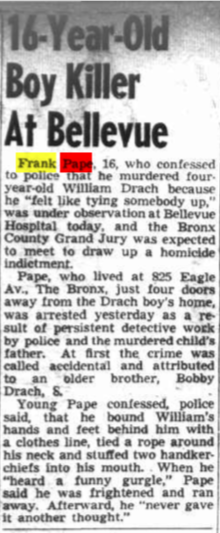
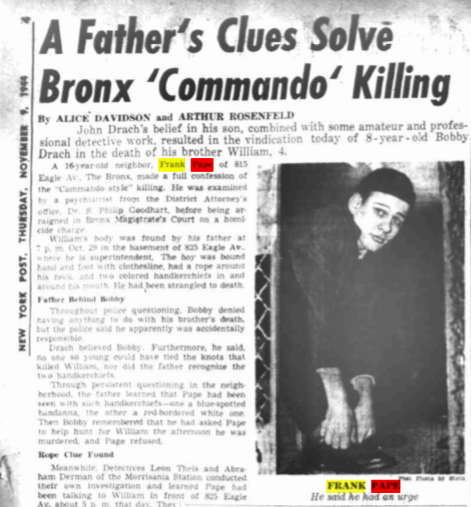
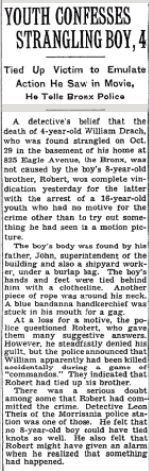
A detective’s belief that the death of 4-year-old William Drach, who was found strangled on Oct. 29 in the basement of his home at 825 Eagle Avenue, the Bronx, was not caused by the boy’s 8-year-old brother, Robert, won complete vindication yesterday for the latter with the arrest of a 16-year-old youth who had no motive for the crime other than to try out something he had seen in a motion picture. The boy’s body was found by his father, John, superintendent of the building and also a shipyard worker, under a burlap bag. The boy’s hands and feet were tied behind him with a clothesline. Another piece of rope was around his neck. A blue bandanna handkerchief was stuck in his mouth for a gag. At a loss for a motive, the police questioned Robert, who gave them many suggestive answers. However, he steadfastly denied his guilt, but the police announced that William apparently had been killed accidentally during a game of “commandos.” They indicated that Robert had tied up his brother. There was a serious doubt among some that Robert had committed the crime. Detective Leon Theis of the Morrisania police station was one of those. He felt that no 8-year-old boy could have tied knots so well. He also felt that Robert might have given an alarm when he realized that something had happened.
No Apparent Reason Found
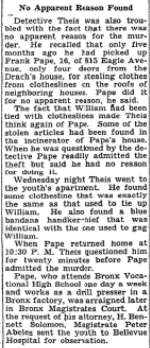
Detective Theis was also troubled with the fact that there was no apparent reason for the murder. He recalled that only five months ago he had picked up Frank Pape, 16, of 815 Eagle Avenue, only four doors from the Drach’s house, for stealing clothes from clotheslines on the roofs of neighboring houses. Pape did it for no apparent reason, he said. The fact that William had been tied with clotheslines made Theis think again of Pape. Some of the stolen articles had been found in the incinerator of Pape’s house. When he was questioned by the detective Pape readily admitted the theft but said he had no reason for doing it.
Wednesday night Theis went to the youth’s apartment. He found some clothesline that was exactly the same as that used to tie up William. He also found a blue bandana handkerchief that was identical with the one used to gag William.
When Pape returned home at 10:30 P. M. Theis questioned him for twenty minutes before Pape admitted the murder.
Pape, who attends Bronx Vocational High School one day a week and works as a drill presser in a Bronx factory, was arraigned later in Bronx Magistrates Court. At the request of his attorney, H. Bennett Solomon, Magistrate Peter Abeles sent the youth to Bellevue Hospital for observation.
“Conduct Frankly Abnormal”
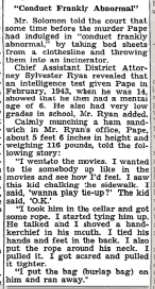
Mr. Solomon told the court that some time before the murder Pape had indulged in “conduct frankly abnormal,” by taking bed sheets from a clothesline and throwing them into an incinerator.
Chief Assistant District Attorney Sylvester Ryan revealed that an intelligence test given Pape in February, 1943, when he was 14, showed that he then had a mental age of 6. He also had very low grades in school, Mr. Ryan added.
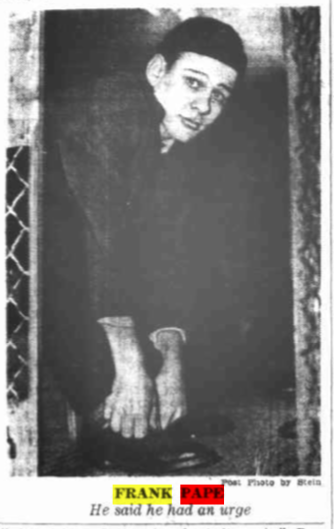
Calmly munching a ham sandwich in Mr. Ryan’s office, Pape, about 5 feet 6 inches in height and weighing 116 pounds, told the following story:
“I went to the movies. I wanted to tie somebody up like in the movies and see how I’d feel. I saw this kid chalking the sidewalk. I said, ‘wanna play tie-up?’ The kid said, ‘O.K.’
“I took him in the cellar and got some rope. I started tying him up. He talked and I shoved a handkerchief in his mouth. I tied his hands and feet in the back. I also put the rope around his neck. I pulled it. I got scared and pulled it tighter.
“I put the bag (burlap bag) on him and ran away.”
New York Times, November 10, 1944, p.21