
Uncategorized
Welcome Brunei!!!
“Don’t Look Now!”

Welcome India, Luxembourg, Chile, Bermuda, and Romania…
Welcome Iraq, Greece, and New Zealand…
Welcome Hong Kong!
Welcome Singapore!
“We are against people who push other people around…”
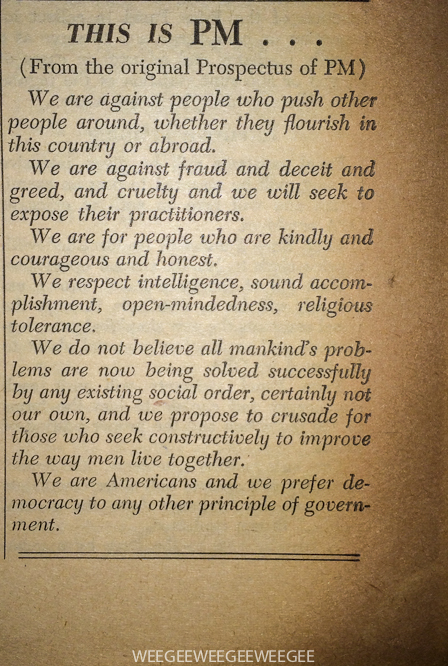
PM, March 17, 1943
THIS IS PM…
(From the original Prospectus of PM)
We are against people who push other people around, whether they flourish in this country or abroad.
We are against fraud and deceit and greed, and cruelty and we will seek to expose their practitioners.
We are for people who are kindly and courageous and honest.
We respect intelligence, sound accomplishment, open-mindedness, religious tolerance.
We do not believe all mankind’s problems are now being solved successfully by any existing social order, certainly not our own, and we propose to crusade for those who seek constructively to improve the way people live together.
We are Americans and we prefer democracy to any other principle of government.
Welcome Algeria!
Photographers of the Genius of the Camera…
Photographers of Genius, p. 152 – PDF
Weegee
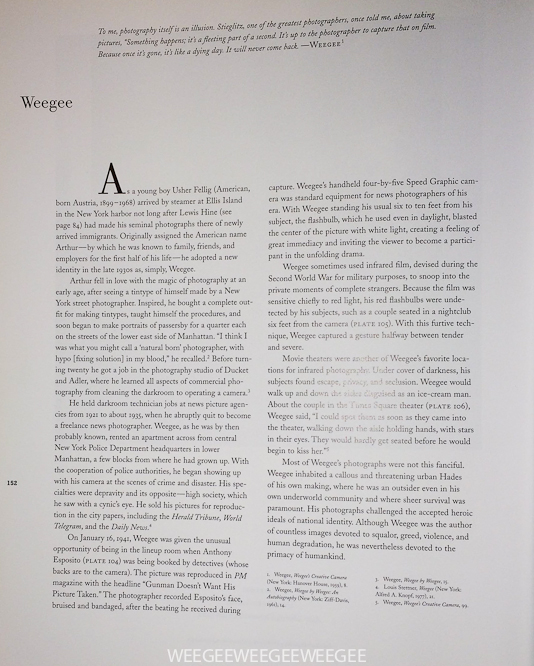
As a young boy Usher Fellig (American, born Austria, 1899-1968) arrived by steamer at Ellis Island in the New York harbor not long after Lewis Hine (see page 84) had made his seminal photographs there of newly arrived immigrants. Originally assigned the American name Arthur-by which he was known to family, friends, and employers for the first half of his life-he adopted a new identity in the late I93OS as, simply, Weegee.
Arthur fell in love with the magic of photography at an early age, after seeing a tintype of himself made by a New York street photographer. Inspired, he bought a complete outfit for making tintypes, taught himself the procedures, and soon began to make portraits of passersby for a quarter each on the streets of the lower east side of Manhattan. “I think I was what you might call a ‘natural born’ photographer, with hypo [fixing solution] in my blood,” he recalled. Before turning twenty he got a job in the photography studio of Ducket and Adler, where he learned all aspects of commercial photography from cleaning the darkroom to operating a camera.
He held darkroom technician jobs at news picture agencies from 1921 to about 1935, when he abruptly quit to become a freelance news photographer. Weegee, as he was by then probably known, rented an apartment across from central New York Police Department headquarters in lower Manhattan, a few blocks from where he had grown up. With the cooperation of police authorities, he began showing up with his camera at the scenes of crime and disaster. His specialties were depravity and its opposite-high society which he saw with a cynic’s eye. He sold his pictures for reproduction in the city papers, including the Herald Tribune, World Telegram, and the Daily News.
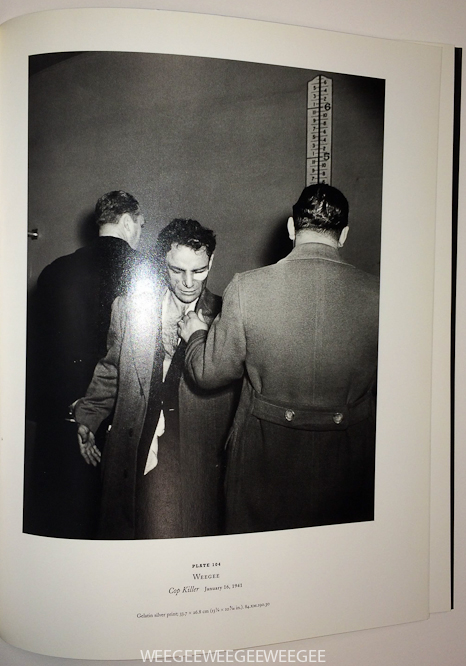
On January 16, 1941, Weegee was given the unusual opportunity of being in the lineup room when Anthony Esposito (PLATE 104) was being booked by detectives (whose backs are to the camera). The picture was reproduced in PM magazine with the headline “Gunman Doesn’t Want His Picture Taken.” The photographer recorded Esposito’s face, bruised and bandaged, after the beating he received during capture. Weegee’s handheld four-by-five Speed Graphic camera was standard equipment for news photographers of his era. With Weegee standing his usual six to ten feet from his subject, the flashbulb, which he used even in daylight, blasted the center of the picture with white light, creating a feeling of great immediacy and inviting the viewer to become a participant in the unfolding drama.
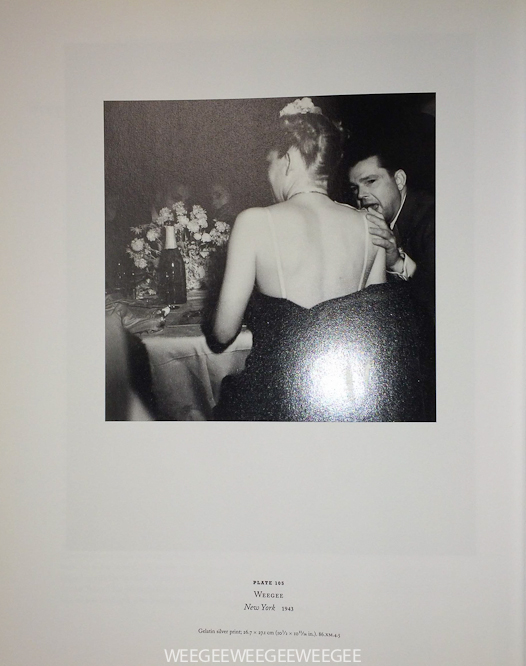
`\’\‚Äò7C‚Ǩ‚ÄúgL2‚Ǩ ¬ª=~ fi-ft%:=1es used infrared film, devised during the Second ‚Äò\77,¬ª‚Äôv ‘ .friiitary purposes, to snoop into the prhfztfw -1 date strangers. Because the film was sexism his red flashbulbs were unde-terff _ = as a couple seated in a nightclub so; it I 2-1.f\T1=: IOS). With this furtive tech- 111q1t.~. ‚Äú 11 gesture halfway between tender and st \’ <_‚Äô .‚Äò
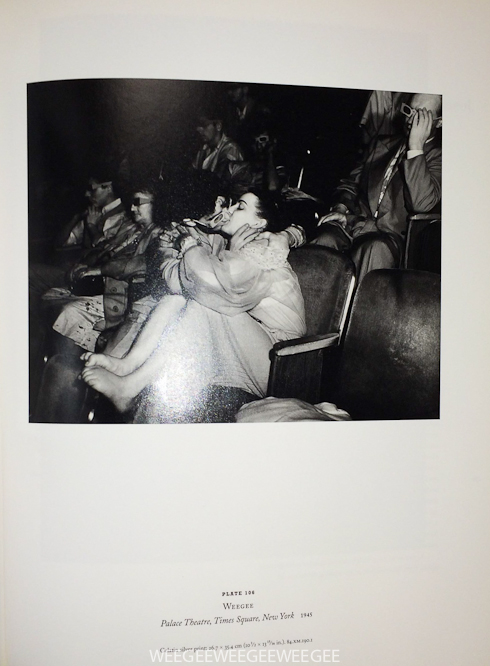
Movie theaters were another ofWeegee's favorite locations for infrared photography. Under cover of darkness, his subjects found escape, privacy, and seclusion. Weegee would walk up and down the aisles disguised as an ice-cream man. About the couple in the Times Square theater (PLATE 106), Weegee said, "I could spot them as soon as they came into the theater, walking down the aisle holding hands, with stars in their eyes. They would hardly get seated before he would begin to kiss her."
Most of Weegee's photographs were not this fanciful. Weegee inhabited a callous and threatening urban Hades of his own making, where he was an outsider even in his own underworld community and where sheer survival was paramount. His photographs challenged the accepted heroic ideals of national identity. Although Weegee was the author of countless images devoted to squalor, greed, violence, and human degradation, he was nevertheless devoted to the primacy of humankind.
1. Weegee, Weegee's Creative Camera.
2. Weegee, Weegee by Weegee
3. Weegee, Weegee by Weegee
4. Louis Stettner, Weegee
5. Weegee, Weegee's Creative Camera.
Photographers of Genius, p. 152
 WEEGEEWEEGEEWEEGEE