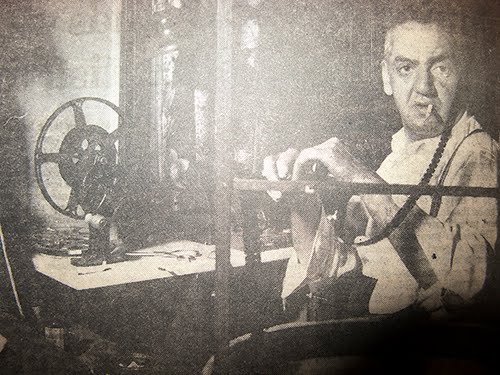
PM Daily March 21, 1948
To be continued…
(something to look forward to…)

PM Daily March 21, 1948
To be continued…
(something to look forward to…)
(Wee were looking for something else on the Internet and stumbled across this auction result, think wee missed it last year… Who took the original negative?)

LOT 122
WEEGEE (1899-1968)
Marilyn Monroe, c. 1960
‘Weegee the Famous’ and ‘Weegee from Photo-Representatives’ credit stamps (on the verso)
11¾ x 10½in. (30 x 26.8cm.)
ESTIMATE
$6,000 – $8,000
PRICE REALIZED
$6,875
Christees:
SALE 2139 | NEW YORK
ICONS OF GLAMOUR AND STYLE: THE CONSTANTER COLLECTION
12 FEBRUARY 2009
[SALE TOTAL: 910,250 (USD)]
The 10th anniversary of Wikipedia brought us back to the Weegee Wikipedia page…
Wee did this over two years ago, that can be read here…
“Weegee worked in the Lower East Side of New York City”
-Not really. As my Weegee map indicates, he worked all over Manhattan, few photos were made in what we now call the Lower East Side. Sure many were made in “Lower Manhattan” and there is a concentration of photos made with-in a few block radius of his apartment, across from police headquarters, 5 Centre Market Place…
“Much of his work depicted unflinchingly realistic scenes of urban life, crime, injury and death”
-Nope. That could be said of his first several (and intense) years of photographing, say 1936-1941. In the early 1940s he stopped. And the last 25 years of his very productive years as a photographer were spent very far removed from crime and violence, in fact, if there’s an opposite of crime and violence (cheesecake and comedy perhaps), that is how he spent doing “most of his work.”
“Weegee published photographic books and also worked in cinema, initially making his own short films and later collaborating with film directors such as Jack Donohue and Stanley Kubrick.”
-Well, he only published six or seven books and a little brochure in his over 35 years as a photographer. In 1950 Weegee contributed, (and played a photographer as an extra) to Donohue’s “Yellow Cab Man” and took stills on the set of “Dr. Strangelove”… calling this a collaboration, is an exaggeration…
“He maintained a complete darkroom in the trunk of his car, to expedite getting his free-lance product to the newspapers. Weegee worked mostly at nightclubs; he listened closely to broadcasts and often beat authorities to the scene.”
-Nope, no darkroom in his trunk, a nice story, but untrue… In his most productive and well documented years, 1940-1945, there was no need to expedite his images to PM….
On page 52 of Weegee by Weegee, Weegee writes:
“My car became my home. It was a two-seater, with a special extra-large luggage compartment. I kept everything there, an extra camera, cases of flash bulbs, extra loaded holders, a typewriter, fireman’s boots, boxes of cigars, salami, infra-red film for shooting in the dark, uniforms, disguises, a change of underwear, and extra shoes and socks.” Surprisingly there’s no mention of a 4 x 5 enlarger, easel, several photo-processing trays, timers, thermometers, running water, and a safe-light… and a place to dry prints and/or negatives…
Nope, didn’t work mostly in nightclubs.
“Weegee experimented with 16mm filmmaking himself beginning in 1941”
-1941 seems a little early, definitely 1946 (with a borrowed Bolex)…
“and worked in the Hollywood industry from 1946 to the early 1960s, as an actor and a consultant.”
-He was in Hollywood from 1947-1950. Maybe the word Hollywood is misleading. He was making movies and “consulting” on movies, many were not in Hollywood.
“In the 1950s and 1960s, Weegee experimented with panoramic photographs, photo distortions and photography through prisms”
-Panoramic photos? Not really. The only images that are “panoramic” were created for the Windjammer (1958) film, in Cinemiracle…
“Weegee’s images are loyal to the tabloid tradition of fast, “hot”, sensationalized crime scenes and acts of vulgarity, but they also transcend the tabloids in terms of their aesthetic and powerful visions of the underbelly of the Great Depression.”
-According to Wikipedia, the timing of the “Great Depression varied across nations, but in most countries it started in about 1929 and lasted until the late 1930s…” Weegee was not actively making photographs and having those photographs published in the Newspapers (tabloid and otherwise) until the late 1930’s (after leaving Acme darkrooms) when, perhaps not coincidentally, the Great Depression was winding down…
“More than this: they create worlds of time that whilst, on one hand, manipulate and deceive a viewer, also create a subjective experience that is perhaps more believable than that of his contemporaries.”
-?????
“Weegee developed his photographs in a homemade darkroom in the back of his car. This provided an instantaneous result to his work that emphasized the nature of the tabloid industry and literally gave the images a “hot off the press” sensation.”
-Nope. No darkroom back there. “Hot off the press” – please.
“Voyeuristic scenes of murder and mayhem established for the mass audience of the newspapers were Weegee’s specialty and his occupation. Their popularity reveals a culture at once desperate to be distracted from the barbaric acts of World War Two and also curious to witness the same brutality. By tuning in to the darker desires of humanity, Weegee’s crime images provide voyeuristic worlds in which the veracity of time is crucial in their reception and effect.”
-Dunno what most of that means, but the timing is wrong. Weegee wasn’t significantly (only a very few here and there) photographing crime scenes during America’s involvement in WWII. He was making many, many photographs of New York’s war effort (recycling, Civil Aid, etc.)
“All of Weegee’s images relish in their impression of spontaneous, unframed action: whether the subjects are completely unaware of the camera, or they are captured unexpectedly by the camera, or they are already posing for another photograph. The fact that the majority of his scenes are those of the emergency also aids in the simulation of spontaneity- his subjects are simply so absorbed and frantic in the action happening around them that they have no interest in the camera.”
All of Weegee’s images…? Absurd…
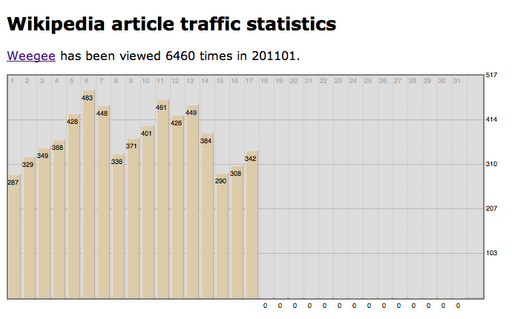
01/18/2011
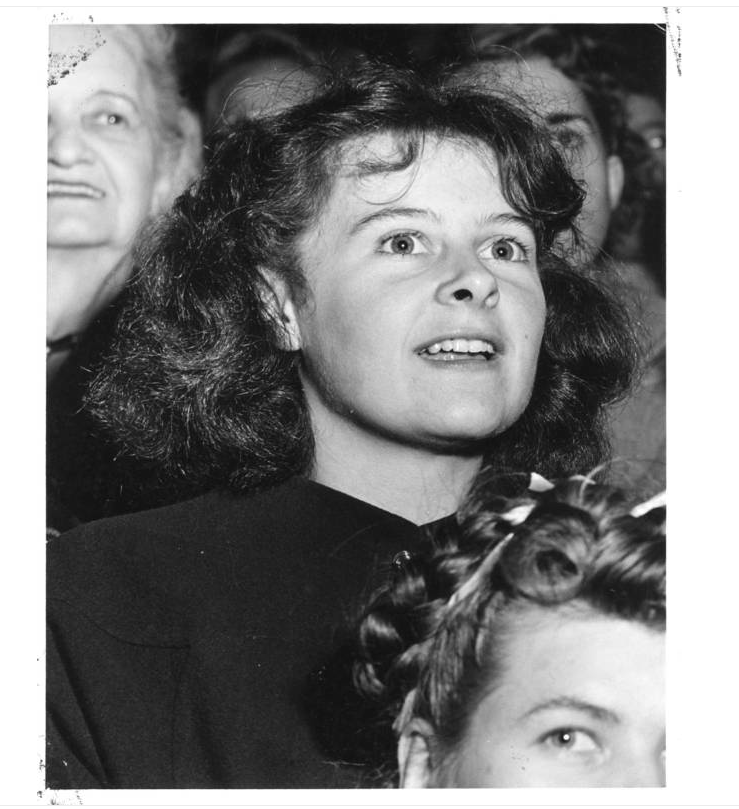
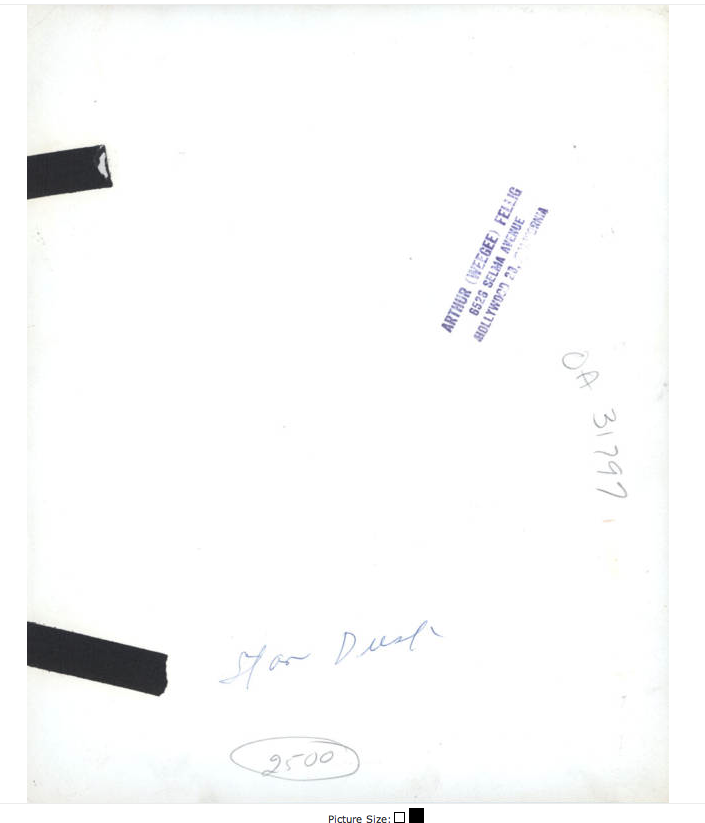
Weegee, Star Dust, ca. 1950
Sold in October for $305.00, sold again in December for $560.00
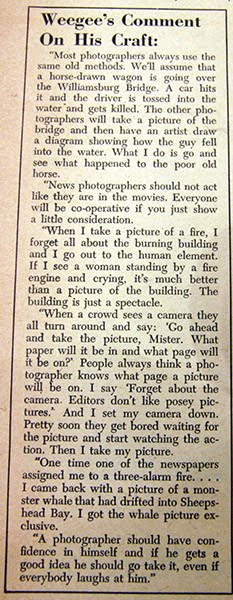
Similar thoughts from from Weegee and Ralph…
“One time one of the newspapers assigned me to a three-alarm fire… I came back with a picture of a monster whale that had drifted into Sheepshead Bay. I got the whale picture exclusive.
A photographer should have confidence in him or herself and if he or she gets a good idea he or she should go take it, even if everybody laughs at him or her.”
Weegee, PM, March 1941
“Eventually I discovered for myself the utterly simple prescription for creativity: be intensely yourself. Don’t try to be outstanding; don’t try to be a success; don’t try to do pictures for others to look at—just please yourself. My father used to say: “Erst komm ich; damn komm ich noch wieder; damn komm ich noch einmal wieder.” When the registrar of the Paris Conservatoire asked Debussy what rules he followed, Debussy’s answer was: “Mon plaisir.” E.E. Cummings put it: “To be yourself and nobody but yourself in a world which is trying night and day to make you everybody but yourself is to fight the hardest battle there is and never stop fighting.”
As I’ve said, for a while in the twenties there was a fashion for making photographs look as much as possible like nineteenth-century painting. Stieglitz himself, in the early days of Camera Work, fell into this trap, but later he was in the forefront to establish photography as a medium with its own values. He also put to rest the debilitating question that was so often debated: “Is photography art?” by making the most terse and apt statement of his life. He said: “I like some photographs more than most paintings and some paintings more than most photographs.
Ralph Steiner, A Point of View, Middletown, Connecticut: Wesleyan University Press, 1979, pp. 6–7


Wee recently saw these on the Internet…
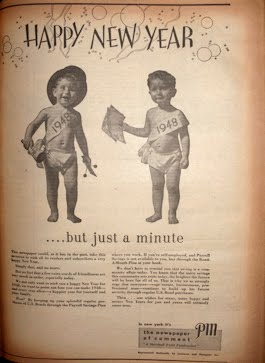

Weegee died today, December 26, 1968…
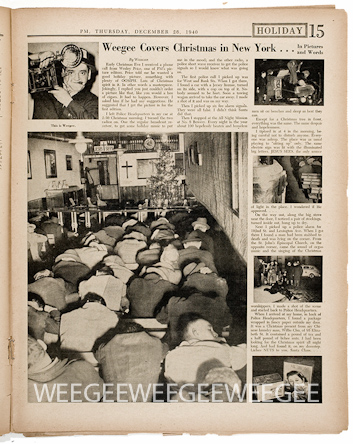
PM, December 26, 1940 by Weegee
Weegee Covers Christmas in New York… In Words and Pictures
Early Christmas Eve I received a phone call [a funny thing to receive from a person who wrote that he had no phone: “In my room, I would have the mail and telegrams slipped under my door. I had no phone; I’m allergic to them…” Weegee by Weegee, 1961, pp. 64-65] from Wesley Price, one of PM’s picture editors. Price told me he wanted a good holiday picture, something with plenty of OOMPH. Lots of Christmas spirit in it. in other words a masterpiece. Jokingly I replied you just couldn’t order a picture like that, like you would a box of cigars. It had to happen. However, I asked him if he had any suggestions. He suggested that I get the picture in for the first edition. [Very funny, LOL, nevertheless, slightly different environment than: “The upshot was that I had a roving assignment from PM for the next four-and-a-half years. I picked my own stories. When I found a good one, I brought t in. All they had to do was mail me my weekly check for seventy-five dollars… which they did.” Weegee by Weegee, 1961, p. 86]
I left police headquarters in my car at 2:30 Christmas morning. I turned the two radios on. One the regular broadcast receiver, to get some holiday music to put me in the mood; and the other radio, a police short wave receiver to get the police signals so I would know what was going on.
The first police call I picked up was for West and Bank Sts. When I got there I found a car with a Jersey license, turned on its side, with a cop on top of it. Nobody seemed to be hurt. Soon a towing wagon arrived to take the car away. I made a shot of it and was on my way.
Then I picked up six fire alarm signals. They were alll false. I didn’t think Santa did that.
Then I stopped at the All Night Mission at No. 8 Bowery. [Not the still extant Bowery Mission.] Every night in the year about 100 hopelessly beaten and homeless men sit on benches and sleep as best they can. [see below]
Except for a Christmas tree in front, everything was the same. The same despair and hopelessness. I tiptoed in at 4 in the morning, being careful not to disturb anyone. Everyone was asleep. The place was as usual playing to “Sitting up” only. The same electric sign was lit with the illuminated big letters, JESUS SEES, the only source of light in the place. I wondered if He approved…
On the way out, along a big stove near the door, I noticed a pair of stockings, turned inside out, hung to dry.
Next I picked up a police alarm for 102nd St. and Lexington Ave. When I got there I found a man had been stabbed to death and was lying on the corner. From the St. John’s Episcopal Church, [according to the Internet, there is no St. John’s Episcopal Church at 102nd St. and Lexington Ave. There is one in the Village, 224 Waverly Place…] on the opposite corner, came the sound of organ music and the singing of the Christmas worshipers. I made a shot of the scene and started back to police headquarters.
When I arrived at my home, in back of Police Headquarters, I found a package wrapped in fancy paper outside my door. It was a present from my Chinese laundry man, Willie Chu, of 95 Elizabeth St. It contained a pound of tea and a half pound of lichee nuts. I had been looking for the Christmas spirit all night long. And had found it, on my doorstep. Lichee NUTS to you, Santa Claus…
Coincidentally The New Yorker also stopped by the All Night Mission in 1940:
ABSTRACT: Talk story about census enumeration of the derelicts in the Bowery. Since none of the homeless men know in the morning whether his address will be a flophouse, an allnight mission, or a doorway, the enumerators waited until evening to cover the Bowery. In each of the hotels – the Sunshine, Uncle Sam House, the Plaza, and the rest – were two enumerators, who got the statistics on each guest before he was allowed to register & go to his bed. At the All-Night Mission, 8 Bowery, we found 80-odd men quietly starting to spend the night sitting up. A single enumerator was taking down the information an old man was giving him. He had been born in N. Y. C. 67 years ago. No wife, no, children? no. He wasn’t looking for work. He was on relief. Home? Well, the mission…

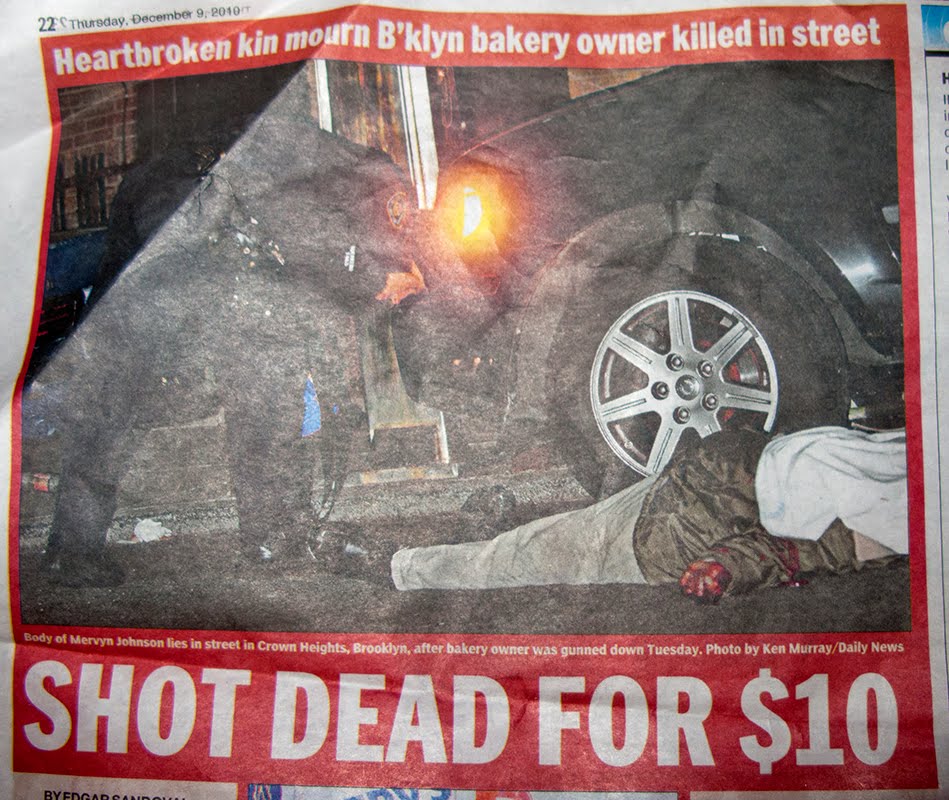
Ken Murray, Body of Mervyn Johnson lies in street in Crown Heights, New York Daily News, December 9, 2010, p. 22
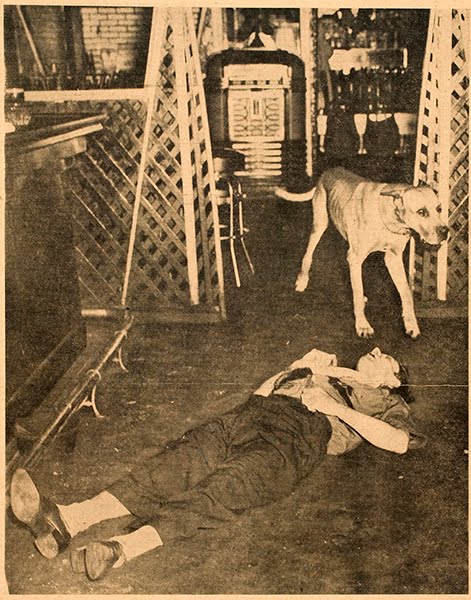
Weegee, Killed for a warm glass of beer, PM Daily, July 31, 1941
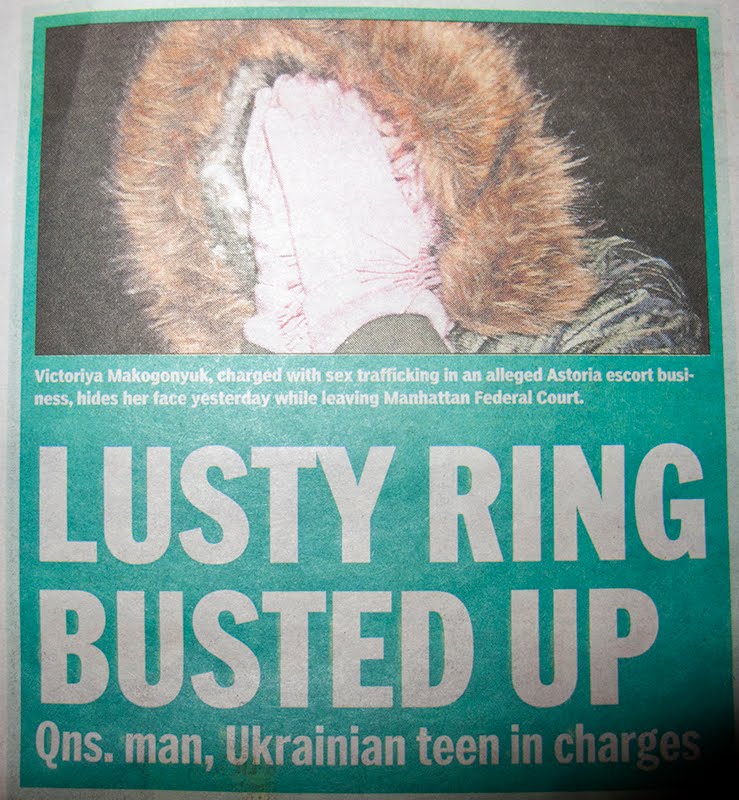
Unidentified photographer, Victoriya Makogonyuk, New York Daily News, December 10, 2010, p. 21
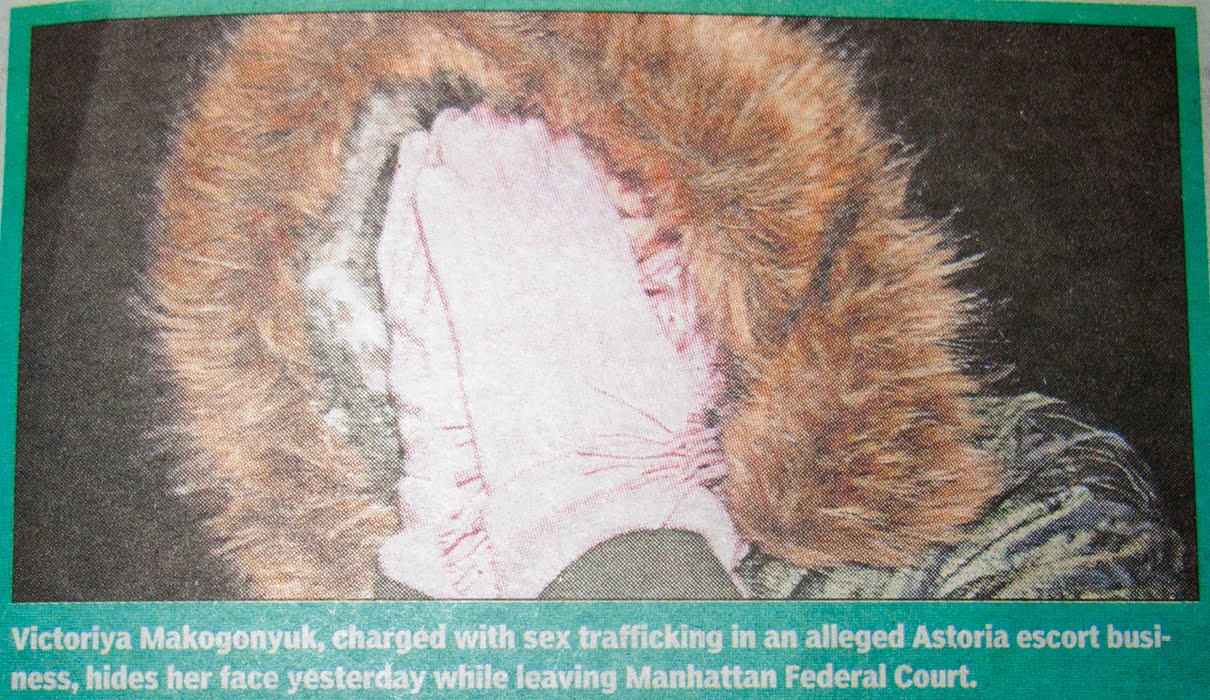
Unidentified photographer, Victoriya Makogonyuk, New York Daily News, December 10, 2010, p. 21
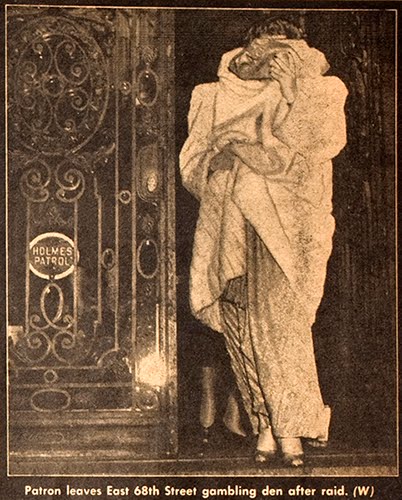
Weegee, Ermine-Wrapped Patron Caught in Gambling Den, PM Daily, June 15, 1941
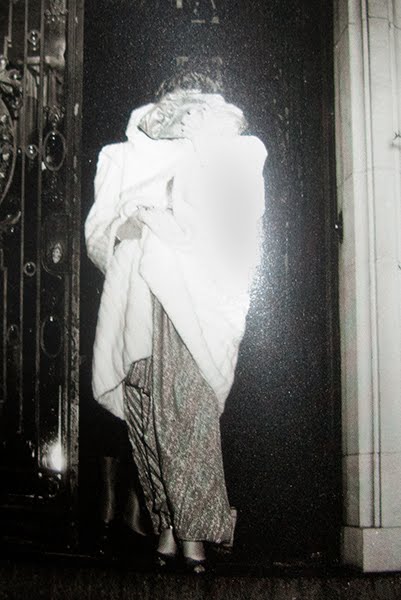
Weegee, Ermine-Wrapped Patron Caught in Gambling Den, December 1940, Unknown Weegee book, p. 28
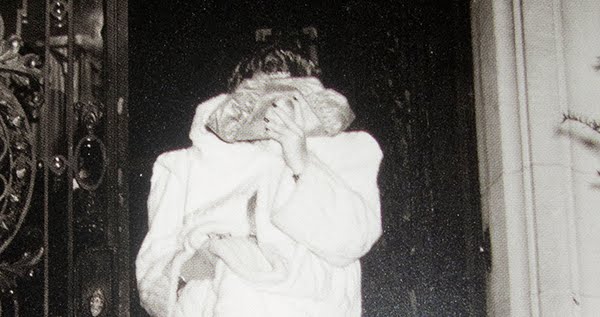
Weegee, Ermine-Wrapped Patron Caught in Gambling Den, December 1940, Unknown Weegee book, p. 28
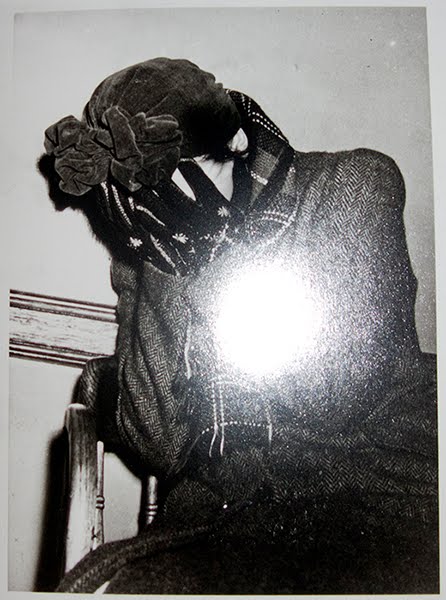
Weegee, Irma Twiss Epstein, Nurse Accused of Killing Baby, 1942, Unknown Weegee book, p. 27
 WEEGEEWEEGEEWEEGEE