Archive

Uncategorized

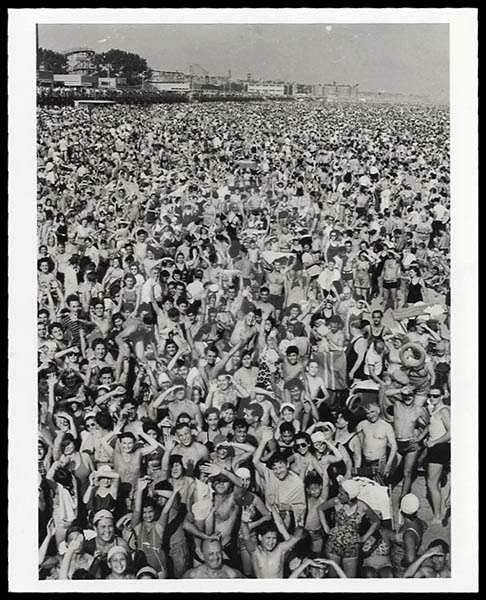
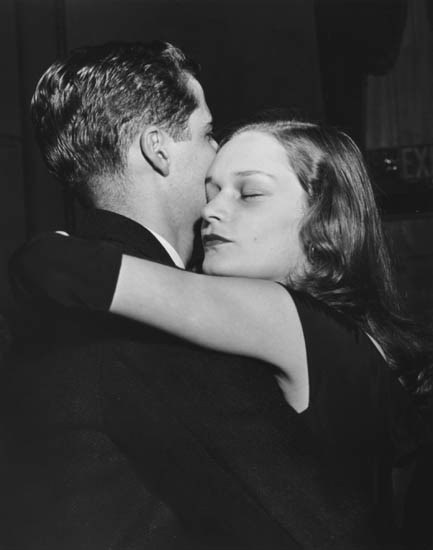
Wee recently saw this on an Internet auction site.
The photographer was not identified.
The print was probably made in the 80s (maybe 70s or 90s).
The only interesting thing is that the print is made from a slightly different negative, not the famous, Weegee’s World negative, possibly the one that was printed in PM, on July 22, 1940…
It sold for $31.00.

(Old News)

The Berinson Weegee Collection Exhibition in Poland:

May 9, 2009 – July 26, 2009
Copied from National Museum’s Web Site:

Weegee from the Berinson’s Collection

9 May 2009  –  26 July 2009

The National Museum in Krakow – the Main Building, al. 3 Maja 1


The figure of Weegee as a pioneer and a classic figure in journalistic photography, 
characterized by the picture taken ‘off the cuff,’ implies questions about the 
borderline between spontaneity and the creation of a spectacle, appeasing the 
mass audience’s desire for the sensational. These pictures from the collection 
of Hendrik Berinsonn, shown in Krakow for the very first time, bear incredible 
testimonial to a time – and from behind the pictures emerges the figure of the 
artist himself, who was already a legend back in the 30s and 40s – when he 
was most professionally active.
Weegee was the pseudonym of Arthur Felig, born in 1899 into a Jewish 
family in Złoczew, not far from Lwów (now Lviv, Ukraine). In 1909 
his family immigrated to the United States – Fellig grew up in New York’s 
Lower East Side. This was one of the most dangerous districts during the
time of the Great Depression – it became the scene of his professional 
work. As a teenager, he left his parents and took various pick-up jobs, 
including one as assistant to a street photographer. He also visited the 
police station, taking pictures of criminals, which in time transformed into 
his passion and his profession. He was a typical self-made man, who was 
more interested in being in the center of events and being their witness
than he was in the artistic side of photography. He worked for the most 
frequently read newspapers: ‘The Daily News,’ ‘The Daily Mirror,’ and ‘PM,’ 
whose editors primarily valued his incredible mobility. Weegee’s speed was 
(like just about everything concerning him) legendary – he apparently could 
appear at the scene of the crime before the police or the firemen. 
This should come as no surprise, given that he was equipped with a police 
radio. He always had a typewriter at the ready and an extra pair of underwear, 
and his car had a darkroom installed in the trunk. Weegee was mainly interested 
in crime – murder, mugging, accidents. In New York in the 30s and 40s you 
could find a ‘fresh’ corpse on just about every street-corner.
Photojournalists back then generally lived in strategic parts of town. One of the 
most famous was the main New York police station, Center Market Place, 
bordering on Little Italy, Chinatown and SoHo. From there, Weegee could 
keep on top of an endless stream of crimes, and also head for the rich 
districts, where he and his camera chronicled the luxurious life of the 
New York’s high society. His photographs unerringly capture the societal 
differences and almost neurotic tension typical of the New York of those 
times. He loved to photograph the rich, and people on the verge of 
madness. For all his documentary approach, Weegee’s work reveals a
heavy dose of cynicism, visible in the title of a 1939 photo – I Cried When 
I Took This Picture.
 ‘The best bad things happen at night.’ Weegee worked mainly at night. 
His photographs are strangely contemporary, a constant attempt to grasp the 
moment. They seem to be spontaneous – they are limited to the moment of 
the flash, whose light is reflected off the subjects in the picture. They are 
the victims of the crime, but also the viewer himself: the participant in 
the crime who wants a picture of it, the tabloid reader. The spontaneity 
and documentary feel may, however, be misleading. A famous picture 
called The Critic (1943) shows self-satisfied ladies of the upper crust 
going toward the Metropolitan Opera, passing by women of the night. 
This picture perfectly captures the tension between the polarized statuses 
of the women. The picture’s fleeting character gives it the feel of authenticity. 
It turns out, however, to have been set up. This fact reveals the process of the 
spontaneous mythologization of events, the constant building of the legend of 
prohibition-era New York. Everything happens like a big performance, 
documented by the Famous Weegee.

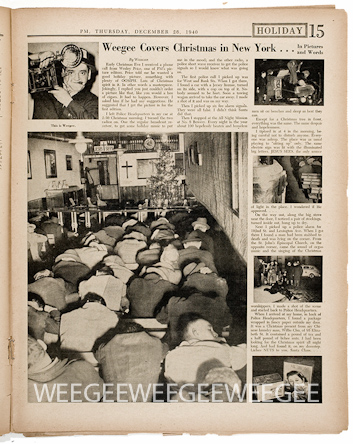
1940_12_26_p15-3

Weegee Covers Christmas in New York… In Words and Pictures PM Daily, December 26, 1940 by Weegee Early Christmas Eve I received a phone call from Wesley Price, one of PM’s picture editors. Price told me he wanted a good holiday picture, something with plenty of OOMPH. Lots of Christmas spirit in it. in other words a masterpiece. Jokingly I replied you just couldn’t order a picture like that, like you would a box of cigars. It had to happen. However, I asked him if he had any suggestions. He suggested that I get the picture in for the first edition.

I left police headquarters in my car at 2:30 Christmas morning. I turned the two radios on. One the regular broadcast receiver, to get some holiday music to put me in the mood; and the other radio, a police short wave receiver to get the police signals so I would know what was going on.

The first police call I picked up was for West and Bank Sts. When I got there I found a car with a Jersey license, turned on its side, with a cop on top of it. Nobody seemed to be hurt. Soon a towing wagon arrived to take the car away. I made a shot of it and was on my way.

Then I picked up six fire alarm signals. They were alll false. I didn’t think Santa did that.

Then I stopped at the All Night Mission at No. 8 Bowery. Every night in the year about 100 hopelessly beaten and homeless men sit on benches and sleep as best they can.

Except for a Christmas tree in front, everything was the same. The same despair and hopelessness. I tiptoed in at 4 in the morning, being careful not to disturb anyone. Everyone was asleep. The place was as usual playing to “Sitting up” only. The same electric sign was lit with the illuminated big letters, JESUS SEES, the only source of light in the place. I wondered if He approved…

On the way out, along a big stove near the door, I noticed a pair of stockings, turned inside out, hung to dry.

Next I picked up a police alarm for 102nd St. and Lexington Ave. When I got there I found a man had been stabbed to death and was lying on the corner. From the St. John’s Episcopal Church, on the opposite corner, came the sound of organ music and the singing of the Christmas worshipers. I made a shot of the scene and started back to police headquarters.

When I arrived at my home, in back of Police Headquarters, I found a package wrapped in fancy paper outside my door. It was a present from my Chinese laundry man, Willie Chu, of 95 Elizabeth St. It contained a pound of tea and a half pound of lichee nuts. I had been looking for the Christmas spirit all night long. And had found it, on my doorstep. Lichee NUTS to you, Santa Claus…

October 22, 2009
Results for Sale 2191, 
PHOTOGRAPHS & PHOTOGRAPHIC LITERATURE.
Swannn Auction Galleries

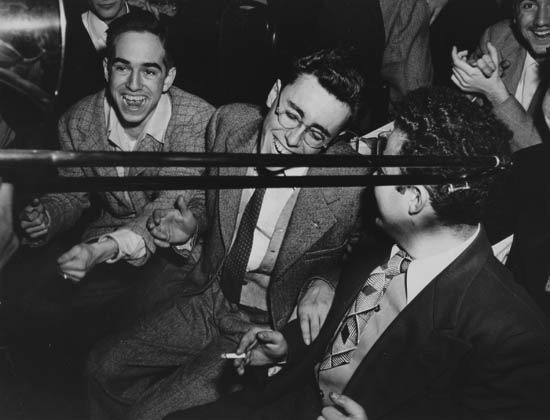
192 WEEGEE (1899-1968) Out of this World. 2,400 Sold
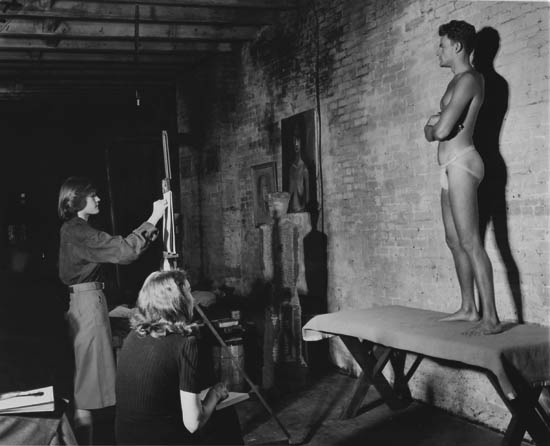
193 WEEGEE (1899-1968) Life Class. 1,080 Sold
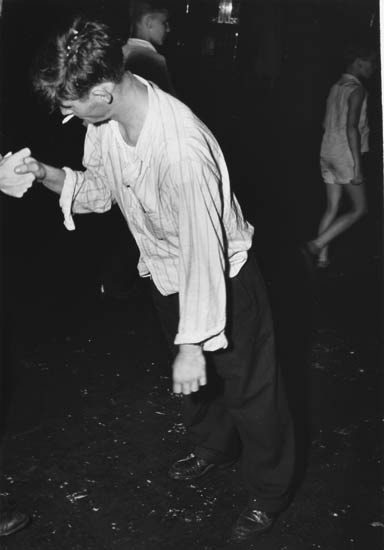
194 WEEGEE (1899-1968) Celebrant. 2,160 Sold
195 WEEGEE (1899-1968) Dancers. 2,400 Sold

Sale 2191 Lot 192
WEEGEE (1899-1968)
“Out of this World.” Ferrotyped silver print, 6 1/2×8 1/2 inches (16.5×21.6 cm.), with the Acme Photo hand stamp and a mimeographed caption label on verso. 1946
Estimate $1,500-2,500

Sold for $2,400
(Weegee’s People, unpaginated.)


WEEGEE (1899-1968)
“Life Class.” Ferrotyped silver print, 6 3/4×8 1/4 inches (17.1×21 cm.), with the Acme Photo hand stamp and a mimeographed caption label on verso. 1946
Estimate $1,500-2,500

Sold for $1,080
(Weegee’s People, unpaginated.)


Sale 2191 Lot 194
WEEGEE (1899-1968)
“Celebrant.” Ferrotyped silver print, 8 1/4×5 3/4 inches (21×14.6 cm.), with the Acme Photo hand stamp and a mimeographed caption label on verso. 1946
Estimate $1,500-2,500
Sold for $2,160
(Weegee’s People, unpaginated.)


Sale 2191 Lot 195
WEEGEE (1899-1968)
Dancers.” Ferrotyped silver print, 8 1/4×6 3/4 inches (21×17.1 cm.), with the Acme Photo hand stamp and a mimeographed caption label on verso. 1946
Estimate $1,500-2,500
Sold for $2,140
(Weegee’s People, unpaginated.
Weegee’s New York, 279 (variant).)

336 WEEGEE (1899-1968) Untitled (fans and cop). 0 Unsold
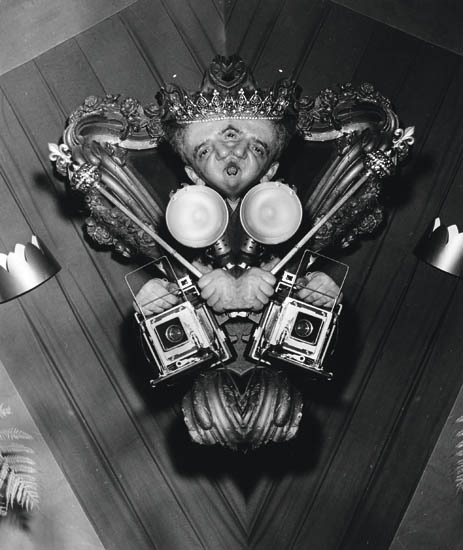
337 WEEGEE (1899-1968) Self-portrait (distortion with cameras, crown and scepter). 0 Unsold
338 WEEGEE (1899-1968) Hedda Hopper (distortion). 0 Unsold

December 8, 2009
Results for Sale 2199, 
PHOTOGRAPHIC LITERATURE & FINE PHOTOGRAPHS 
Swannn Auction Galleries…

Sale 2199 Lot 336
WEEGEE (1899-1968)
Untitled (fans and cop). Ferrotyped silver print, 11×10 1/2 inches (27.9×26.7 cm.), with the “Weegee The Famous” and Arthur Fellig hand stamps on verso. Circa 1940
Estimate $2,000-3,000
Unsold
From the Marcuse Pfeifer Gallery, New York; to the present owner in 1976.


Sale 2199 Lot 337
WEEGEE (1899-1968)
Self-portrait (distortion with cameras, crown and scepter). Ferrotyped silver print, 9×7 1/2 inches (22.9×19.1 cm), with the “Credit Photo by Weegee” and “Photo Representatives” hand stamps on verso. Circa 1950
Estimate $1,500-2,500

Unsold

Sale 2199 Lot 338
WEEGEE (1899-1968)
Hedda Hopper (distortion). Ferrotyped silver print, 9 1/4×7 1/2 inches (23.5×19.0 cm.), with a “Photo-Representatives” hand stamp and notations, in pencil, on verso. Circa 1951
Estimate $1,500-2,500

Unsold