…only a first draft, we spent a number of hours identifying locations of Weegee’s photos and finding them with Google’s Street View, again, this is only a first draft, an experiment…
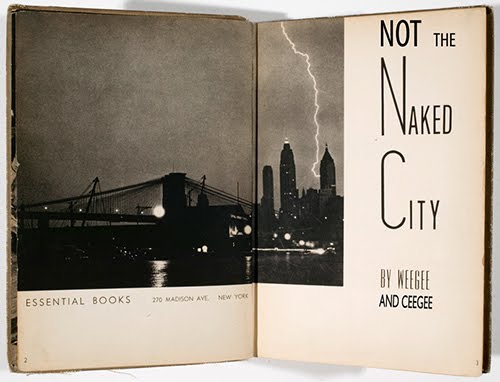
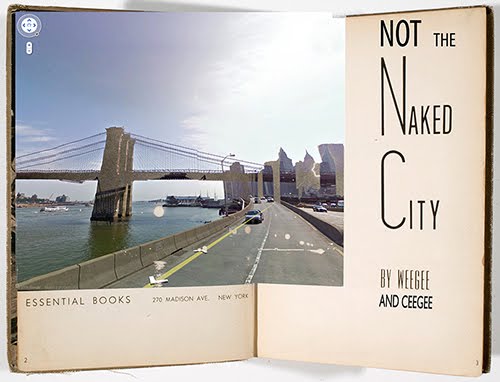
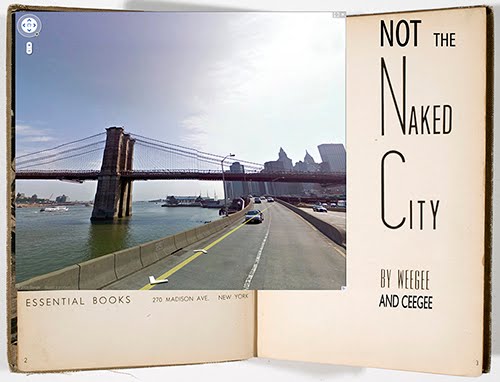

…only a first draft, we spent a number of hours identifying locations of Weegee’s photos and finding them with Google’s Street View, again, this is only a first draft, an experiment…

(Old News)
The Berinson Weegee Collection Exhibition in Poland:
|
||||||
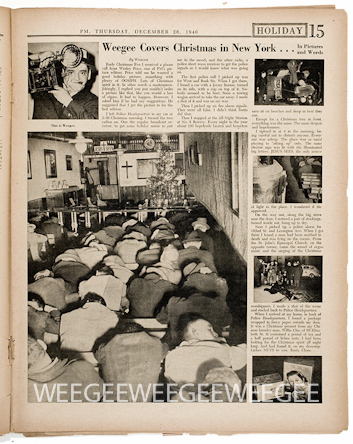
Weegee Covers Christmas in New York… In Words and Pictures PM Daily, December 26, 1940 by Weegee Early Christmas Eve I received a phone call from Wesley Price, one of PM’s picture editors. Price told me he wanted a good holiday picture, something with plenty of OOMPH. Lots of Christmas spirit in it. in other words a masterpiece. Jokingly I replied you just couldn’t order a picture like that, like you would a box of cigars. It had to happen. However, I asked him if he had any suggestions. He suggested that I get the picture in for the first edition.
I left police headquarters in my car at 2:30 Christmas morning. I turned the two radios on. One the regular broadcast receiver, to get some holiday music to put me in the mood; and the other radio, a police short wave receiver to get the police signals so I would know what was going on.
The first police call I picked up was for West and Bank Sts. When I got there I found a car with a Jersey license, turned on its side, with a cop on top of it. Nobody seemed to be hurt. Soon a towing wagon arrived to take the car away. I made a shot of it and was on my way.
Then I picked up six fire alarm signals. They were alll false. I didn’t think Santa did that.
Then I stopped at the All Night Mission at No. 8 Bowery. Every night in the year about 100 hopelessly beaten and homeless men sit on benches and sleep as best they can.
Except for a Christmas tree in front, everything was the same. The same despair and hopelessness. I tiptoed in at 4 in the morning, being careful not to disturb anyone. Everyone was asleep. The place was as usual playing to “Sitting up” only. The same electric sign was lit with the illuminated big letters, JESUS SEES, the only source of light in the place. I wondered if He approved…
On the way out, along a big stove near the door, I noticed a pair of stockings, turned inside out, hung to dry.
Next I picked up a police alarm for 102nd St. and Lexington Ave. When I got there I found a man had been stabbed to death and was lying on the corner. From the St. John’s Episcopal Church, on the opposite corner, came the sound of organ music and the singing of the Christmas worshipers. I made a shot of the scene and started back to police headquarters.
When I arrived at my home, in back of Police Headquarters, I found a package wrapped in fancy paper outside my door. It was a present from my Chinese laundry man, Willie Chu, of 95 Elizabeth St. It contained a pound of tea and a half pound of lichee nuts. I had been looking for the Christmas spirit all night long. And had found it, on my doorstep. Lichee NUTS to you, Santa Claus…
At the Atlass Gallery
Weegee did take many Polaroids, nevertheless, I don’t think there are any in this exhibition.
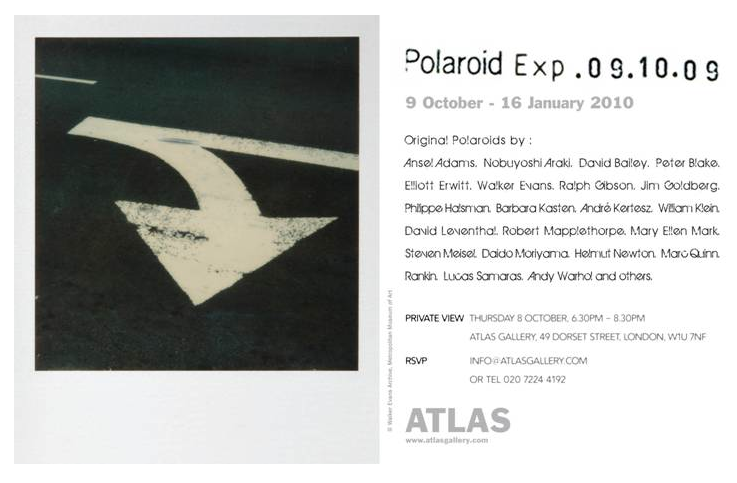
“Weegee’s Polaroids” new exhibition, coming soon…



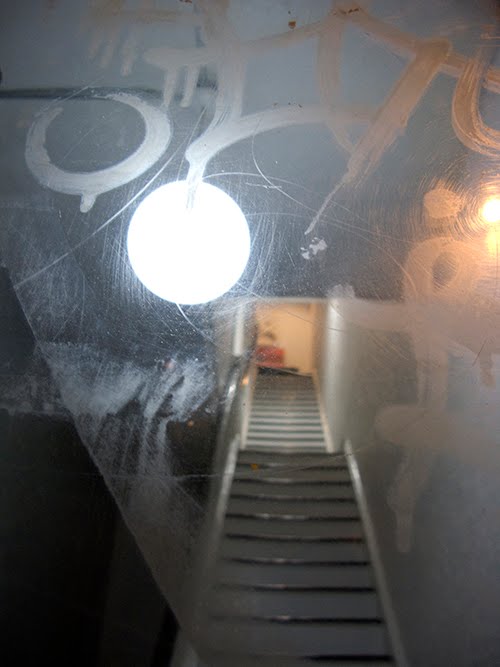


Indecisively walking down Centre Market place, coming back from a performance at Phill Niblock’s Experimental Intermedia loft…
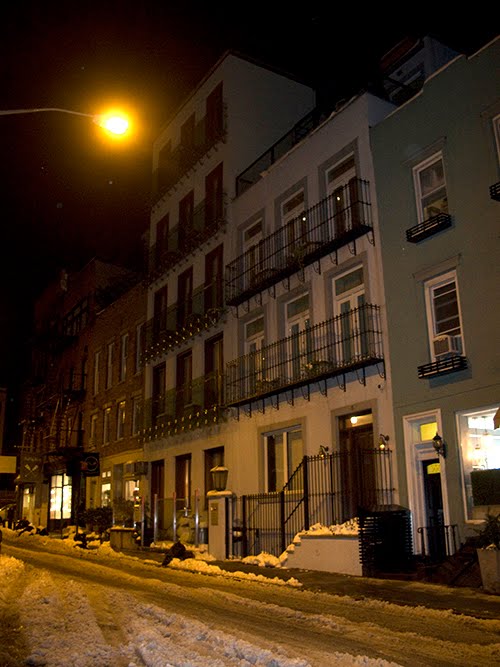
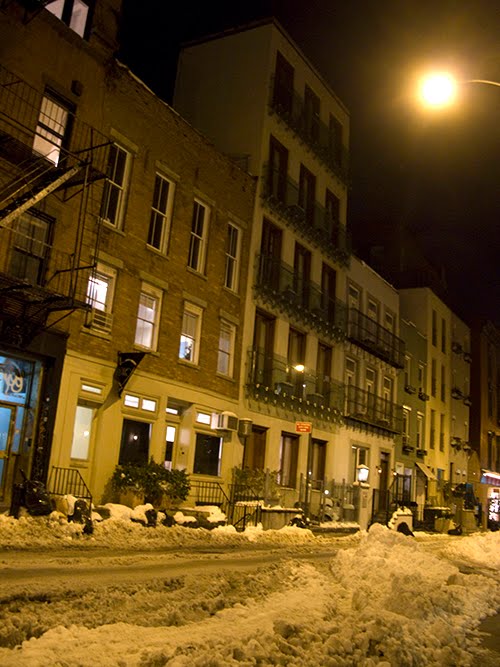
October 22, 2009
Results for Sale 2191,
PHOTOGRAPHS & PHOTOGRAPHIC LITERATURE.
Swannn Auction Galleries
| 192 | WEEGEE (1899-1968) Out of this World. | 2,400 | Sold |
| 193 | WEEGEE (1899-1968) Life Class. | 1,080 | Sold |
| 194 | WEEGEE (1899-1968) Celebrant. | 2,160 | Sold |
| 195 | WEEGEE (1899-1968) Dancers. | 2,400 | Sold |
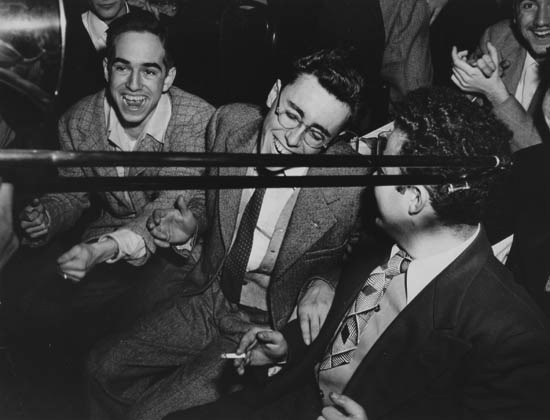
Sale 2191 Lot 192
WEEGEE (1899-1968)
“Out of this World.” Ferrotyped silver print, 6 1/2×8 1/2 inches (16.5×21.6 cm.), with the Acme Photo hand stamp and a mimeographed caption label on verso. 1946
Estimate $1,500-2,500
Sold for $2,400
(Weegee’s People, unpaginated.)
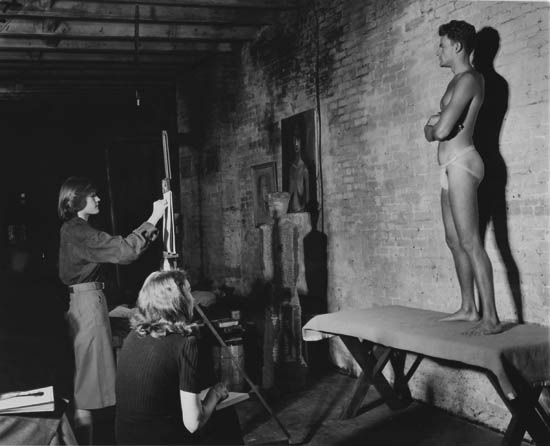
WEEGEE (1899-1968)
“Life Class.” Ferrotyped silver print, 6 3/4×8 1/4 inches (17.1×21 cm.), with the Acme Photo hand stamp and a mimeographed caption label on verso. 1946
Estimate $1,500-2,500
Sold for $1,080
(Weegee’s People, unpaginated.)
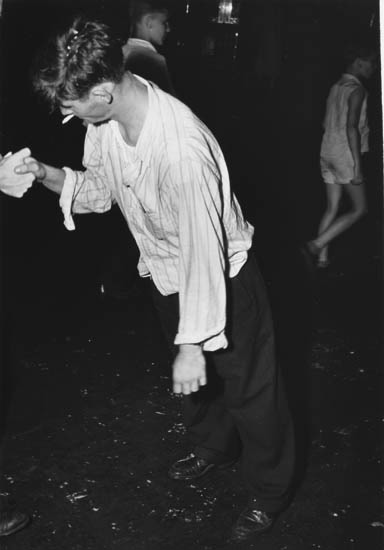
Sale 2191 Lot 194
WEEGEE (1899-1968)
“Celebrant.” Ferrotyped silver print, 8 1/4×5 3/4 inches (21×14.6 cm.), with the Acme Photo hand stamp and a mimeographed caption label on verso. 1946
Estimate $1,500-2,500
Sold for $2,160
(Weegee’s People, unpaginated.)
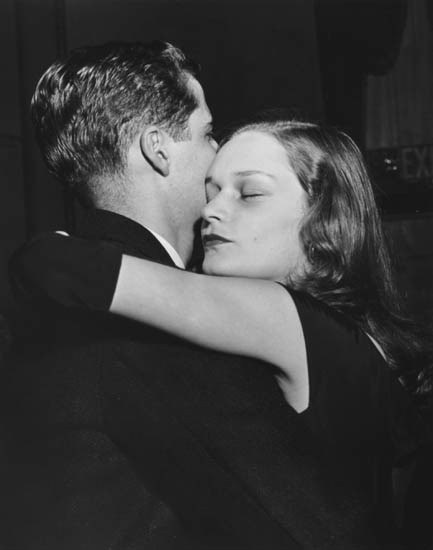
Sale 2191 Lot 195
WEEGEE (1899-1968)
“Dancers.” Ferrotyped silver print, 8 1/4×6 3/4 inches (21×17.1 cm.), with the Acme Photo hand stamp and a mimeographed caption label on verso. 1946
Estimate $1,500-2,500
Sold for $2,140
(Weegee’s People, unpaginated.
Weegee’s New York, 279 (variant).)
| 336 | WEEGEE (1899-1968) Untitled (fans and cop). | 0 | Unsold |
| 337 | WEEGEE (1899-1968) Self-portrait (distortion with cameras, crown and scepter). | 0 | Unsold |
| 338 | WEEGEE (1899-1968) Hedda Hopper (distortion). | 0 | Unsold |
December 8, 2009
Results for Sale 2199,
PHOTOGRAPHIC LITERATURE & FINE PHOTOGRAPHS
Swannn Auction Galleries…

Sale 2199 Lot 336
WEEGEE (1899-1968)
Untitled (fans and cop). Ferrotyped silver print, 11×10 1/2 inches (27.9×26.7 cm.), with the “Weegee The Famous” and Arthur Fellig hand stamps on verso. Circa 1940
Estimate $2,000-3,000
Unsold
From the Marcuse Pfeifer Gallery, New York; to the present owner in 1976.
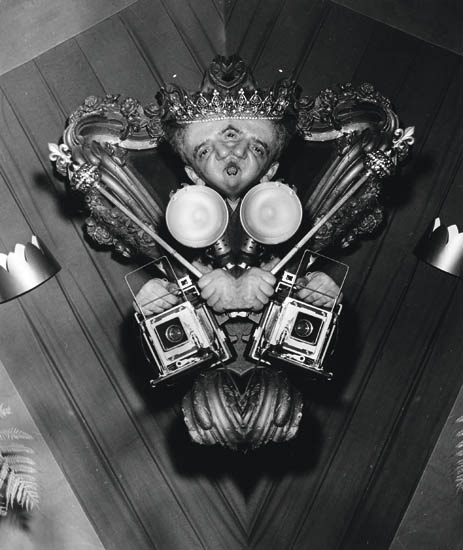
Sale 2199 Lot 337
WEEGEE (1899-1968)
Self-portrait (distortion with cameras, crown and scepter). Ferrotyped silver print, 9×7 1/2 inches (22.9×19.1 cm), with the “Credit Photo by Weegee” and “Photo Representatives” hand stamps on verso. Circa 1950
Estimate $1,500-2,500
Unsold
Sale 2199 Lot 338
WEEGEE (1899-1968)
Hedda Hopper (distortion). Ferrotyped silver print, 9 1/4×7 1/2 inches (23.5×19.0 cm.), with a “Photo-Representatives” hand stamp and notations, in pencil, on verso. Circa 1951
Estimate $1,500-2,500
Unsold
At the Michael Hopppen Gallery, “Weegee – It’s a crime to take photographs this good…”
From the gallery’s website: http://www.michaelhoppengallery.com
(A text indebted to the introduction of Weegee’s World.)
“It’s a crime to take photographs this good…’
Always in the right place at the right time, Weegee’s lense was perpetually aimed the visceral and sometimes violent city of New York. In 1993, Wilma Fellig, Weegee’s widow, bequeathed his entire archive of original prints to the ICP in New York, and we are delighted to offer selected pieces of this unique photographers work which includes many images never previously seen in the UK.
Weegee photographed New York in the 1930s and 1940s… Weegee’s voyeuristic eye sought out the harsh realities of the urban experience, but also the joie de vivre and carefree attitude which typified the years between the wars.
Born in 1899 in the Austrian province of Galicia, which is today part of Ukraine, Weegee (real name Usher, then Arthur Fellig) was the second of seven children from Jewish parents. Weegee’s family left Europe in 1910 for the Lower East Side ofManhattan, where Weegee grew up. He left home at 15 and in 1917 got a job in a photo studio and became assistant to a cameraman. In 1921, he got a part-time position at the New York Times and its legendary agency Wide World Photos, soon afterwards switching to Acme News pictures. Eventually, frustrated with the lack of recognition for his work, and not having his name on photographs, he became a freelance news photographer by late 1935.
Weegee’s images bridge the gap between art, evidence and photojournalism. His nickname was a phonetic rendering of ouija,as in ouija board, due to his sixth sense of being able to arrive at a scene minutes after the occurrence of a crime. In 1938, Fellig was the only New York newspaper reporter with a permit to have a portable police-band short wave radio. The trunk of his car was a carefully maintained darkroom, to enable himto deliver his freelance images tothe newspapers as speedily as possible. He worked predominantly at night listening closely to radio broadcasts, often beating the NYPD to the scene. It also meant he was on hand to document the raucous night life in the Bowery, Harlem and The Village, and he went on to document the society events and functions of the era.
His photographs were taken with the very basic press photographer equipment, a [Speed Graphic] Graflek [sic] and flashbulbs which gave his work such graphic qualities. He had no formal photographic training being entirely self taught, and was a relentless self-promoter.”
Michael Hopppen Gallery
3 Jubilee Place,
London SW3 3TD
Tel: +44 (0)20 7352 3649
Fax: +44 (0)20 7352 3669



