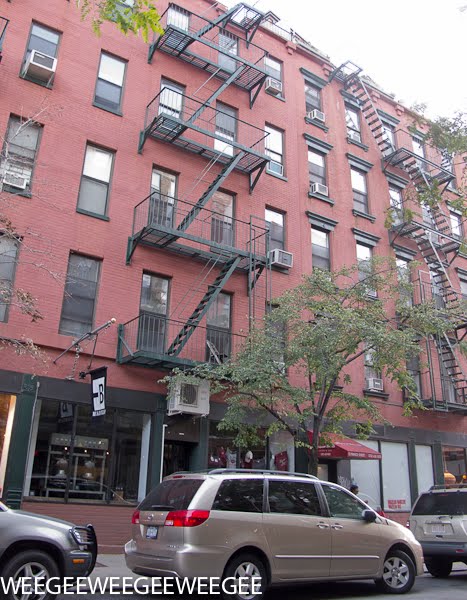
“Opening of the George Washington Bridge, New York City,” Oct. 25, 1931

Did Weegee take this photo?

What was Weegee doing in 1931?
Working for Acme photos, in the darkroom, and maybe occasionally taking photos, at night. In 1932 he took the bus to Los Angeles, for the summer Olympics to help in the Acme darkroom…

Wee guess it’s not by Weegee…
It would be nice to see what’s on the back…


Some images from the infamous, edgy, Arbus-influencing, Weegee, from the South Kentucky zebra-skin-suitcase/trunk…

Of course it’s the bridge image that’s the anomaly…
(and the edgy ice-cream-eater, butter buyers, sleepers, etc…)

The inscriptions are nice, typically tender…

from art daily.org

INDIANAPOLIS.- The Indianapolis Museum of Art announced today that it has received a gift of 210 photographs by acclaimed artist Weegee (Arthur Fellig, 1899-1968) as well as nearly 100 documents relating to his life. The collection, which is believed to have belonged at one time to Weegee’s long-time companion Wilma Wilcox, contains photographs spanning Weegee’s career and portraying all aspects of his idiosyncratic subject matter. Also included are numerous portraits of the artist, and various ephemera such as letters and postcards from Weegee to Wilma, newspaper clippings, press passes, and even Weegee’s Social Security card. The collection is a partial gift of Steven H. Nowlin, and a partial purchase by the Caroline Marmon Fesler Fund and the Alliance of the Indianapolis Museum of Art.
The Weegee collection, considered second only to that from the artist’s estate at the I C P in New York,
[it’s not] was discovered in a trunk at a farmhouse yard sale in southern Kentucky in 2003 and acquired by Indianapolis historic documents dealer Steve H. Nowlin the same year. It includes works ranging from crime photographs, Harlem in the 1940s, audiences at jazz concerts or in darkened movie theaters taken surreptitiously with infrared film, strippers, transvestites, Greenwich Village in the 1950s, and distortions of celebrities such as Marilyn Monroe, Judy Garland, Bette Davis, Elizabeth Taylor, Picasso, Eisenhower, Jackie Kennedy, and the Duke and Duchess of Windsor.
“Without an ounce of decorum, Weegee gave permission to us all to observe the dark corners and bright lights of modern urban America. The unscripted, unvarnished tone of Weegee’s photographs anticipates the free-wheeling character of today’s Internet-based candid photography,” said Maxwell L. Anderson, the Melvin & Bren Simon director and CEO of the IMA. “The incredible range and depth of this collection makes it an outstanding addition to our photography holdings and will enhance the IMA’s role as a community resource and encyclopedic art museum.”
Weegee was a photojournalist whose work was synonymous with New York City. From 1930 to the end of his life, he prowled the metropolis with his Speed Graphic camera—from Uptown to Downtown, from the upscale to the down-and-out. While Weegee’s intent was simply to photograph “the soul of the city I knew and loved,” his unflinching eye set the trend for young, edgy photographers in the 1960s, most notably Diane Arbus who was a great admirer. Ever the intrepid chronicler of the city, he began his career as a freelance photographer, providing gritty crime scene photos to the tabloids and he arrived on the scene so frequently in advance of the police that they told him that he must be using a Ouija board, which the photographer adopted as his moniker— “Weegee.” In 1945, Weegee compiled a selection of his candid street photographs into a book, Naked City, which brought him fame and which inspired the film noir classic of the same title. This film drew Weegee to Hollywood in 1947 where he embarked on a second phase of his career. For five years, he photographed the glamorous at movie premiers and Oscar ceremonies and then, in the darkroom, distorted those portraits into wicked and perceptive caricatures of movie stars and personalities. These were published for the first time in Weegee’s Naked Hollywood in 1953.
The Weegee works join the IMA’s growing photography collection. In 1992, the Museum embarked on building a comprehensive photography collection. While still accounting for a small fraction of the IMA’s collection of 28,000 works on paper, the photography holdings now number some 700 works and include vintage images by William Henry Fox Talbot, Julia Margaret Cameron, Carleton Watkins, Charles Sheeler, Andre Kertesz, Alexander Rodchenko, Brassai, Berenice Abbott, Margaret Bourke White, Dorothea Lange, Edward Weston, Walker Evans, Robert Frank, Diane Arbus, Cindy Sherman, James Casebere, Gregory Crewdson among other masters of the 19th, 20th and 21st centuries.

This sounds familiar, it’s almost exactly the same as almost all of the other “articles” on the web… Why bother doing research or thinking, when you can read and repeat a press release…

(of course I’m just reading and repeating a thinly disguised press release…)

From the National Press Photographer’s Association website:

“Indianapolis Museum Gets Yard Sale Trunk Of Weegee Photos

INDIANAPOLIS, IN (June 3, 2008) – The contents of an old trunk at a farmhouse yard sale in southern Kentucky in 2003 were worth far more than the trunk itself.
In it were 210 photographs by photographer Weegee (Arthur Felig, 1899-1968) and nearly 100 documents pertaining to his life, including pictures that spanned his career, portraits of the artist, letters and postcards, newspaper clippings, press passes, and Felig’s Social Security card.
It’s believed the trunk belonged to Weegee’s long-time companion, Wilma Wilcox. The contents included letters to Wilcox and photographs that were autographed to her.
The trunk and its contents were acquired that same year by Indianapolis documents dealer Steve H. Nowlin, and now it’s been acquired by the Indianapolis Museum of Art as a partial gift from Nowlin and a partial purchase funded by the Caroline Marmon Fesler Fund and the Alliance of the Indianapolis Museum of Art.
The collection is considered to be second only to the Weegee photographs at the I C P in New York, which acquired the artist’s estate. [It’s not the second largest.]
The contents of the yard sale trunk include crime scene photographs from Harlem in the 1940s, audiences at jazz concerts, strippers, transvestites, Greenwich Village in the 1950s, and Weegee’s “distorted” images of celebrities, including Marilyn Monroe, Judy Garland, Bette Davis, Elizabeth Taylor, Picasso, Dwight D. Eisenhower, and more.
Weegee was a photojournalist whose work was synonymous with New York City. From 1930 to the end of his life, he prowled the metropolis with his Speed Graphic camera—
[that’s absurd] from Uptown to Downtown, from the upscale to the down-and-out. While Weegee’s intent was simply to photograph “the soul of the city I knew and loved,” his unflinching eye set the trend for young, edgy photographers in the 1960s, most notably Diane Arbus who was a great admirer.
Ever the intrepid chronicler of the city, he began his career as a freelance photographer, providing gritty crime scene photos to the tabloids and he arrived on the scene so frequently in advance of the police that they told him that he must be using a Ouija board, which the photographer adopted as his moniker — “Weegee.” In 1945, Weegee compiled a selection of his candid street photographs into a book, Naked City, which brought him fame and which inspired the film noir classic of the same title.
Weegee’s photographs join the IMA’s growing photography collection. In 1992, the Museum embarked on building a comprehensive photography collection. While still accounting for a small fraction of the IMA’s collection of 28,000 works on paper, the photography holdings now number some 700 works and include vintage images by William Henry Fox Talbot, Julia Margaret Cameron, Carleton Watkins, Charles Sheeler, Andre Kertesz, Alexander Rodchenko, Brassai, Berenice Abbott, Margaret Bourke White, Dorothea Lange, Edward Weston, Walker Evans, Robert Frank, Diane Arbus, Cindy Sherman, James Casebere, Gregory Crewdson among other masters of the 19th, 20th and 21st centuries.”

It’s funny how most of these “articles” sound exactly the same, make the same mistakes, the same over-generalizations, even use the same words, like “edgy”, make the same references, like “Arbus”…

from pdn online:

Indianapolis Museum Announces Major Weegee Acquisition

By Daryl Lang June 03, 2008

A trove of Weegee photos discovered in a trunk at a 2003 yard sale has been acquired by the Indianapolis Museum of Art, the museum announced Tuesday.
The acquisition is a major boost for the museum’s fledgling photography collection and represents the biggest Weegee collection outside of his estate, which is housed at the I C P in New York.
[That’s not true]
The IMA acquisition includes 210 photos and over 100 documents, including letters, press clippings and artifacts such as Weegee’s social security card.
“Weegee is such a fascinating figure and character, and straddles the photojournalism and edgy modernism… worlds,” says Martin Krause, the IMA’s curator of prints, drawings and photographs. Krause says the museum hopes to show the work once a slot is available on its exhibition calendar, perhaps in 2010.
A serendipitous shopper unearthed the collection at a yard sale at a Kentucky farmhouse in 2003. The photos and documents were then acquired by Steve H. Nowlin, a dealer of rare documents in Indianapolis. Nowlin then pitched the collection to the museum. “He invited me to come take a look and see if I was interested, and I was,” Krause recalls.
But the museum declined to purchase the collection until now, under its new director and CEO – Maxwell L. Anderson – and with funding from the Caroline Marmon Fesler Fund and the Alliance of the Indianapolis Museum of Art.
It’s unclear how the work ended up in a trunk at a yard sale, but it likely belonged to Weegee’s longtime partner Wilma Wilcox. Wilcox bequeathed the artist’s archive to the I C P in 1993.
Weegee’s real name was Arthur Fellig. He took his nickname (after the Ouija board) from his uncanny ability to be first on the scene of crimes and accidents while working as a news photographer in New York City. His street photography in New York and his later coverage of the Los Angeles celebrity scene were collected in the influential books Naked City and Naked Hollywood. He died in 1968.

There’s nothing as useful as a good press release…

An article from the NY Times:

Kentucky Yard Sale Yields a Trove of Weegee Images

By RANDY KENNEDY June 3, 2008
Correction Appended

“As letters go, they aren’t exactly the stuff of literature. One from 1959 asks that the recipient phone Con Edison and complain about an unusually high electric bill ($54.92). Another requests a shipment of beloved New York cigars because of apparent dissatisfaction with the options available in Europe. At least one, written from the Regina-Palast Hotel in Munich, Room 551, starts to provide a hint of the sender.
“Looks like the picture won’t be finished on time,” the letter explains. “It rains every day and we can’t find 2 midgets, so it looks like I’ll be here at least 2 more weeks.”
The letters, along with 210 vintage black-and-white photographic prints, were found in 2003 in a zebra-stripe trunk that was bought at a yard sale in Kentucky by two Indiana women who were on their way back from a camping trip. One of the women simply liked the look of the trunk, and when she found old clothes, yellowed papers and pictures inside, she thought about throwing the contents away.
But she took them instead to an Indianapolis rare-documents dealer. And this week the Indianapolis Museum of Art plans to announce that it has acquired a trove of work and correspondence by Weegee, the crepuscular, stogie-smoking New York photographer whose visceral pictures became a template not only for artists like Diane Arbus but also for much of the uncomfortably close tabloid imagery that exists today. The museum described the acquisition as a partial gift and partial purchase from the dealer.
The trunk is assumed to have once been the possession of Wilma Wilcox, a social worker who was Weegee’s companion and lived with him from 1957 until his death in 1968. Upon her death in 1993, she bequeathed the bulk of his work — thousands of prints and negatives — to the I C P in Manhattan. How the trunk full of prints and 62 letters to Ms. Wilcox from Weegee (born Usher Fellig in what is now Ukraine, and later known as Arthur Fellig) ended up in Kentucky is a mystery that neither the Indianapolis Museum nor the dealer, Steve H. Nowlin, has solved.
“We’re just lucky that it all survived,” said Martin Krause, the museum’s curator of prints, drawings and photographs. “The woman who found them thought maybe these were just old family snapshots or something — though how you could mistake a Weegee for a family photograph, I don’t know.”
The size of the newly discovered collection pales in comparison with the holdings of the I C P, and Mr. Krause said that no previously unknown work had been found among the prints. But for a museum that began collecting photography seriously only 15 years ago, the work is an important addition — especially because the trunk contained a surprisingly broad survey of Weegee’s career, with the only weak spot being fewer prints from his early years of crime and murder-scene coverage in the 1930s.
Maxwell Anderson, the museum’s director, said the institution’s young collection has notable 19th-century work and a concentration of contemporary photography. “So this will serve as a great bridge between those traditions,” he said, adding, of the discovery of the prints and letters, that it was “like the last keystroke of a life of accidental purpose.”
Weegee — whose nickname, according to one story he told, was a transliteration of Ouija, a reference to his almost psychic ability to find a fresh crime scene — was the archetype of a tabloid photographer, working mostly at night in the lower-rent parts of New York City.
“People who work in the daytime are suckers,” he once said. Before the publication of his first book, “Naked City,” made him famous in 1945, he lived in a cheap room near police headquarters and was said to be so accustomed to working on the run that he once developed a picture of a prizefight in a subway motorman’s cab while rushing back to a newspaper office.
As his star rose in the 1950s and 1960s, he began to travel extensively, make experimental films and worked for other directors, some as illustrious as Stanley Kubrick, for whom he served as a consultant during the filming of “Dr. Strangelove.”
But as many of the newly discovered letters to Ms. Wilcox show, much of his film career was on a lower plane. The letter from Munich refers to his work on a 1958 quasi-documentary called “Windjammer,” the story of an epic sea journey filmed in something called Cinemiracle, a short-lived widescreen format. (In fact, very short-lived: “Windjammer” was the only movie to be shot with that method.) Given Weegee’s influence on Arbus, Andy Warhol and even contemporary photographers, Mr. Krause said the museum was extremely lucky to come into such a body of work all at once. But he added that the heavily flashed, high-contrast pictures — of corpses, movie-house lovers, jazz clubs, celebrities, bums and oddball street scenes — were also simply as entertaining as the man who took them.
“This gives our collection a certain personality,” he said. “And what a personality to get.”

This article has been revised to reflect the following correction:
Correction: June 4, 2008
A picture caption on Tuesday with the continuation of an article about a trove of Weegee photographs found at a yard sale misstated the date of the photograph “Viewing News Report of a Yankee Game, Times Square.” It was Oct. 6, 1943, not Dec. 6.

An article from the Indianapolis Star, indystar.com, newspaper…

http://www.indystar.com/apps/pbcs.dll/article?AID=/20080602/NEWS/80602063

By Christopher Lloyd June 2, 2008

“The Indianapolis Museum of Art acquires rare photos worth $500K…
A treasure trove of personal items from one of New York’s most iconic photographers has found a home in Indianapolis, by way of a Kentucky farmhouse.
The Indianapolis Museum of Art will announce Tuesday the acquisition of 210 photos and nearly 100 letters and other documents from Weegee, aka Arthur Fellig.
Weegee, who died in 1968, was famous for his news photographs capturing the underbelly of mid-century New York in stark black-and-white images. He got his moniker after an Ouija board for his uncanny ability to show up at a murder scene or fire ahead of police and firefighters.
The collection, thought to be worth about $500,000, was found in the bottom of a trunk by two Indianapolis women at a yard sale at a southern Kentucky farmhouse five years ago.
Under some old dresses, they found a pile of photographs and papers, which they almost threw away. Instead, the women sold them to local historic document dealer Steve Nowlin, who has decided to donate them to the IMA. He did not reveal how much he paid for the items.
“When I first saw them, I had no idea who Weegee was. But I’m pretty quick on the Internet, and it took me a few minutes to find out who he was and what the value was,” said Nowlin, adding that he spent a month researching the material. “It was just an incredible find of photographs and hand-written letters, and some other miscellaneous things.”
The items are believed to have belonged to longtime Weegee companion Wilma Wilcox. She was a New Yorker, too. Nobody is sure how the trunk made it to Kentucky.
The items include photographs spanning his career, as well as letters, postcards, newspaper clippings, Weegee’s press passes and even his Social Security card. And there are about three dozen portraits of Weegee taken by others, including photographers Philippe Halsman and Simon Nathan.
The collection is a partial gift from Nowlin, and a partial purchase by the Caroline Marmon Fesler Fund and the Alliance of the Indianapolis Museum of Art, according to IMA officials. Nowlin said he is donating about $400,000 of the value, and the museum is compensating him for the balance.
Photographs in the collection include crime scene images for which Weegee was most renowned, as well as pictures of Harlem, jazz concerts, darkened movie theaters, strippers, transvestites and other myriad aspects of the city he chronicled using his Speed Graphic camera. There are also images from the 1950s and ’60s, when Weegee started taking intentionally distorted photographs of celebrities such as Marilyn Monroe, Elizabeth Taylor and Bette Davis.
Nowlin said one series of photographs came from an exhibit of paintings by Pablo Picasso in London that the artist attended. “Weegee befriended him and took pictures of Picasso, and distorted pictures of Picasso’s distorted pictures.”
A compilation of Weegee’s photographs was published in 1945 under the title “Naked City,” which was turned into a 1948 classic film noir of the same name. “The Public Eye,” a 1992 movie starring Joe Pesci, is said to be inspired by the life of Weegee.
Maxwell Anderson, director and CEO of the IMA, says Weegee’s work straddled the line between candid journalism and posed art photography.
“Photography is a 20th-century language, and artworks made throughout the course of the 20th century were affected by photography,” Anderson said.
“Weegee is a fascinating figure in that story, because there’s the school … of photojournalistic intent that metamorphoses into art, and then there is art photography where people are working in a medium that is very much apart and separate from candid photography. And then there is Weegee, who represents a bridge between a couple of approaches that people have taken to the camera.”
Martin Krause, the museum’s curator of prints, drawings and photographs, said they don’t yet know when any of the collection might go on exhibit. The IMA’s main galleries are booked until 2010.
The size and breadth of the collection are what make it a historic find, according to Anderson.
“A single photograph by Weegee tells a story. But having a couple hundred allows you to distill some of that creative tension and nervous energy, the hiss and crackle of what life in the big city was like after the Second World War.””


1. Coney Island (Joe’s Penny Arcade)
$240
gelatin silver print, ‘Weegee’ credit stamp, titled ‘Coney Island’ and inscribed ‘from European’ in pencil (on the verso)
11¼ x 14 in. (28.4 x 35.3 cm.)
SALE 1538, 12 – 13 JULY 2005

2. Midnight Robbers, before 1946
£230 ($389)
Glossy gelatin silver print, image size 9 7/8 x 10¾ in., various ink stamps including Weegee The Famous and Photo-Representatives and pencil annotations on verso.
SALE 7854, 20 NOVEMBER 1997

3. At Sammy’s in the Bowery (c.1944)
$403
Gelatin silver print. Printed in 1993 by Sid Kaplan. Numbered 1/100 in pencil and copyright credit stamp on the verso.
13 x 10.5/8in. (34.2 x 27cm.) Framed.
SALE 8241, 9 JUNE 1999

4. Couple dancing, 1940s, printed later
£242 ($422)
Gelatin silver print, 12½ x 10 in., mounted on card, framed.
SALE 4637, 31 OCTOBER 1991

5. Merry Go Round, Coney Island
$460
Gelatin silver print. 1940s. Inscribed No. 22 in ink in the margin and credit stamp on the verso. 10 5/8 x 13in.
SALE 7505, 7 DECEMBER 1993

6. ‘Morning after’, 1950s
£345 ($558)
Gelatin silver print, 11 5/8 x 6¼ in., mounted on yellow card, titled in ink on mount, signed in ink and with exhibition label Haber & Fink New York on verso, matted
SALE 5265, 19 OCTOBER 1994

7. Marilyn Distorted
$633
Gelatin silver print. 1960s. Weegee The Famous and West 47th Street stamps on the verso. 13 3/8 x 10½in.
SALE 7646, 8 APRIL 1993

(The above info is culled from the Christie’s website…)