Another Weegee reference in the NYTimes this week:

Art Review
A Show Is All Cyber, Some of the Time
By KarenRosenberg
Published: October 21, 2010

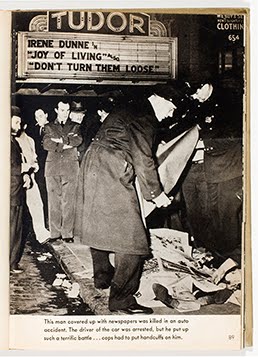
“Technical difficulties inspire AndreaLongacre-White, who repeatedly reshoots low-resolution photographs of car accidents until the images themselves become blurry wrecks. Working in black and white, she’s a Weegee for what we used to call the information superhighway.”

…free or not, she’s got an amazing website: http://andrealongacrewhite.com/

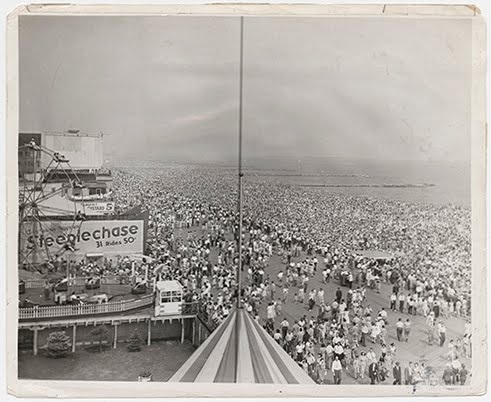
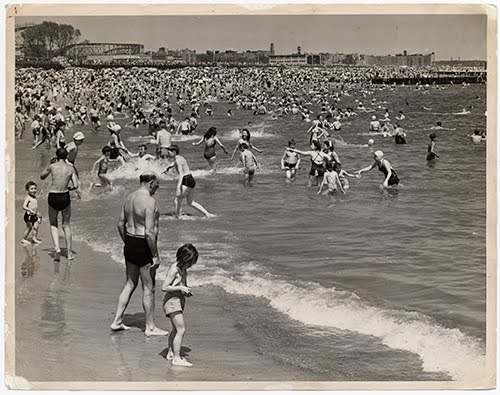
There were a number of attempts by Weegee to make the famous Coney Island photo…
Here are some of them:


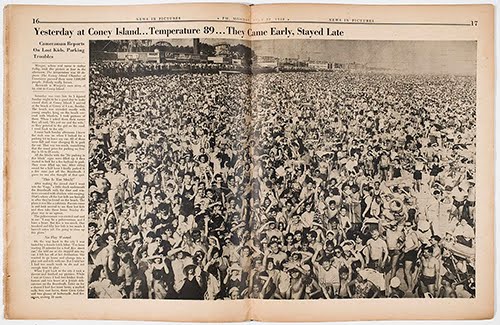
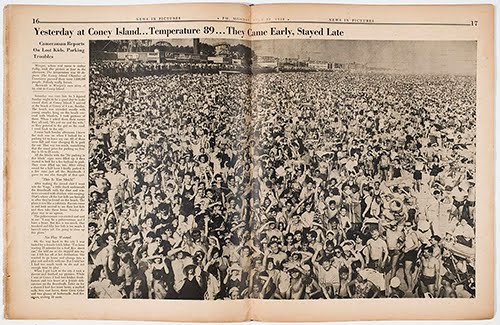
PM Daily June 17, 1940, pp.16-17
(The first draft of the first draft of the first draft of history…)


Weegee’s photos of the crowd at Coney Island, taken before July 22, 1940 (perhaps in chronological order)…

The number of variants, or number of exposures, or photos that Weegee made of the same scene is something that interests us a great deal. The version of this photo that was published in PM Daily on July 22, 1940, is not the same photo that appears in the all of the Weegee books, from Naked City to Weegee’s World… A prominent photo agency has a number of variations on their web site…

An early “version” of, or attempt at, this photo was published in PM Daily on June 17, 1940, in a trial or test version of the paper, a day before PM started publishing, a day before Volume one, Number one…

PM Daily, July 22, 1940, pp. 16-17 and The New York Times, Wed., October 20, p. A22
In the Lens photographer’s feature L. Romero writes:
“Timeless… this Coney Island spectacular, taken on July 22, 1940, never fails to amaze…”

The photo wasn’t taken on July 22, 1940, it was published on July 22, 1940. July 22, in 1940 was a Monday.
In a March 1941 issue of Life magazine, Weegee writes that the Coney Island photo was made on July 21, 1940…

Weegee writes in the July 22, 1940 PM: “Saturday was very hot. So I figured Sunday ought to be a good day to make crowd shots at Coney Island. I arrived at the beach at Coney at 4 am, Sunday…”
The text ends: “When I got back to the city, I took a shower and finished my pictures. While I was at Coney I had two kosher frankfurters and two beers at a Jewish delicatessen on the Boardwalk. Later on for a chaser I had five more beers, a malted milk, two root beers, three Coca Colas, and two glasses of buttermilk. And five cigars, costing 19 cents.”

The timeless photo is often incorrectly dated and titled, in the first two Weegee monographs:

“Coney Island, the crowd turned to look at Weegee standing on top of the lifeguard station, 1938-39, Weegee, 1977, pp. 52-53
“Coney Island, 28th of July 1940, 4 o’clock in the afternoon” Weegee’s New York, 1982, p.41

A very selected bibliography of this Coney Island image (and its variants):

PM Daily, July 22, 1940, Vol. I, No. 25, pp. 16-17

Life, March 3, 1941, p. 108

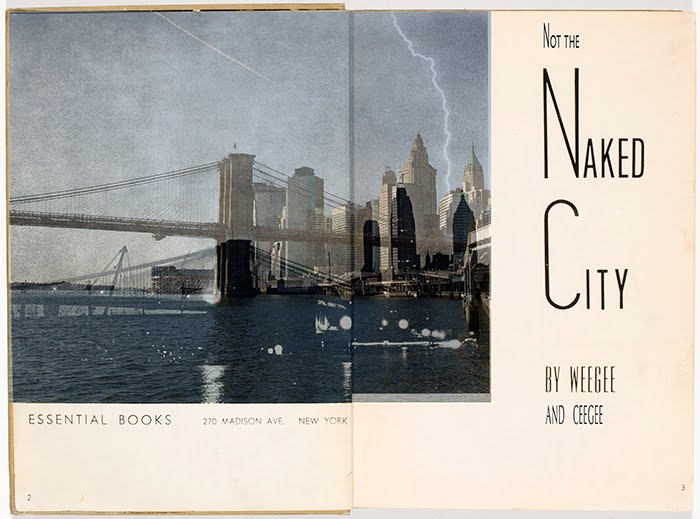
Weegee, Naked City, New York: Essential Books, 1945, pp. 178-179

Photography Handbook, ca.1958, no. 6

Weegee, Weegee by Weegee, New York: Ziff-Davis Publishing Company, 1961

Stettner, Louis, ed. Weegee. New York: Alfred A. Knopf, 1977, p. 52-53

Coplans, John, Weegee’s New York: Photographs 1935-1960. Munich, GmbH: Schirmer Art Books, Schirmer/Mosel Verlag, 1982, p. 41

Centre National de la Photographie, Weegee, Paris: Centre National de la Photographie, 1985, fig.62-63

Barth, Miles, Weegee’s World. New York: Bullfinch Press, 1997, pp. 140-141

On December. 23, 1940, p. 18, PM Daily published a fraction of this photo, and:
“These Pictures Are PM’s Gift to You…
They are being given to readers who give PM Christmas gift subscriptions. Page 7 gives details.”

A favorable Weegee reference in the NY Times:

June 24, 2010
Streetwise New Yorkers Caught in Their Unguarded Moments
By K. JOHNSON

If you wanted to assemble a compendium of street photography clichés, you could simplify the task by picking from “Hipsters, Hustlers and Handball Players: Leon Levinstein’s New York Photographs, 1950-80” at the Metropolitan Museum of Art.

Mr. Levinstein (1910-1988) was not a bad photographer. Every one of the 45 black-and-white works on view is impeccably composed and printed. But viewed against the background of masters of the genre like Weegee, Robert Frank and Tina Modotti, Mr. Levinstein’s focus on funny, scary, repulsive and eccentric characters and the seamier sides of the city looks pretty routine.
Born in West Virginia, Mr. Levinstein moved to New York in 1946 and supported himself as a graphic designer while prowling the streets with camera in hand in his spare time. Alexey Brodovitch, artistic director of Harper’s Bazaar, spotted and supported his talent, and Edward Steichen included him in the hugely popular 1955 exhibition “The Family of Man” at the Museum of Modern Art. But having had only one solo exhibition and having produced no books of photographs during his lifetime, he is not well known today.
The show was organized by Jeff L. Rosenheim, a Met photography curator, who selected from 100 Levinstein photographs in the museum’s collection, most of which were recently given by the collector Gary Davis.
There is a paradox in Levinstein’s approach that is shared by legions of greater and lesser street photographers: he was hunting for the poetry of real life, but what he shot was generally the sort of thing that street photographers generally shoot. Not the types of people or situations that you barely notice because they are so ordinary, but people who seem strange, marginal or ridiculous. The Beat generation’s coolly noirish, anti-bourgeois spirit animates his work.
Numerous pictures have fun with sartorial peacocks like the guy in the Stars-and-Stripes-patterned bell-bottom outfit and the dandy in the zoot suit and bowler hat. (Mr. Levinstein did not title or date his photographs; exhibition wall labels identify them by subject and approximate decade.) Overweight women in short, tight dresses are a favorite subject. The image of a plus-size lady standing at a street corner wearing an elaborately curled platinum wig could be a Diane Arbus outtake. The satire is not always without affection, as in the picture of two short, elderly gents strolling side by side in boxy plaid jackets.
More often, though, aiming from oblique angles, Mr. Levinstein put his subjects in unflattering light. The man with a rotund stomach is cropped at the neck so that he seems the embodiment of All-American gluttony.
Another man, with his rugged, monumental head filling the whole picture, the hollows of his gaunt face deeply shadowed, looks as if he could have modeled for the ancient sculptors of Easter Island.
Mr. Levinstein evidently was not a sexual predator, but he did produce the requisite pictures of underdressed young women. Shot from behind, a shapely specimen leaning into an open car window — a prostitute, perhaps — wears short shorts that fail to cover her underwear fully. Also in this vein are examples of the standard device of people looking at other people, as in the image of a young man studying a svelte woman in scanty summer wear.
Some photographs teeter on the brink of voyeuristic cruelty. The sagging, corpulent old woman in a bathing suit with a brown paper bag for a hat glares at the camera with what seems like a lifetime of stored-up rage. In other pictures you feel condescension masquerading as social sympathy, as in generic images of emaciated women — drug addicts, no doubt — sitting exhaustedly on stoops. Couples and families lying on the crowded sands of Coney Island are works of mandarin Social Realism.
Political subjects are largely absent. The picture of a young, female nuclear war protester in 1970s-style clothes lying down on the pavement in an act of passive resistance is exceptional for its historic interest. But for the most part, Mr. Levinstein’s photographs seem vaguely timeless.
The exhibition’s most remarkable image pictures two handball players in black pants in action. Viewed from behind, one in the foreground hovers off the ground just after executing a shot, as his opponent, close to the wall in a balletic posture, awaits the rebound. Cartier-Bresson would have envied this magic moment.

(Of course it’s an absurd review, Leon is obviously a great photographer, and one of the “masters of the genre.”)