
Naked City 002
Leave a comment


In Weegee’s Secrets (1953) the title of this photo is: “Weegee at work in his ‘office.'”
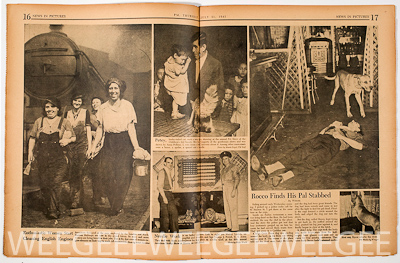
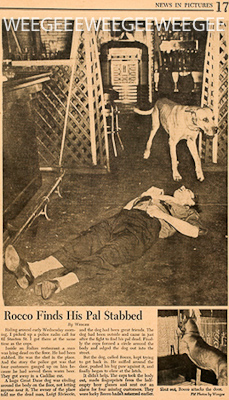
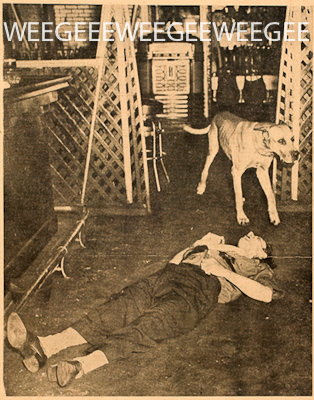

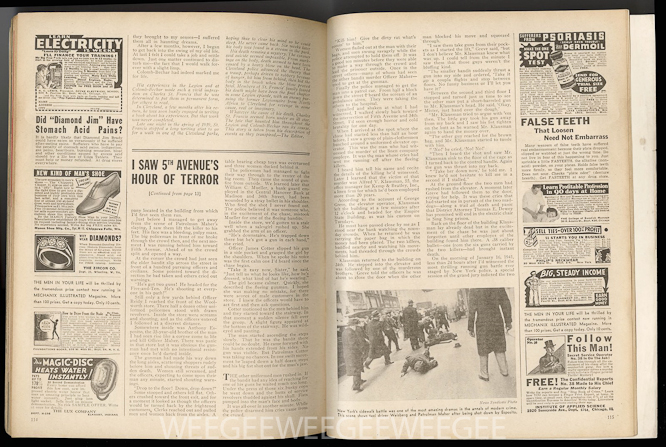
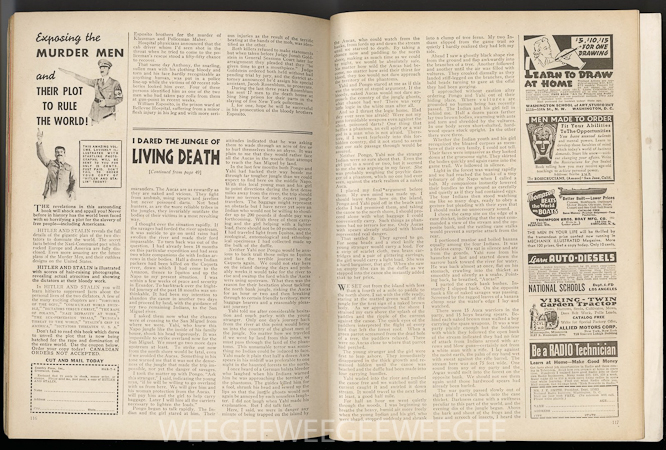
PM, July 31, 1941, pp. 16-17
An on-going collection of images from publications of “Rocco Finds His Pal Stabbed” (Published July 31, 1941) and variants…
Surprisingly, this image isn’t in Naked City. It’s slightly interesting to ask and examine how many variant images there are for each well-known image, or how many exposures, how many different negatives did Weegee make of each scene. Of course every “crime scene” or the setting of each photo is different; for the “Rocco Finds His Pal Stabbed” image (corpse and dog), there were at least two negatives made. And one of the negatives was sometimes cropped significantly when it was published. Even though the corpse is, of course, not going to move, Rocco was moving, Rocco was walking across the floor and frame, we guess that Weegee took the photo that was published in PM first, somewhat hastily, after he recognized the poignancy and novelty, and the possibility of a great caption, something like, “Dead man and his best friend…” and then as the man was walking toward the corpse and dog, Weegee quickly changed film, replaced the exposed sheet of 4×5 negative film with an unexposed one, and then after the man walked over to the dead body and live dog, then Weegee took a slightly more thoughtful or composed image… How many images did Weegee make for each story, how many images were made for context, to illustrate the story. Was Weegee consciously creating photo essays? For the Rocco image, he took at least four total negatives, two of the corpse and dog, one of Rocco outside, at the door, and one of the bar, with the warm glasses of beer. And then he (presumably) looked across the street and saw the crowd of people in front of the synagogue, made an exposure, and then walked over and took another picture…


Life, April 12, 1937, p. 8 and p. 9
A significant early portrait of Weegee.
Speaking of pictures… here’s two:


PM Daily, Feb. 1, 1944, p. 10
U.S. Camera, Feb. 1945, p. 39
Naked City, 1945, p. 61
Weegee’s Secrets, 1953, p. 24
“Ritz, the puppy belonging to William Kinsman, was one of the causalities of the two-alarm blaze at 157 West 74 St.
yesterday. Noticing the dog had a broken leg, a fireman wrapped him in a blanket and took him to the street.”
PM Daily, Feb. 1, 1944, p. 10
An on-going collection of images from publications of “Ritz, the puppy…” (Feb. 1, 1944).
(The “Ritz, the puppy…” photo makes our ever-changing top 250 Weegee photos list…)
… and here, and here, and here.
Where was Weegee?
Wee made a Google Map of some of the places Weegee took photos…
It’s not every location, and it’s unfinished and incomplete, a work-in-progress…
Wee have to add more photos and edit…
Nevertheless, wee have identified almost 300 photographic locations, this includes some iconic photos, like “Their First Murder.”

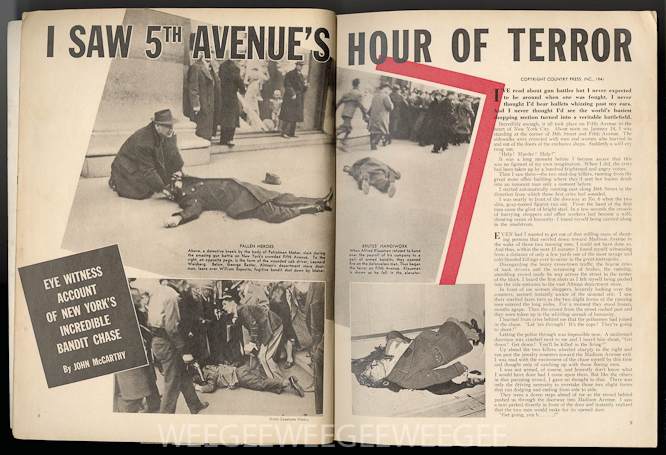


“He looked like a sullen surly, snarling animal,” Weegee reported. “He stumbled and sagged over to one side like a drunk.” PM Daily, January 16, 1941.


Several Sunday’s ago in a pile of old books we found a card that read: “San Rocco, pregate per noi” with a picture of a Jesus-like man, with shells on his shoulders, pointing to a drop of bright, red blood on his thigh; next to him was a fairly large dog, with something in its mouth. The dog is looking up at the man and the man is looking up, perhaps at or for god… Blood, a dog, and someone named Rocco reminded us of the great Weegee photo: “Rocco Finds His Pal Stabbed.” So we hopped on the subway and tried to find Rocco and his pal…
PM, July 31, 1941, pp. 16-17
The photo was was taken at 62 Stanton St. It was published in PM on July 31, 1941, p. 17…
Unfortunately, the entire block that housed the Italian restaurant at 62 Stanton St., and Rocco, and Rocco’s pal, Luigi Rivieccio, are gone. Replaced by the … Housing projects… The banality of progress…


A few bits of trivia we learned after googling Saint Rocco: Saint Rocco is believed to be “the protector against the plague and all contagious diseases.” The story of Rocco takes place at the end of the 1300s. Rocco was wandering around France and Italy, curing plague victims and eventually contracted it himself. “…Miraculously a dog that refused to eat, faithfully brought him bread as a means of sustenance. The dog used to leave a nearby castle and the Lord of this castle having a curious nature followed this dog into the woods and discovered Rocco. The nobleman had pity on Rocco and brought him to his castle where Rocco was cured.” http://www.sanrocco.org. The 83rd annual San Rocco festival will be held this summer, in Aliquippa, Pennsylvania. See http://www.sanrocco.org for more details…
Amusing article from the NY Times:
October 22, 1995
SUNDAY, OCTOBER 22, 1995: PHOTO OP;Remains Of the Day
“Miles Barth recently discovered Weegee.
It’s about time, you might think, since Barth (right) is the curator of archives and collections at the Int. Center of Photos and Weegee was the photographer whose stark pictures of croaked gangsters filled New York’s tabloids in the 30’s and 40’s and bared what he called “the naked city.” No, Barth knew the work; it was the man’s essence he discovered.
His real name was Arthur Fellig, but New York baptized him Weegee because of the Ouija board that was said to get him to a cadaver faster than a cop. He died in 1968 and his companion, Wilma Wilcox, 25 years later; eventually, his life’s work ended up at the center and with Barth: cartons, boxes, packages. And one paper bag.
In the bag was a six-inch- square cardboard box. “I thought it was most likely a broken lens,” Barth says. But there was a label. And what it said was, “Contents: Arthur Fellig.” And that’s exactly who was there. His ashes now repose, in the still-unopened box, alongside his negatives. There are eight million stories in Weegee’s naked city. This is his.”
Unfortunately, the ashes no longer reside near Times Square, they gave someone the “hee-bee-gee-bees” and the ashes have since been dispersed at sea…
In the NY Times:
http://www.nytimes.com/2008/04/27/nyregion/thecity/27jill.html?ref=nyregion&pagewanted=print
April 27, 2008
Through Weegee’s Lens
By NIKO KOPPEL
“BACK in the 1970s, a gutsy blond named Jill Freedman armed with a battered Leica M4 and an eye for the offbeat trained her lens on the spirited characters and gritty sidewalks of a now-extinct city.
Influenced by the Modernist documentarian André Kertész, with references to the hard-edged, black-and-white works of Weegee and Diane Arbus, this self-taught photographer captured raw and intimate images, and transformed urban scenes into theatrical dramas…”
Although the title is amusing, wee think “Through Jill’s Lens” or even “Through Helen’s Lens” would be more appropriate…

