Archive

Tag Archives: 1946

IMG_6114-2-2
PM, August 25, 1946

CRITICAL and AMUSEMENTS
Ager
“Bogart, Bacall, Babes and Bums

The Big Sleep yearns to be the most shocking picture that ever was. To that end, it sells shock for its own sake-realizing that any good reason for its trafficking would necessarily weaken the blows.
Realizing, too, that because they’ve become so familiar, murder, crimes, beatings-up alone have lost much of their jolt-value-The Big Sleep decides that its chief assaults shall be made with the still shining bludgeons of personal corruption, fetidness, decay.
But it is so intensely proud of its new weapon, there is so much determination in its batterings, it is so dedicated to thoroughness in its laying bare of evil-that a terrible thing, the very last thing it wanted to have happen to it, happens to it.
The deep sincerity of its striving for vice arouses affection. It’s so very serious about purveying depravity that its seriousness becomes endearing. It becomes kind of touching, kind of sweet.

Men Are Killers

It becomes winning. It evokes the fond indulgence that a blue-eyed, rosy-cheeked, good little boy meets when earnestly relating the very naughtiest day-dream the dear little fellow is able to think up.
All the men in the The Big Sleep are murderers, naturally; all the women, babes. Except perhaps for the showgirls in a Metro musical. There has never been assembled for one movie a greater and more delightfully varied number of female knock-outs. But whereas Metro showgirls at least look content, every woman in The Big Sleep is feverishly hungry for love. Though they appear ripe, inwardly they are starved, and so desperate for assuagement that though every one of them would prefer Humphrey Bogart, they settle instantly for anybody.
Quickest settler of them all is Martha Vickers, who looks like somebody’s kid sister budding into beauty, and who acts at least like Lauren Bacall’s kid sister, who, indeed, she plays.

Female Technique

She too looks up at a man with her hair impairing the vision of one eye. She too talks cryptic, in a cigaret voice. Her legs too are long; her technique, aggression.
But when denied her opium and her men, Miss Vickers pouts; whereas Miss Bacall, denied her bottle and her man, smoulders. The distinction is slight – having to do with the virtue of the singular “man” versus the plural “men” – but sufficient to make Miss Bacall the heroine, a legal movie conviction required to be pinned on some lady in a picture so that the audience can feel reassured that God’s in His heaven: all’s right with the world.
The love song of heroine Bacall and hero Bogart is wailed on a police siren, the counterpoint to a phantasmagoria of violence, mist, and confusion; a great many uglinesses happening fast. But how or why one ugliness succeeds the last is not easy to determine, inasmuch as producer-director Howard Hawks is so entranced with making each ugliness an individual gem of its kind that their relationship to each other has been neglected.
But these individual gems are recommended as samples of the skill of cinema craftsmen when engaged in cutting and polishing rhinestones to simulate diamonds, instead of just cutting and polishing diamonds. They are marvelous fakes. If there were such people and things as The Big Sleep has made up, they would certainly jerk that way.

-Cecelia Ager

PM Reviews

THE BIG SLEEP, a Warner Brother picture at the Strand. starring Humphrey Bogart and Lauren Bacall with Martha Vickers, Charles Waldron, John Ridgely, Elisha Cook Jr. Sonia Darrin, Pat Clark, Dorothy Malone, Regis Toomey; screenplay by William Faulkner, Leigh Brackett and Jules Furthman from the story by Raymond Chandler; produced and directed by Howard Hawks.

IMG_6097z-2
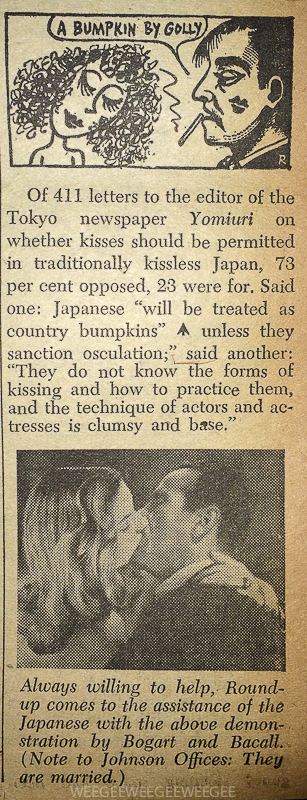
PM, August, 15, 1946
“Of 411 letters to the editor of the Tokyo newspaper Yomiuri on whether kisses should be permitted in traditionally kissless Japan, 73 per cent opposed, 23 were for. Said one: Japanese “will be treated as country bumpkins” unless they sanction osculation;” said another: “They do not know the forms of kissing and how to practice them, and the technique of actors and actresses is clumsy and base.”
Always willing to help, Round-up comes to the assistance of the Japanese with the above demonstration by Bogart and Bacall. (Note to Johnson Offices: They are Married.
IMG_6097-4

IMG_3841
PM, June 6, 1946
(By James Parlatore, Photos by Morris Gordon)

Bowery’s Mayor Sammy Says It With Champagne
Three-Hour Show Celebrates Rise to Title

“The forgotten man was remembered yesterday on the Bowery.
He was a guest at a cocktail party where champagne, scotch and beer were served lavishly to wash down huge helpings of corned beef and hot dogs – and it was all free!
The forgotten man – one of the many individuals who come to that gloomy street under the noisy Third Ave. El in downtown Manhattan to forget their pasts – shuffled in with other derelicts and bums into Sammy’s Bowery Follies at 267 Bowery, because the host, Sammy Fuchs, was celebrating his accession to the honorary title of “Mayor of the Bowery”…”

IMG_4447
(Coincidentally, we walked the length of the Bowery last night, and 267 Bowery is open again, with out hizzoner and the character(s)…)

IMG_3840-2
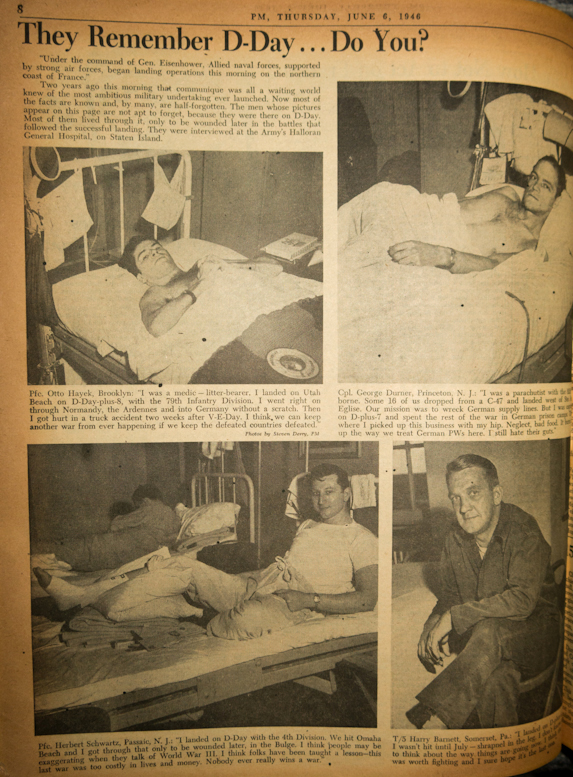
PM, June 6, 1946 (photos by Steven Derry)
“Under the command of Gen. Eisenhower, Allied naval forces, supported by strong air forces, began landing operations this morning on the northern coast of France.”
Two years ago this morning that communique was all a waiting world knew of the most ambitious military undertaking ever launched. Now most of the facts are known and, by many, are half forgotten. The men whose pictures appear on this page are not apt to forget, because they were there on D-Day. Most of them lived through it, only to be wounded later in the battles that followed the successful landing. they were interviewed at the Army’s Halloran General Hospital, on Staten Island.”

“… I think we can keep another war from happening if we keep the defeated countries defeated.”
“… I still hate their guts.”
“… I think folks have been taught a lesson – this war was too costly in lives and money. Nobody ever really wins a war.
“… I think the war was worth fighting and I sure hope it’s the last one.”

From the New Yorker, by P. Hamburger, 1943:

After leaving Halloran, he wrote me, “It was the first place in America I hit after more than a year out of the country. Coming back wounded, I was afraid that I’d enter a vacuum, that nobody would give a damn. But at Halloran I never had a chance to be lonely and there were times I actually forgot I was in a hospital.” Recently I spent an afternoon at Halloran and found out what my friend meant.

Halloran lies approximately in the centre of Staten Island, about a half hour by bus from the ferry terminal at St. George. It’s a sprawling group of low, red-brick Colonial buildings, dominated by a seven-story structure with four wings jutting, like spokes, from the middle. I was met at the main building—the seven-story one—by one of its officials, Captain Max Lipsky, a stocky, jovial man, who suggested that the Red Cross recreation building would be the best place for me to talk with some of the patients and see how they spend their free time. Most of the ambulatory patients, the ones who can get around, drop in there during the afternoon and early evening, Captain Lipsky told me, and free and easy is the rule.

“Nobody ever really wins a war.”

IMG_3837
IMG_3838
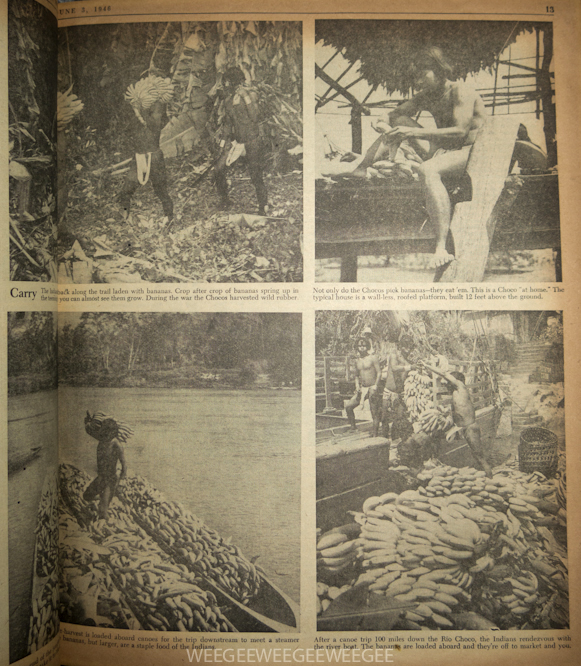
PM, June 3, 1946
Here Are Bananas – But Where’s Chaquita?
“Down Panama way these Choco Indians hack their way through an old trail to harvest wild bananas…”
“Not only do the Chocos pick bananas – they eat ’em…”
(Not Weegee, but bananas…)

1947_06_IMG_3880
June 1946
Easy on the Eyes – Marie Wilson is the reason “Ken Murray’s Blackouts” has been running to capacity houses for the past five years at El Capitan Theatre in Hollywood…