“Crime Does Not Pay,” Frank Luther Trio; Bob Miller; July 1934

“I Found You in the Rain,” Tony Pastor and his Orchestra; Eugenie Baird; Harold Barlow; Chopin; July 7, 1941


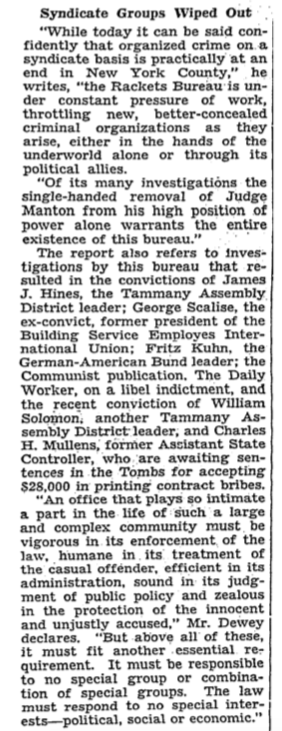
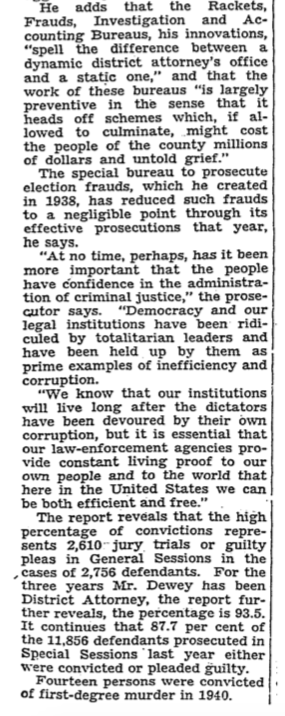
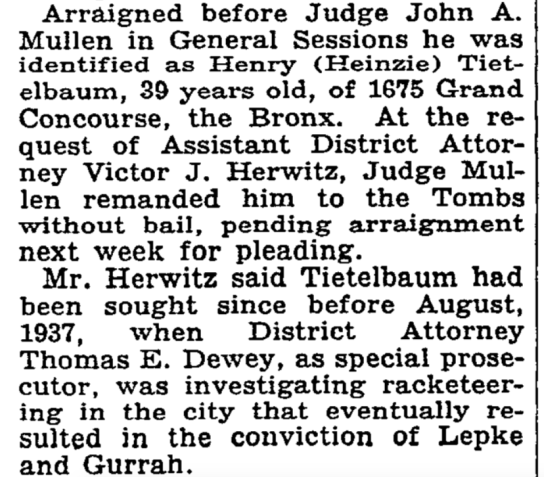
The New York Times, July 7, 1941

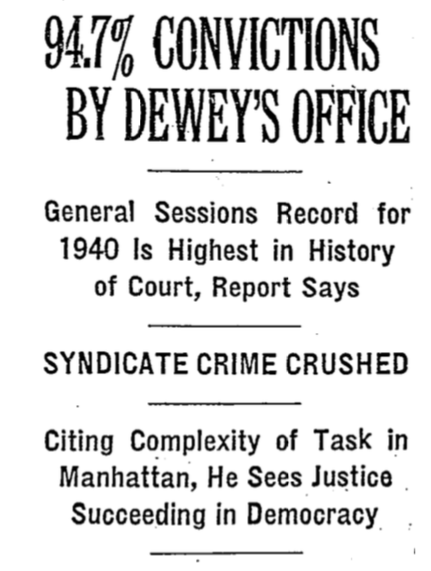
94.7% CONVICTIONS BY DEWEY”S OFFICE

General Sessions Record for 1940 Is Highest in History

SYNDICATE CRIME CRUSHED

Citing Complexity of Task In Manhattan, He Seems Justice Succeeding In Democracy

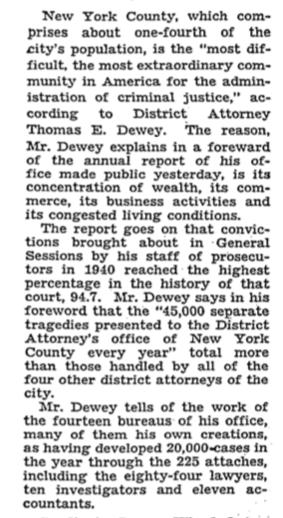
…Fourteen persons were convicted of first-degree murder in 1940.


“Crime Will Never Pay,” Gene Autry and The Pinafores; Carl Cotner; Willard Robison; Jack Pepper, 1951


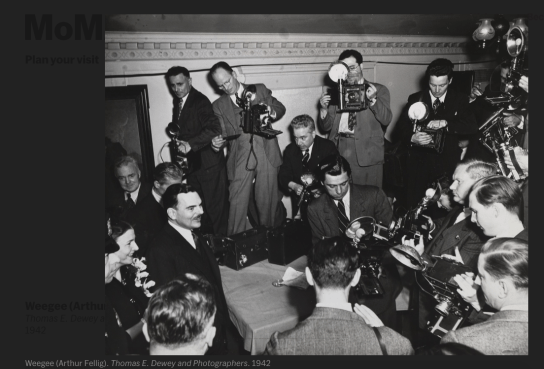
Weegee, Thomas E. Dewey and Photographers, 1942 (Screenshot from moma.org)

(Might have been a little premature to say: “…confidently that organized crime on a syndicate basis is practically at an end in New York County.”… In Kings County, in July 1941, Murder Inc. was reeling from Reles’ confessions…)


“The Blues Have Got Me,” Jack Teagarden And His Orchestra; Jack Teagarden; Charles La Vere; Irving Mills; July 7, 1941


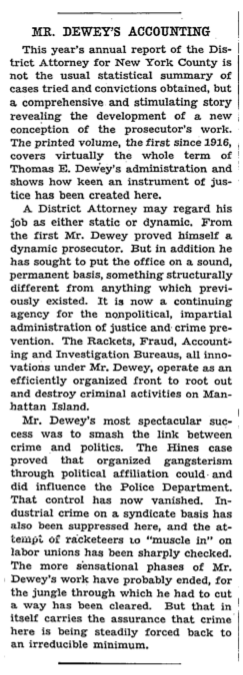
The New York Times, July 7, 1941

MR. DEWEY”S ACCOUNTING


“I’m Going To Start A Racket,” Lil Green; James Maddox; July 1941


“Spider Sent Me,” Paul Williams Sextette; Paul Williams; Spider Burks St. Louis, 1948


PM, July 5, 1942, p. 7

Coney Island At Noon Saturday

The crowd came later, according to Weegee who wanted a photo that showed some beach and not too many people. The masked man said that he was a laundry man, but would only be photographed incognito. The mask is a gag of his; he call himself the Spider, and likes to frighten people. Weegee didn’t get the names and addresses of the others in the photo, either. PM Photo by Weegee.
PM, July 5, 1942, p. 7


“Just Like a Spider,” Arthur “Big Boy” Crudup; Arthur Crudup, 1947


(“Mexican Elections Heated Wind Up,” photos by Margaret Bourke-White)


“Rifftime,” Erskine Hawkins (The Twentieth Century Gabriel) and his Orchestra; Avery Parrish, Bluebird (B-11161-B), 1940


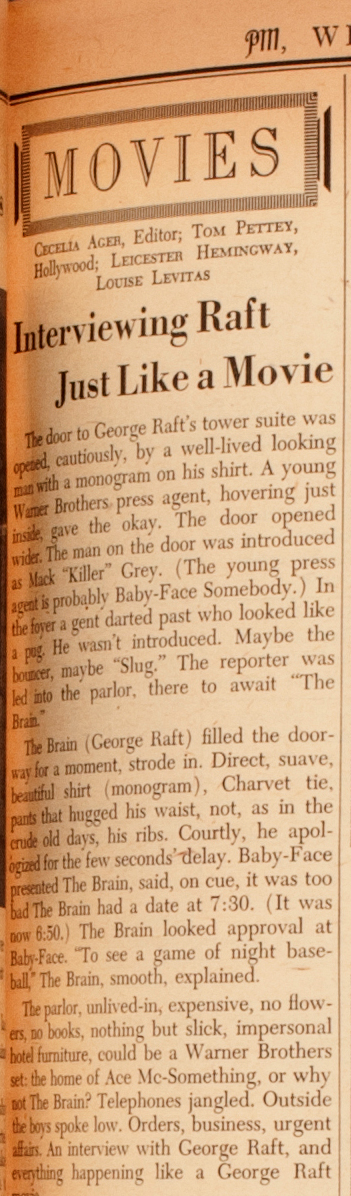
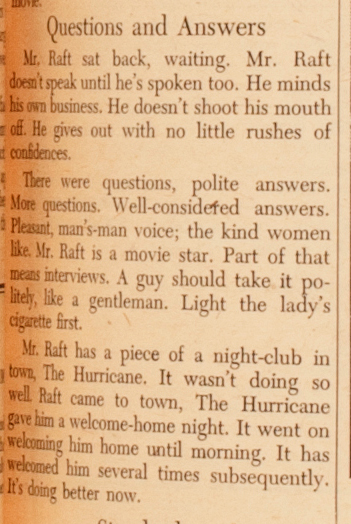
PM, July 3, 1940 (Interview by Cecelia Ager) [Raft was a close friend of Benjamin “Bugsy” Siegel, etc. etc…]


“I Smell a Rat,” “Young” Jessie And His Orchestra; “Young” Jessie; Stoller; Leiber, Modern Hollywood (921), 1954


“They Drive By Night,” 1940, associate producer, Mark Hellinger…

“They Drive By Night,” 1940, trailer


“Doctor Jazz,” Jelly-Roll Morton and his Red Hot Peppers; Joe Oliver; Jelly-Roll Morton; Omer Simeon; George Mitchell; Kid Ory; John Lindsay; Andrew Hilaire; Johnny St. Cyr , 1926


“Somebody’s Getting My Love,” Mabel Robinson; The 4 Blackamoors; Farrior; Nurse, 1941


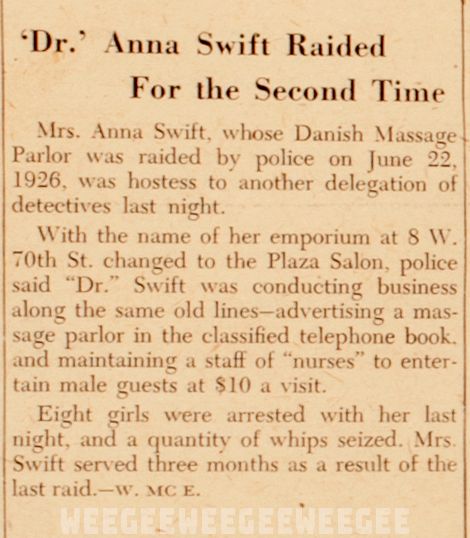
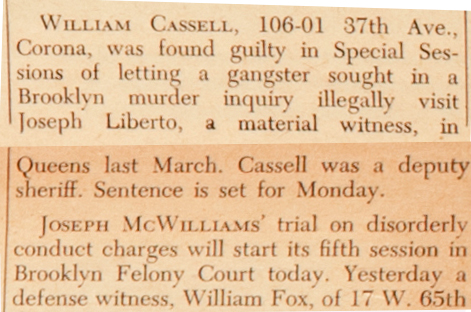
PM, July 2, 1940

[The “gangster sought in a Brooklyn murder inquiry” was Vito Gurino.]


“Doctor Sausage’s Blues,” Doctor Sausage And His Five Pork Chops; Doctor Sausage; Tyson, 1940


“Money Blues (If You Ain’t Got No Money, I Ain’t Got No Use for You),” Camille Howard And Her Boy Friends; F. Wray; B. Carter, 1951

“…We let love take its course…”


“Everybody’s Got Money,” Eddie Beale Fourtette; Gene Forrest; Forrest; Dolphin; Hollywood (172-AA), 1951

In July 1940 $688,369.00 had the same buying power as $13,236,106.64 in May 2021.
In July 1940 $265,000.00 had the same buying power as $5,095,476.79 in May 2021.


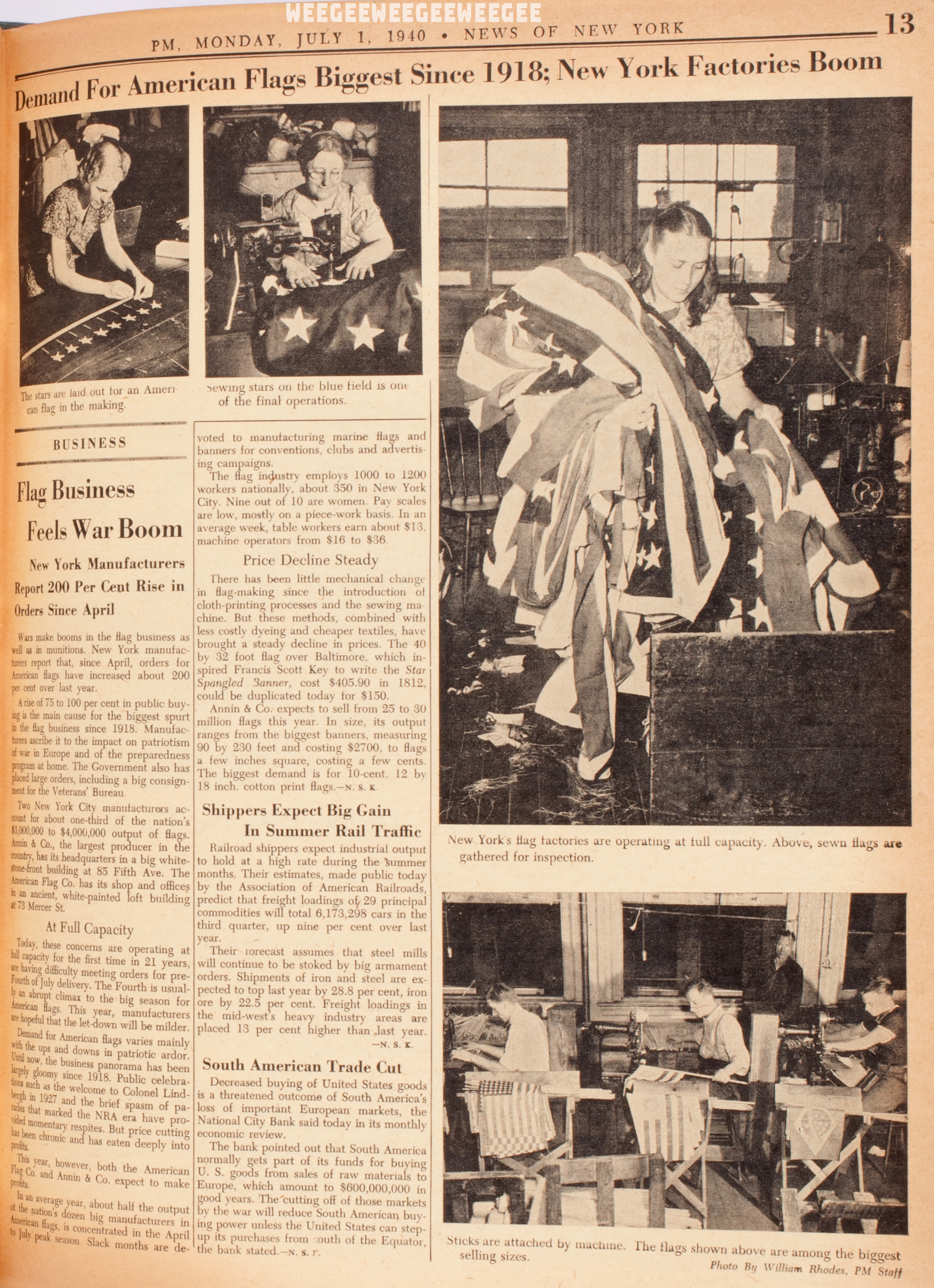
“PLEDGE TO THE FLAG,” Igor Gorin; Albert Hay Malotte, 1940


(Photos by William Rhodes)

Demand For American Flags Biggest Since 1918; New York Factories Book


“(a) PLEDGE TO THE FLAG (b) THE STAR SPANGLED BANNER,” by Leopold Stokowski; The All-American Orchestra; Key; Goddard Lieberson, 1940

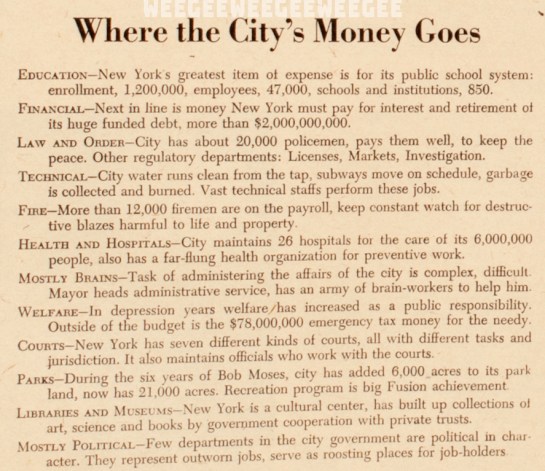
New York City Budget, 1940-21


“If Money Grew on Trees,” Eddie Rochester Anderson; Rene, 1940


“Money is Honey,” The Ramblers; O’Neil Spencer; Hopkins, 1939

Where the City’s Money Goes

PM, July 1, 1940


“Taxpayers’ Blues,” Bulee Gaillard and his Southern Fried Orchestra; Carroll; Gaillard; Norman Granz, 1952


The New York Times, June 28, 1941

Liquor License For Hero

Weisberg, Figure in Esposito Capture, Will Open a Store

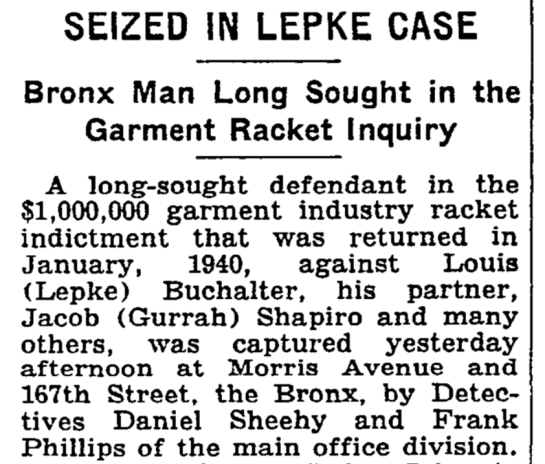
…Leonard Weisberg, the taxi driver who was injured in heroic efforts to capture the Esposito brothers after a midtown hold-up and murder last January…


“Troubles Good-Bye,” Jimmy Liggins And His Drops of Joy; Jimmy Liggins; J. Liggins, 1947

Eighty years ago today: a conclusion of sorts to the midtown Mad Dog Esposito brothers’ story…
A quick review of Leonard Weisberg’s heroics…
(With irreverent, irrelevant, and almost contemporaneous musical accompaniment.)


“Sloppy Drunk,” Walter Brown And Jay McShann’s Quartet; Walter Brown; Brown, 1947

…Not all in the crowd ran. Mr. Weisberg, whose cab was parked in Thirty-Fifth Street, ran up and threw himself on the armed bandit. Esposito shot him in the neck and the taxi driver rolled over onto the sidewalk….
New York Herald Tribune, January 15, 1941

As the wounded bandit [William Esposito] fired, Leonard Weisberg, thirty-six year old taxi driver, of 1577 Carroll Street Brooklyn, jumped on him. The gunman shot him in the neck just before he was captured, the payroll money, in a brown envelope, still in his pocket…
New York Herald Tribune, January 15, 1941
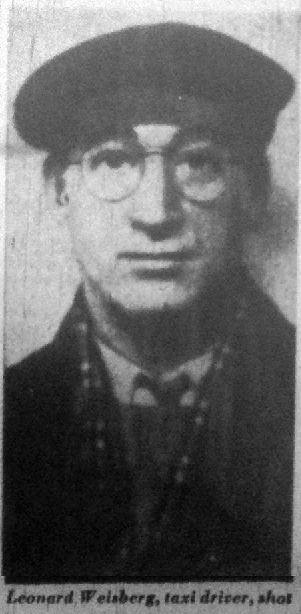

The New York Herald Tribune, January 15, 1941


“I Ain’t Drunk,” Jimmy Liggins, 1954

…A brave taxi driver named Leonard Weisberg lunged full at the spitting gun in an effort to save Maher, who was his friend. But the policeman fell dead and Weisberg writhed on the sidewalk, a bullet in his throat…
LIFE, January 27, 1941
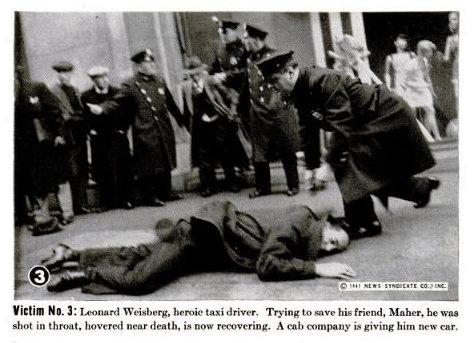

LIFE, January 27, 1941


“I Got Hi,” Frank Ervin and His Band; Hurley; Moore, 1955

Slaughter on Fifth Avenue

…The crowd surged back, then forward. A taxi driver named Leonard Weisberg leaped on the prone gunman. He grabbed for the revolver, missed. Esposito jerked it back a few inches, fired again. Weisberg, clutching his throat, gasping for breath, fell to the sidewalk…

The Espositos went to the hospital, to the line-up, to indictment for murder. Leonard Weisberg, recovering from his throat wound, was promised a new cab of his own and won a hero’s praise. The Nazi press gleefully played up the crime as evidence of democratic depravity.
Time, January 27, 1941


“When I Been Drinking,” Rosetta Howard; Big Three Trio; Broonzy, 1947


The New York Daily News, January 15, 1941


“Thinking and Drinking,” Amos Milburn and his Aladdin Chickenshackers; O. O. Merritt, 1952
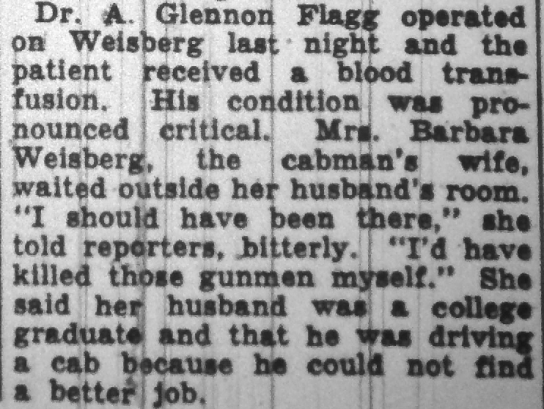

The New York Times, January 15, 1941


“When I’ve Been Drinking,” Jay McShann and His Jazz-Men; Numa Lee Davis; Cleophus Curtis; Raymod Taylor; Jay McShann; Albert Wichard, 1945


The New York Herald Tribune, January 16, 1941 [$18 in January 1941 had the same buying power as $343.65 in May 2021.]


“Lips That Touch Liquor Shall Never Touch Mine,” Tiny Hill And His Orchestra; Tiny Hill; Edgin; J. Hill, 1946

“Street Scene,” Benny Carter Quintet; Norman Granz; Alfred Newman, 1952


PM, June 27, 1941, pp. 12-13

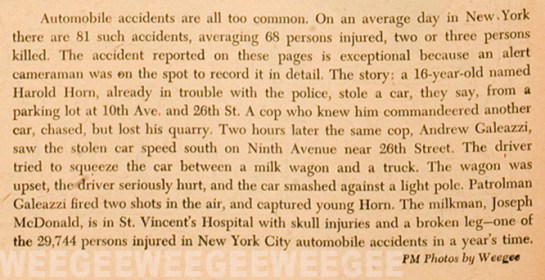
Street Scene In New York:
A Wild Kid in a Stolen Car
Knocks Over a Milk Wagon

Automobile accidents are all too common. On an average day in New York there are 81 such accidents averaging 68 persons injured, two or three persons killed…

PM, June 27, 1941


(1) Car starting and running; (2) Screech of brakes and crash with women’s scream; (3) Crowd murmurs at scene of accident; (4) Ambulance Bell and Siren; (5) Surf)

The Durable Harold Horn
He Keeps Popping Up in Front of Cop

A drama in three acts… entitled: “If At First You Don’t Succeed Try, Try Again.”

Horn was booked on charges of grand larceny, driving without a license, leaving the scene of an accident, dangerous driving, and – inasmuch as Joseph McDonald, 24, of 352 50th St., Brooklyn, driver of the milk-wagon was injured in the crash – third degree assault.
The New York Post, June 26, 1941, p.4


“Milkman Polka,” Jolly Jack Robel And His Orchestra, 1941


“Wild Man Blues,” Louis Armstrong and his Hot Seven; Armstrong; Morton; Louis Armstrong; Kid Ory; Johnny Dodds; Lillian Hardin; Johnny St. Cyr; Pete Briggs; Baby Dodds, 1927


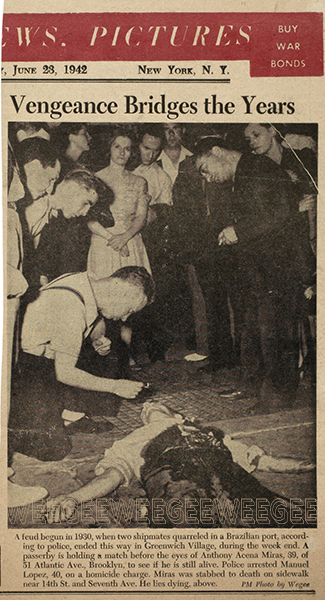
PM, June 23, 1942

Vengeance Bridges the Years

Feud begun in 1930, when two shipmates quarreled in a Brazilian port, according to police, ended this way in Greenwich Village, during the week end. A passerby is holding a match before the eyes of Anthony Acena Miras, 39, of 51 Atlantic Ave., Brooklyn, to see if he is still alive. Police arrested Manuel Lopez, 40, on a homicide charge. Miras was stabbed to death on sidewalk near 14th St. and Seventh Ave. He lies dying, above. PM Photo by Weegee


“It’s Murder,” Lil Armstrong And Her Swing Orchestra, Lil Armstrong, 1936


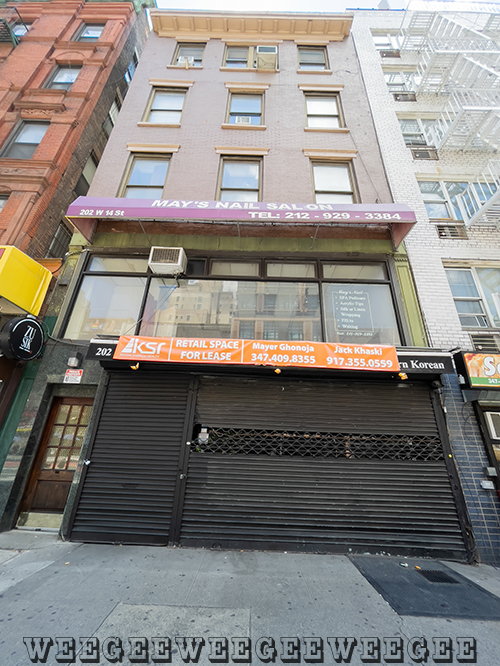
202 West 14th St., June 23, 2021


Brooklyn Eagle, June 22, 1942, p.2

12-Year-Old Feud Ends With Fatal Stabbing

The final chapter to an argument between two seamen which began 12 years ago on the ill-fated Vestris [1912-1928] was written today with the fatal stabbing of one of the men.

The original quarrel began in a Brazilian port and was resumed last night with flashing knives outside of a Greenwich Village bar. It ended with the death of Anthony Acena Miras, 39, and the arrest of Manuel Lopez, 40 on a charge of homicide.

The two were shipmates on the Vestris and during a quarrel in 1930 Lopez was slashed across the face with a knife, which left an ugly scar. The two men had not see each other since until Saturday night when Lopez passed a tavern at 202 W. 14th St. Manhattan, and saw at the bar. He called him outside, and the two resumed their 12-year-old battle.


“Wee Wee Hours,” Big Bill Broonzy, July 1941