Screenshot from eastman.org.

Copied from eastman.org:

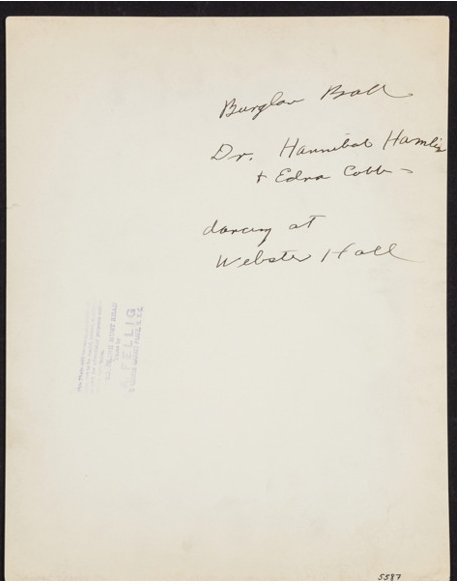
“Inscriptions verso (ink): The notice for Burglars Ball
Hospital took this notice
down

(stamped): [inscription partially obscured] photo sold for use in one Publication
[illeg.] not to be resold, loaned, [illeg.]
[illeg.] used for advertising purposes with [illeg.]
written permission.
CREDIT LINE MUST READ
photo by
A. FELLIG
5 CENTER MARKET PLACE, N. Y. C.”

This is intriguing… another “Burglar’s Ball” photo recently acquired by GEH…


Daily Mail, August 2, 2018 (Updated 8:18 EDT), screenshot

Text copied from dailymail.com:

Grisly crime scene pictures of bloodied murder victims from early 1900s New York City taken by legendary news photographer Weegee are seen in color for the first time

Arthur Fellig took dozens of harrowing crime scene photos by following emergency services around
He was first on scene so often he was said to be able to predict crime and was nicknamed Weegee…
Black and white photos were painstakingly colorized for the first time by Frenchman Frédéric Duriez

By Nic White For Mailonline

Published: 06:08 EDT, 2 August 2018 | Updated: 08:18 EDT, 2 August 2018

Gruesome early 20th Century crime scenes of New York’s gangland murders by a legendary news photographer can be seen in color for the first time.

The unnerving shots by Arthur Fellig show the bodies of Robert Green and Jacob Jagendorf after a failed robbery attempt, a bloodied couple lying dead in bed, and a murder victim with a chalk outline drawn around him.
Fellig was said to have been able to ‘predict’ crime and captured dozens of harrowing scenes under the pseudonym Weegee by following emergency services around…”
“Fellig revolutionized photojournalism with his stark portraits of urban crime scenes, often shooting the aftermath of violent murders and horrific accidents.
The images captured the rapidly changing city that New York was in the decade before prohibition, which itself brought a fresh wave of violent crime.
Fellig worked on New York City’s Lower East Side as a press photographer during the 1930s and 1940s, and developed his signature style by following the city’s emergency services and documenting their activity.
Much of his work depicted unflinchingly realistic scenes of urban life, crime, injury and death…”
“The photos like this one of a woman who was murdered in her own bed in a run-down apartment can now be seen in brilliant color, as with her purple dress, for the first time. The unnerving shots were taken by Arthur Fellig, who was said to have been able to ‘predict’ crime and captured dozens of harrowing scenes under the pseudonym Weegee by following emergency services around.
He published photographic books and also worked in cinema, initially making his own short films and later collaborating with film directors such as Jack Donohue and Stanley Kubrick.
Fellig earned his nickname, a phonetic rendering of Ouija, because of his frequent, seemingly prescient arrivals at scenes only minutes after crimes, fires or other emergencies were reported to authorities.
He is variously said to have named himself Weegee or to have been named either by the staff at Acme Newspictures or by a police officer…”

Above text copied from dailymail.com.


Daily Mail, August 2, 2018 (Updated 10:55 EDT), screenshot

Text copied from dailymail.com:

Grisly crime scene pictures of bloodied murder victims from early 1900s New York City are seen in color for the first time

WARNING GRAPHIC CONTENT…
They were taken in the first two decades of the 20th Century as New York underwent social change
Black and white photos were painstakingly colorized for the first time by Frenchman Frédéric Duriez
Gruesome early 20th Century crime scenes of New York’s gangland murders, robberies gone wrong, and crimes of passion can be seen in color for the first time.
The unnerving shots show the bodies of two thieves who fell down an elevator shaft in a failed robbery attempt, a bizarre murder-suicide, and a victim with a chalk outline drawn around him.
The black and white crime scene photographs were painstakingly colorized by Frédéric Duriez, 52, from Angres, France, to show what detectives would really have seen.
‘I think that it’s is a haunting collection of crime scene photographs never meant to be seen by the public in color,’ he said.
‘I like how picture was taken, just above the character, this increases the dramatic side of the scene. It is by chance that I discovered these pictures on the internet, they seemed fantastic. I thought, why not colorize them.’
The images captured the rapidly changing city that New York was in the decade before the prohibition of 1920-33, which itself brought a fresh wave of violent crime. ”

Above text copied from dailymail.com.

dailymail.co.uk

Obviously Weegee didn’t make the photos, they were made by unidentified photographers, the “original” digital files are from the NYC Municipal Archives.


New Yorker cover, August 6 and/or 13, 2018 and/or Weegee, Naked City, pp. 178-179

You’re based in London. Where did you get this vision of a beach day?”

“The spark for this idea came from a 1940 photograph by Weegee, which shows Coney Island beach completely covered with people: a whole city decamped onto the sand. In London, we have a similar thing with parks, which fill to bursting point when the hot summer weather comes.”
Tom Gauld’s “On The Beach”, By Françoise Mouly, July 30, 2018, newyorker.com

Coincidentally and irrelevantly… 75 years ago today:


PM, August 1, 1943
“Sketched on the spot, by Grant Reynard, July 1943.”


Weegee, [Jeremiah Erranght’s room], 1942, screenshot from icp.org

body bag (not empty)
books (open and closed)
box (open)
calendar (February 1942)
cans (open and closed)
coat
lamp (empty)
newspaper
quilt (in sink)
Selox soap box
sink
table
window (open)

(First Jeremiah Erranght, 55, post is here.)


Weegee, [Jeremiah Erranght’s room], 1942, screenshot from icp.org (Detail)

(Book on box… what did the “recluse” read?)


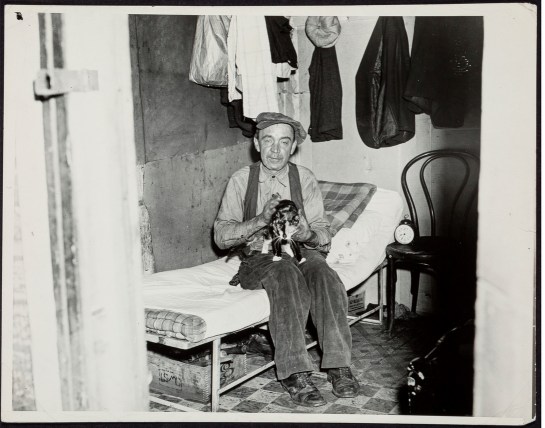
Weegee, Shanty Town, Mr. ‘Sawdust’ with ‘Monkey’, 6 3/4″ x 8 3/4″, ca. 1936-37. (Screenshots from auction house website.) Sold for $1,500.00.

(Interior reminiscent of Fellig’s flat; one of the most beautiful photos we’ve seen. Unclear why there’s a PIX stamp… perhaps Karger related…)


Weegee, Burglar’s Ball, Webster Hall, 7 5/8″ x 9 1/2″, ca. 1937 (screenshots from auction house website). Not sold.


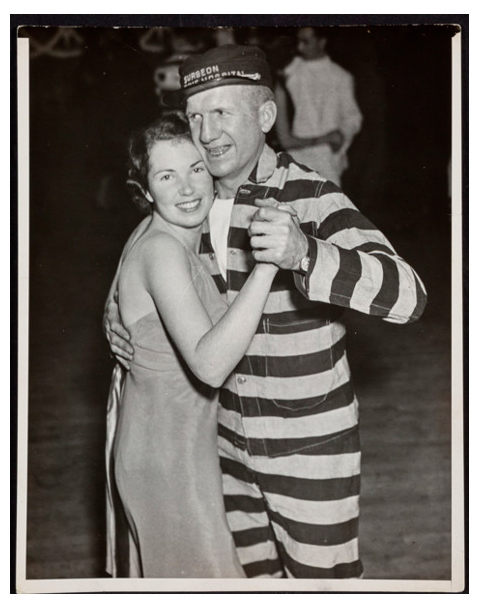
Weegee, Burglar’s Ball. Dr. Hannibal Hamlin and Edna Cobb dancing at Webster Hall, 10″ x 7 5/8″, ca. 1937 (screenshots from auction house website). Sold for $1,250.00.

Unrelated:

NY Sun, December 21, 1937.

Provenance: “a record of ownership of a work of art or an antique, used as a guide to authenticity or quality.”


Images from eBay.

Sold for $199.43.

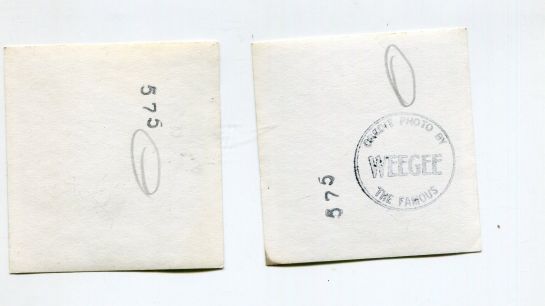
These photographs were not made by Weegee.

Copied from the eBay listing:

“Vintage Pair of WEEGEE PHOTOS (1 stamped) Ornate Theatre Interiors small

ORIGINAL ITEM, NOT A REPRINT

size: 2 1/2 x 2 3/4 inches approx each

light wear
no rips
no bends

Please see scan for details”

Provenance: “a record of ownership of a work of art or an antique, used as a guide to authenticity or quality.”

Provenance: “a record of ownership of a work of art or an antique, used as a guide to authenticity or quality.”


Images from eBay.

This photograph was not made by Weegee.

Sold for $95.

Copied from original eBay listing:

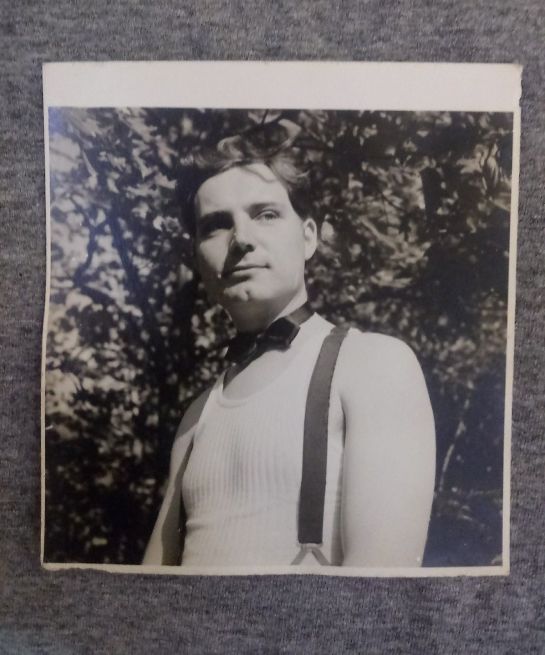
“Vintage Weegee ORIGINAL 4×4 Undershirt Suspenders and Bow tie STAMPED Photograph

Original
4″ x 4″ Photograph
untitled

Portrait

Man in undershirt with Suspenders and a Bow Tie.

Original Weegee (Arthur Fellig) photograph

Printed circa early-to-mid 1950s from his original negative,

the image was printed and by Weegee himself.

There is his credit stamp on the back as shown.

Condition
NEAR FINE OR BETTER

1 original 4″ x 4″ B&W silver gelatin print

(circa late 1940s)

on double-weight fiber paper with lustre finish and narrow borders.

Tonally rich, bright and clean with a bit of handling.

Please examine the images I have included.

Though the print has a much finer grain than the images present,

they show you the actual condition of the photograph.”


Images from eBay.

This photograph was not made by Weegee.

Sold for $100.

Copied from eBay listing:

“Vintage Arthur Fellig Weegee ORIGINAL 4×4 Hunters Lodge Bar STAMPED Photograph

Original

4″ x 4″ Photograph

untitled

Portrait

Men in Hunter’s Lodge Bar

Original Weegee (Arthur Fellig) photograph

Printed circa early-to-mid 1950s from his original negative,

the image was printed and by Weegee himself.

There is his credit stamp on the back as shown.

Condition

VERY GOOD PLUS OR BETTER

1 original 4″ x 4″ B&W silver gelatin print

(circa late 1940s)

on double-weight fiber paper with lustre finish and narrow borders.

Tonally rich, bright and clean with loss to lower right corner as shown.

Please examine the images I have included.

Though the print has a much finer grain than the images present,

they show you the actual condition of the photograph.”

Provenance: “a record of ownership of a work of art or an antique, used as a guide to authenticity or quality.”


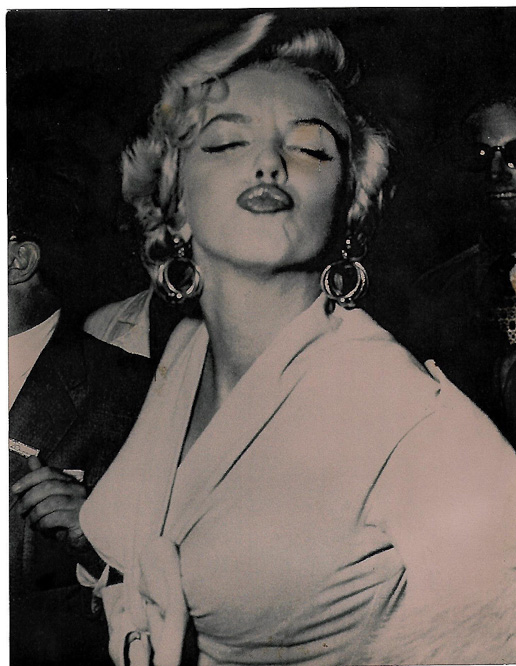
Not Weegee, Marilyn Monroe (image from eBay)

Sold for $121.

Copied from the Ebay listing:
“Marilyn Monroe rare vintage ‘Weegee’ classic snapshot photograph .
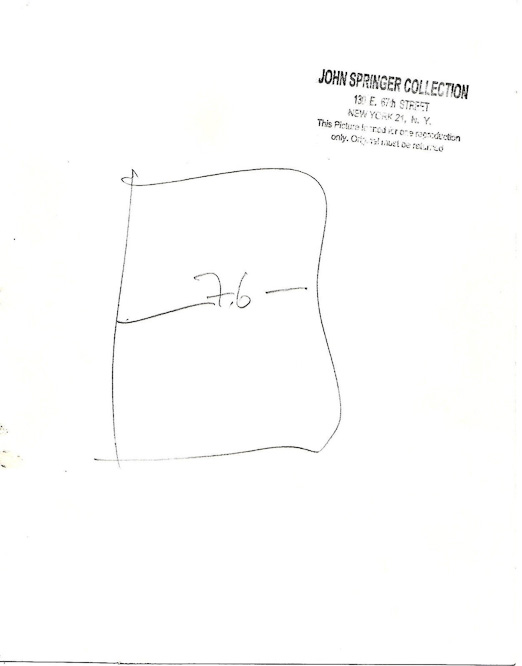
Marilyn Monroe 1954 rare 7×9 1/2 in. aproox. vintage double weight gelatin silver snapshot taken by New Yorker night hunter paparazzi, Weegee. John Springer collection stamp on verso of photo. In fine preserved archive condition”

(John Springer: press agent, Hollywood publicist.)

We don’t think Weegee made this photo…

Provenance: “a record of ownership of a work of art or an antique, used as a guide to authenticity or quality.”


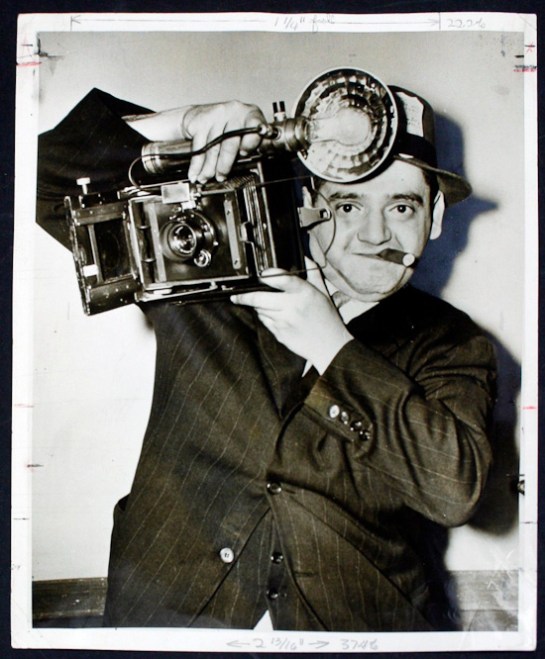
Selfie, July 1941 (sold for $461.78)
Great photo…


Church, ca. 1944 (sold for $100)
Beautiful photo and like the listing said, rare…


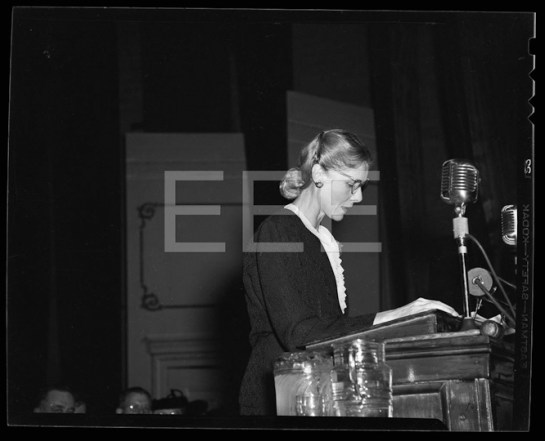
Clare Boothe Luce in New Jersey, 1944, 4×5 negative (sold for $9.99)
Good portrait… one of about a dozen photos of CBL in NJ…