Archive

exhibition

IMG_1969-2

IMG_1935-2

IMG_1931-2

IMG_1937-2

IMG_1938-2
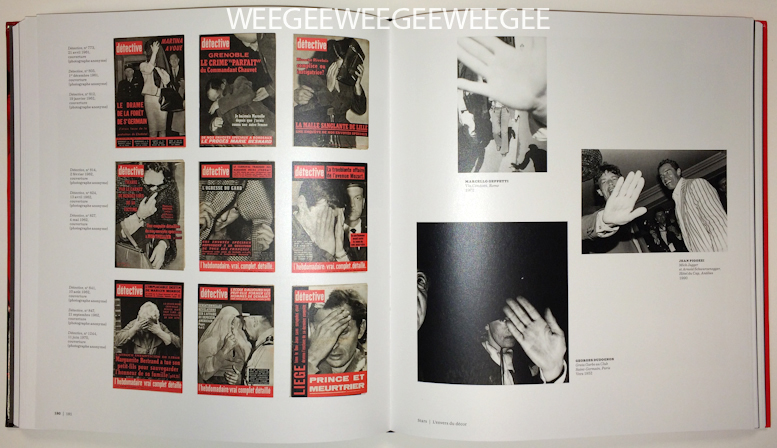
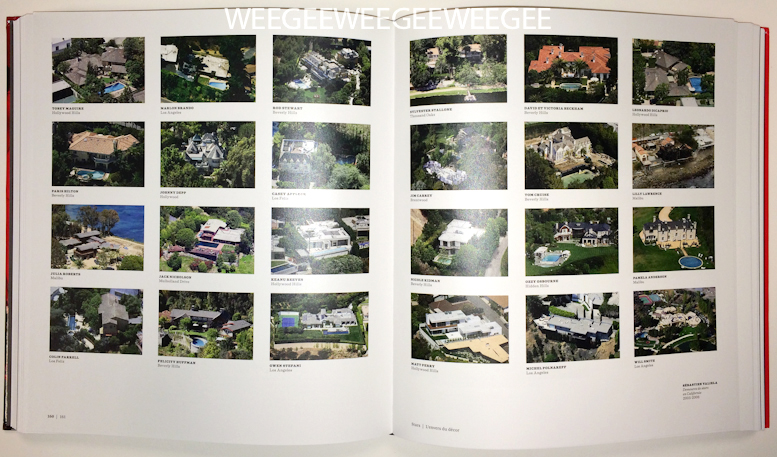
Paparazzi! Photographers, stars and artists, Centre Pompidou-Metz and Flammarion, 2014

Images are from the book Paparazzi! Photographers, Stars and Artists, a catalogue for the exhibition (February 26 to June 9, 2014) at the Centre Pompidou-Metz, published by Centre Pompidou-Metz and Flammarion.

“Centre Pompidou-Metz dedicates an unprecedented exhibition to the phenomenon and aesthetic of paparazzi photography through more than 600 works (photography, painting, video, sculpture, installation, etc.).
Covering fifty years of celebrities caught in the lens, Paparazzi! Photographers, stars and artists considers the paparazzo at work by examining the complex and fascinating ties that form between photographer and photographed, going on to reveal the paparazzi influence on fashion photography.
By associating some of the genre’s leading names, including Ron Galella, Pascal Rostain and Bruno Mouron, Tazio Secchiaroli, with reflections on this modern-day myth by Richard Avedon, Raymond Depardon, William Klein, Gerhard Richter, Cindy Sherman and Andy Warhol, Paparazzi! Photographers, stars and artists sets out to define the paparazzi aesthetic.”
From the Centre Pompidou-Metz website

Weegee was obviously not a Paparazzi, if the definition of Paparazzi is: “a freelance photographer who pursues celebrities to get photographs of them.” And Paparazzi is “mid 20th century: from Italian, from the name of a character in Fellini’s film La Dolce Vita (1960).” (Google definition)
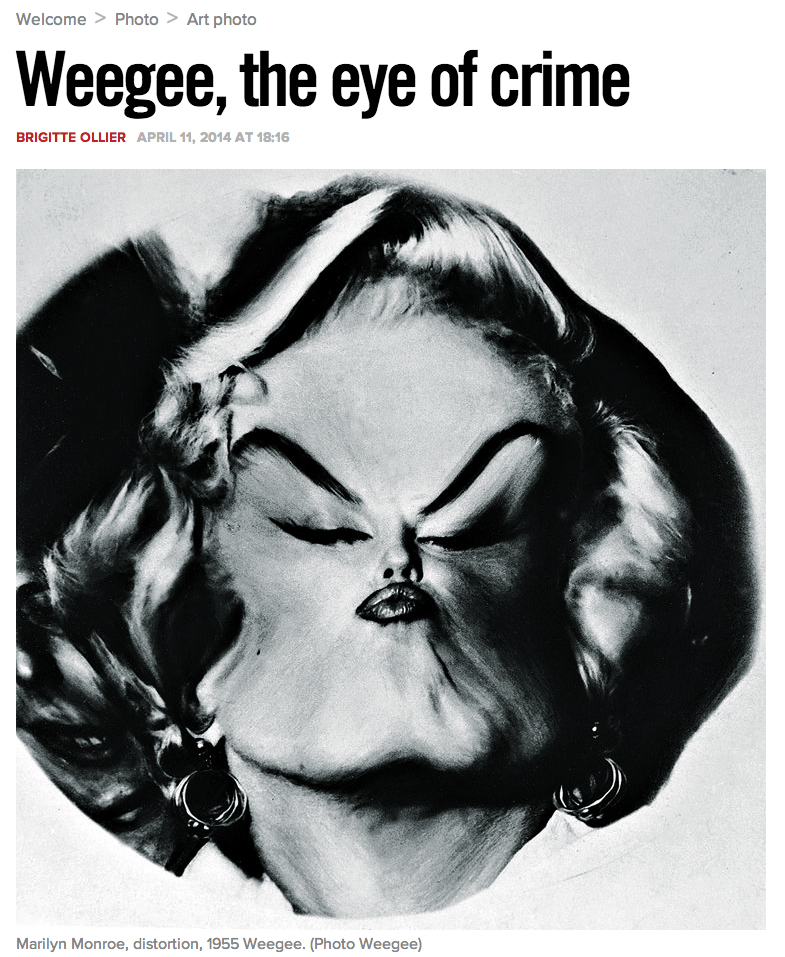
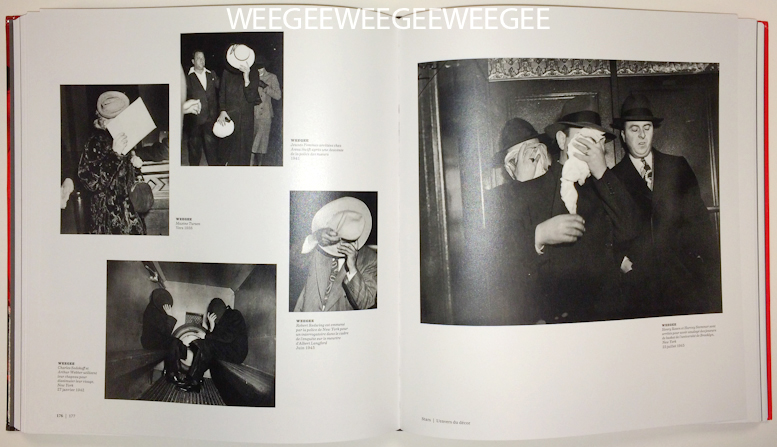
There are obvious similarities between Weegee’s photos of alleged criminals hiding their faces and photos of contemporary celebrities hiding their faces. Early in Weegee’s career he used a few Paparazzi-like tricks to photograph a few alleged criminals… With one or two exceptions, like kissing Dorothy Hart, Weegee was pretty tame towards celebrities. Weegee made caricatures of celebrities, he didn’t doggedly pursue them in real life…

“Seated in the chair was the handcuffed burglar. The minute he saw me, he covered up. Out of the side of his mouth, he said. “I don’t want my picture took!” (Such grammar!) But this guy was a hardened criminal and knew his rights. The cops couldn’t force him to pose for me. I put my camera down on a nearby desk, and said to no one in particular, “I’m going out to get a cup of coffee and a pastrami sandwich.” As I reached the door, I looked back. The guy was uncovered. The flash bulb went off when I pressed the remote control switch in my pocket, and I had my picture. When criminals tried to cover their faces it was a challenge to me. I litereally uncovered not only their faces but their black souls as well.”
Weegee by Weegee, p. 69

“I went into the basement where they were holding the girl [who was arrested for robbery]. As soon as she saw me, she covered up. “I just want to talk to you, lady,” I said. “I won’t take you picture unless I get permission.”
We talked. She wanted to know why she should let me take her picture so her friends could see her on the front pages of the papers. She was no dope, even if she had been caught. I argued with her: “Why don’t you let me take your picture? I’ll make you so glamorous, it’ll land you on the society page. You’ll get a lot of sympathy. Or, would you prefer that I get a rogues’ gallery picture from the cops with a number under it?” That was a lot of hooey, but I finally convinced her that it was the lesser of two evils to pose for me. This being a quiet Sunday night with the papers starved for pictures, I knew that I had a ready sale.”
Weegee by Weegee, pp. 69-70

IMG_8866-3z
New Yorker, Oct. 27, 2014
“Weegee steals it with a mysterious, nearly impenetrably inky picture of men warming their hands at a fire in an oil drum…”
Fellig the Zelig is the highlight of an experimental, abstract photography exhibition…
(Keith De Lellis Gallery, “Experiments in Abstraction,” Sept 18 – Nov 8, 2014)

Le Monde.fr
April 11, 2014

(Great Google translation)

“The eye scoundrel Weegee”

“It is always a pleasure to find Weegee, the night owl who photographed crimes and settling of accounts, suicides and bastons in New York of the 1930s and 1940s. His keen eye did fly, as its black humor : letters and signs in the city manage to drag in the image blink of an eye the macabre corpse that just to cool .
Gallery Blue sky in Lyon , favored in the collection of Michel and Michèle Auer, images that show Weegee, paparazzi and see , was also a portraitist – especially with an amazing series of photos prostitutes, gangsters or Mafia … taken in the paddy wagon.”

“Weegee the Famous. Black photography” on gallery Blue sky, 12, rue des Whimsical, Lyon 1. Tel. : 04-72-07-84-31. Until June 21

weegee-le-monde
Screen shot from Le Monde.fr

weegee-liberation2
(Screenshot from liberation.fr)

From Liberation.fr, April 11, 2014

Google translation:

American photographer is honored to Toulouse.
Weegee, born Arthur H. Fellig, is not a paparazzo, he values ​​and sense of justice. This does not prevent strafe like hell and order crime scenes to his liking. Nobody arrives at the ankle and the history of photography, without him, would be sad to die. Sometimes reduced to a vampire attracted by blood, Weegee (1899-1968) immortalized the New York injustice, racial segregation (photo of a cinema cut in half), those who sleep on the floor and the rich parading as these men back, wearing high-hat, straight out of a painting by Caillebotte.

Weegee was a surefire thing, a sudden flash of his signature to Zorro, which turns any moment into hallucination. His Chevrolet coupe, equipped with a radio plugged into the police frequencies, allowing it to be the first on the scene of various facts, photographs faster than his shadow and be the headlines. Nothing can resist him or the guys or Marilyn Monroe. It is a crazy and daring plays, on occasion, its role mortician paper with panache. In a hundred photographs, the Water Tower offers the best of the American Stanley Kubrick loved and who was set photographer for Dr. Strangelove.

Weegee Gallery Water Tower, 1 place Laganne, Toulouse (31). Until May 18 Rens. :
galeriechateaudeau.org
(video interview, conference audio, and educational kit).

Liberation article here…

weegee-liberation1
(Screenshot from liberation.fr)

photo1-2
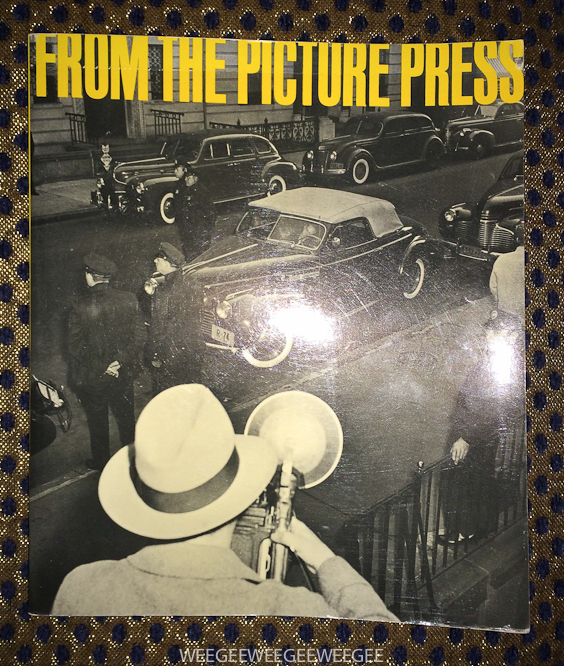
Cover, “Caption not available. (Harry Maxwell shot in car.)”

photozz-2
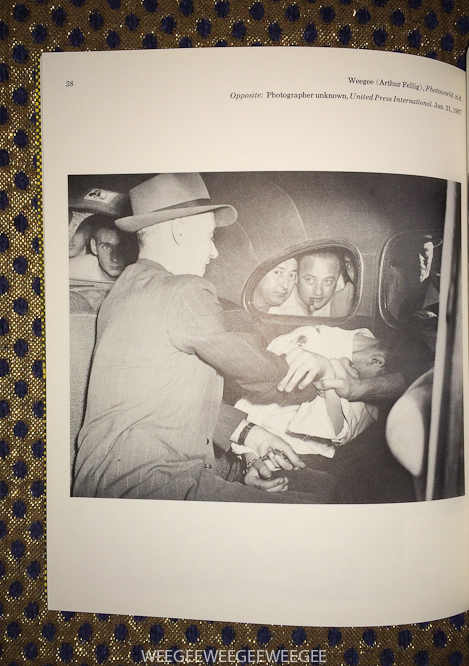
p. 28 “Caption not available. (Auto thief arrested, car crashed, one killed.)”

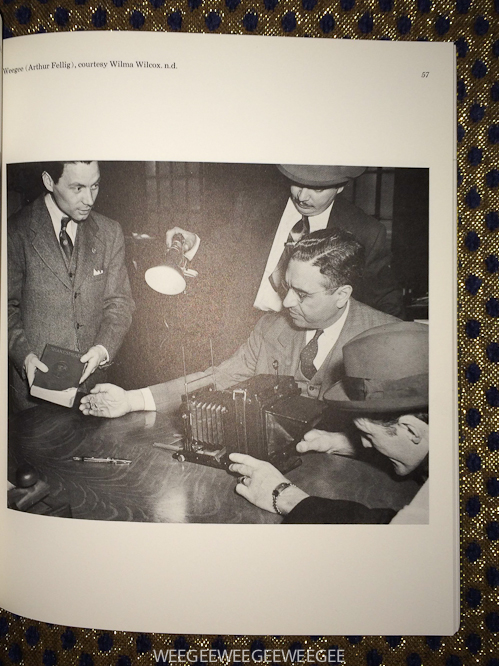
photo2-2
p. 57 “Caption not available.”

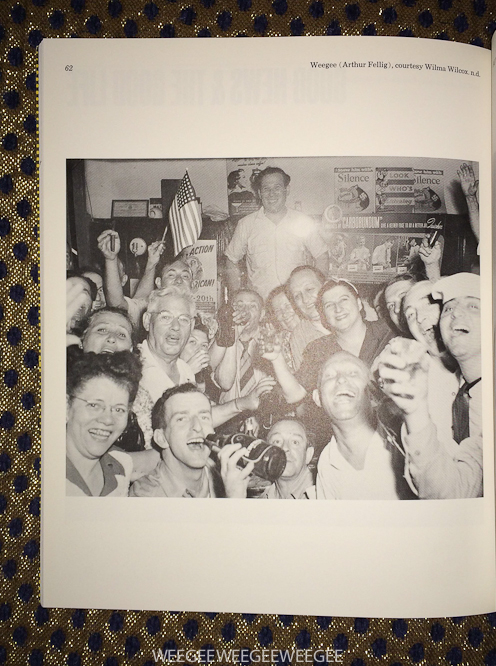
photo4-2
p. 62 “Caption not available. (Free drinks, World War II celebration in hardware store, Delancey St.)”

From the Picture Press, MoMA, 1973
“A major portion of the preliminary picture research was done by the late Diane Arbus and by Carole Kismaric. The quality of the pictures reproduced here is in large measure a tribute to their eyes and understanding…”

Strangelove’s Weegee, June 14 – July 26, 2013

“Rare set of Weegee photographs on view at Presentation House.”
Interview with the curator here…

“He was working with a Speed Graphic and so you were limited in the number of photographs you could take. He was working with flash because that had been insisted upon by Kubrick. On the set every time he took a photograph you had a little mini atomic explosion going off. I think that’s one of the reasons he got invited on the set because Kubrick wanted him to take flash photographs. He didn’t have to by that time because the technology had changed. He was using flash with a Speed Graphic 4 by 5 camera and you couldn’t take a lot of photographs with that because you had to change the plate and put in another bulb.”

(Perhaps Weegee was really using a 2 1/4 Rolliflex camera. Perhaps in 1963 Weegee was not using a 4 x 5 Speed Graphic; the negatives are 120mm…)

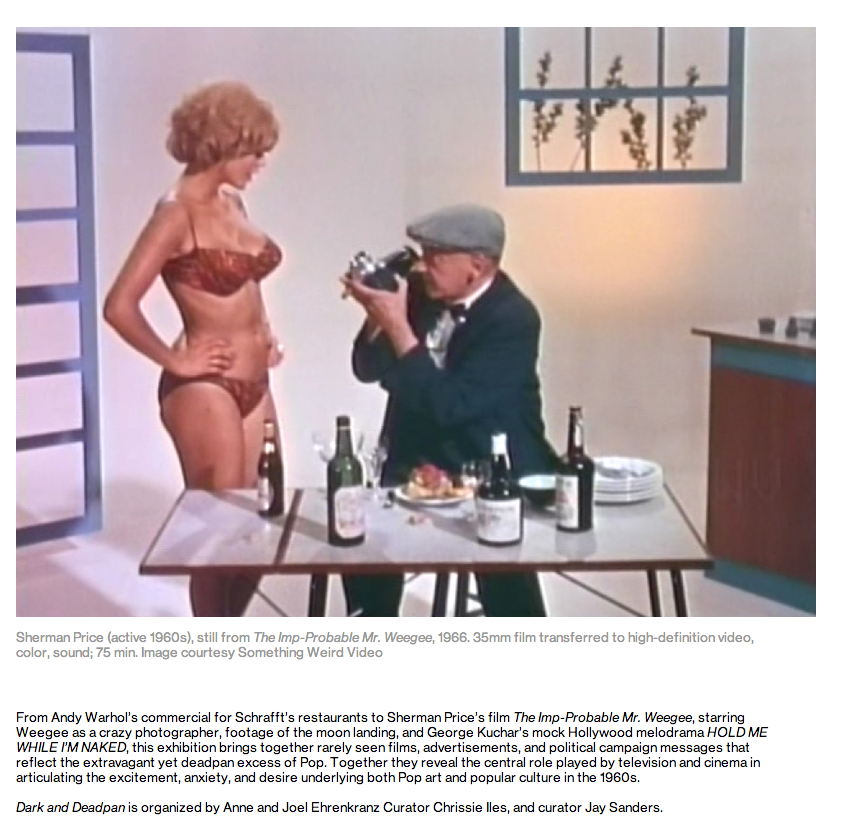
1963? In the UK? Unstrangelove…