

(No Weegee photos…)
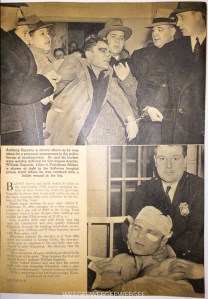
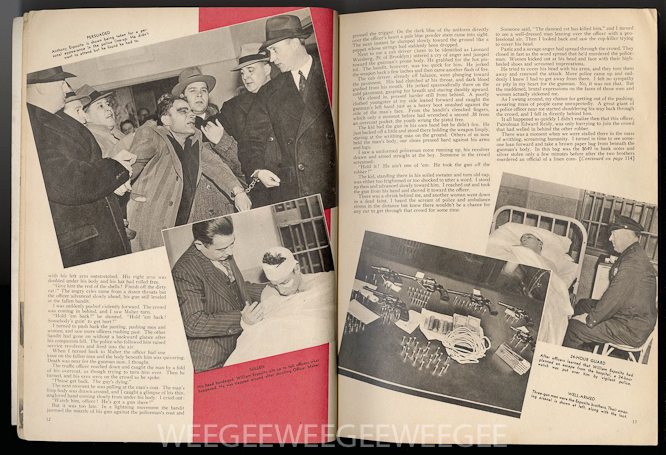
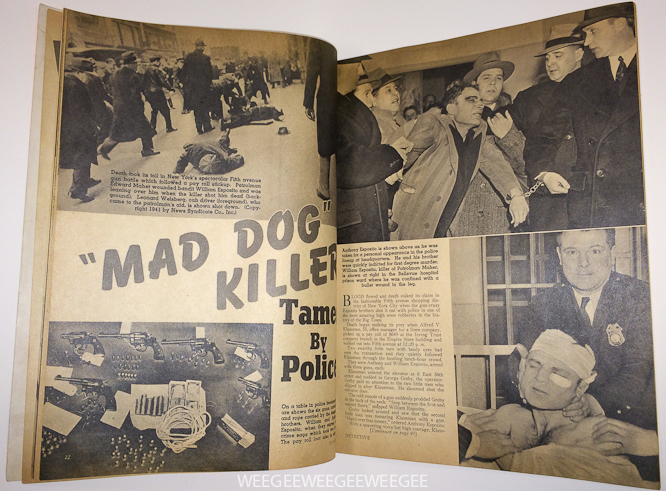
“Anthony Esposito is shown above as he was taken for a personal appearance in the police lineup at headquarters. He and his brother
were quickly indicted for first degree murder. William Esposito, killer of Patrolman Maher, is shown at right in the Bellevue hospital prison ward where he was confined with a bullet wound in the leg.
BLOOD flowed and death staked its claim in the fashionable Fifth avenue shopping district of New York City when the gun-crazy Esposito brothers shot it out with police in one of the most amazing high noon robberies in the history of the Big Town.
Death began stalking its prey when Alfred V. Klausman, 55, office manager for a linen company, picked up a pay roll of $649 at the Irving Trust company branch in the Empire State building and walked out into Fifth avenue at 12:20 p.m.
Two swarthy little men with beady eyes had seen the transaction and they quietly followed Klausman through the bustling lunch-hour crowd.
They were Anthony and William Esposito, armed with three guns, each. Klausman entered the elevator at 6 East 34th street and nodded to George Greby, the operator. Greby paid no attention to the two little men who slipped in after Klausman. He slammed shut the elevator door.
The cold muzzle of a gun suddenly prodded Greby in the back of the neck. “Stop between the first and second floors, snapped William Esposito.
Greby looked around and saw that the second little man was menacing Klausman with a gun. “Hand over that money‚ ordered Anthony Esposito.
With a quavering voice but high courage, Klaus-
[Continued on page 49]
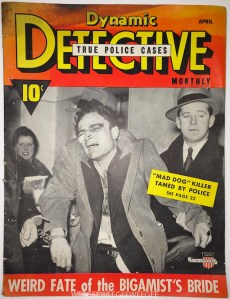
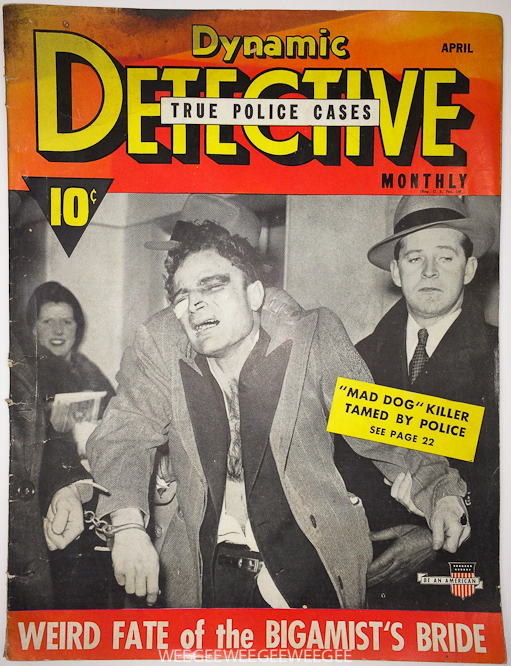
“Mad Dog” Killer Tamed by Police
[Continued from page 23]
man refused. Anthony; jabbed him viciously with the gyn muzzle.
“Come on,” he snarled. “Turn it over.”
“You won’t get it,” Klausman cried.
The roar of a shot from Anthony’s gun filed the elevator. Klausman slumped to the floor, a bullet hole drilled through his forehead. William Esposito’s hands were clawing at him almost before life left his body. When William rose he held the pay roll sack.
Gerby, stunned by the brutality of the crime, heard one of the bandits order him to stop at the second floor. He obeyed automatically and the duo leaped out.
“Go up to the roof with this car and keep your mouth shut,” was the next command. Then, as elevator door closed, leaving them alone with their loot, Anthony and William lost their heads. They ran down the single flight of stairs and rushed out of the building.
_ Pedestrians 34th street. Screams arose. Hounded and frantic the Espositos plunged into Altman’s department store on the north side of the street. Women shoppers scrambled out of their way as they tore through the busy aisles, turned right and headed for the Madison Avenue exit.
Two doormen took up the chase. Officers on duty at Fifth avenue who had heard the shot which killed Klausman, rushed through the store in hot pursuit.
Bursting through the Madison Avenue exit, the Espositos leaped into a parked taxicab. Driver Isidore Eder looked up, amazed, into two gun muzzles and heard the order. “Get this cab going or else!”
Eder saved his own life by starting his motor, then endangered it a second later by deliberately turning his cab so that it was blocked by a bus. Cursing but holding their fire, the two gunmen leaped out and began racing up the avenue toward 35th street.
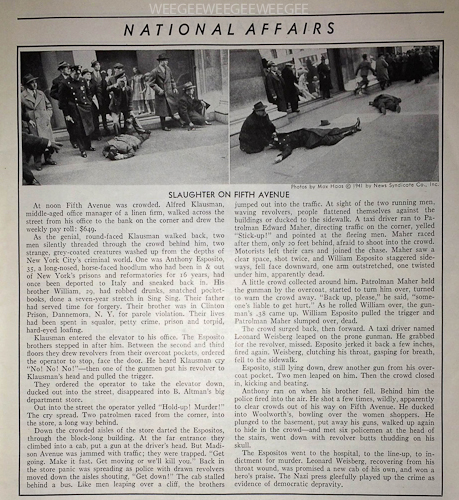
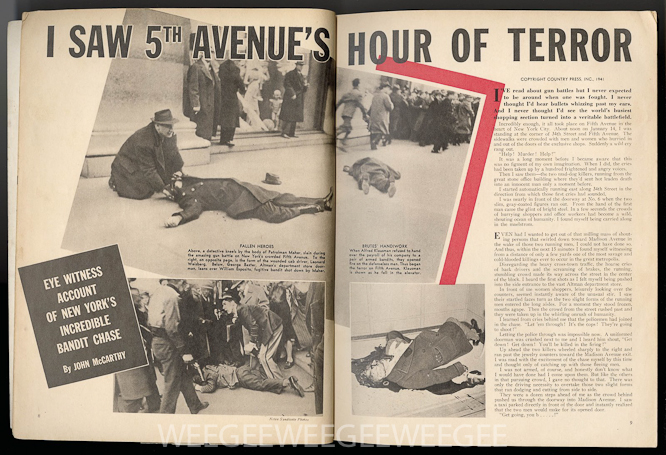
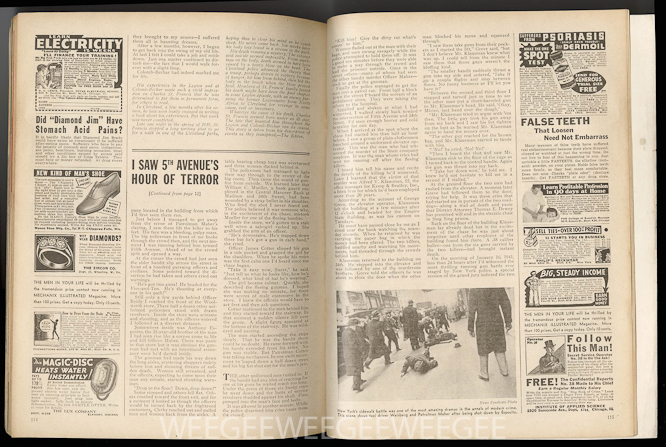
They were not fast enough. Traffic Patrolman Edward Maher, 52, who had left his post a block away, was closing in. As the fleeing brothers turned the corner and dashed into 35th street, Maher began firing. As pedestrians and cars swerved out of the way, Maher saw a clear opening, aimed and fired. Halfway down the block. William Esposito pitched forward on his face, a bullet through one of his legs.
Anthony kept on running as several officers took up the pursuit, but Patrolman Maher paused by the side of the man he had dropped. William was lying quiet but did not seem to be unconscious. Maher waved back the crowd which had gathered, then pulled at the wounded man’s greatcoat to turn him over. William Esposito turned over with suspicious ease. From under his body he pulled a .38 revolver. It flashed up and belched flame against the blue of the officer’s uniform. Maher slumped.
“Eddie” Maher had been a popular officer among the cabbies in that stretch of mid-town New York. Leonard Weisberg, 39, one of the cabbies who knew him best, did not hesitate when he saw Maher fall. He rushed forward, unarmed.
William Esposito’s gun cracked. Weisberg staggered back with a bullet in his throat. Once more the maniacal little bandit pressed the trigger and this time William C. Mueller, a bank guard, was whirled about by the impact of a slug which bit into his shoulder.
The crowd answered William’s madness with a fury of its own. Truck drivers, doormen, office workers and nondescript citizens closed in with a single impulse, seized the hoodlum’s pistol and overpowered him. Police had to rescue him from their pounding hands and feet.
As William cringed in imprisoning arms, his brother, Anthony, headed in frantic flight toward Fifth avenue. Officers pounded after him, firing into the air. Anthony cleared pedestrians from his path by firing an occasional shot in return. Then he reached a Woolworth five-and-ten and charged through the door. His precious pay roll sack was stuffed into his pocket and in each of his hands was a revolver. Six officers followed him into the store.
Bedlam reigned. Women shoppers screamed, rushed in groups toward the exits or threw themselves on the floor in their efforts to evade the chase which moved with unbelievable swiftness from one aisle to another. Anthony managed to
get into the store basement, then made the mistake of coming up again. An avalanche of bluecoats floored him. officers took two guns from him. He broke loose and squirmed along the floor until he was again overpowered. A third gun was found sewn in a pocket in his trouser leg. His police captors fended off infuriated women who were striking at the gunmen with fists and handbags, then handcuffed him.
Fifteen minutes had passed since the saga of death had begun.
Then Anthony and William Esposito were taken away and the voice of midtown New York subsided to its usual dull rumble.
In Bellevue hospital where he lay in bed behind stout bars and latticed windows, the wounded William snarled rebelliously when a priest was brought in to see him.
“I quit talking to you guys years ago.” he said.
Anthony, placed in a police lineup, alternately cursed and cringed. In court, he tried to play idiot, an obvious preparation for an insanity defense. While District Attorney Dewey moved to indict the two killers for first degree murder, Patrolman Maher was given a commissioner’s funeral by his comrades on the force. His friend, Leonard Weisberg, passing the critical stage of his wound with the aid of blood transfusions, was tendered $1,000 by the police and was rewarded with a new taxicab for his bravery.
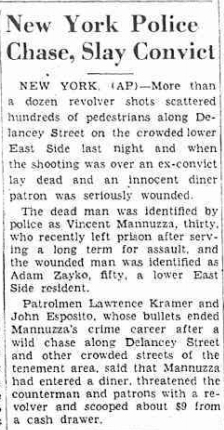
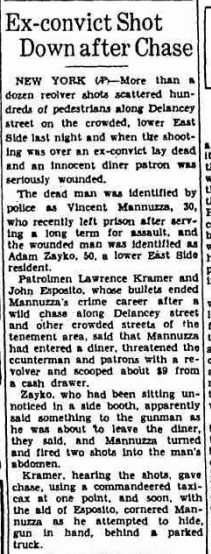
The murder spree of the Espositos, had climaxed dual careers of crime since childhood. Anthony, 35, deported in 1936 after serving a prison term for robbery had returned to the United States illegally and was being sought by immigration authorities at the time of his bloody raid. William, 29, who once had tried to kill a detective, was wanted for parole violation when he teamed with his brother to turn Fifth avenue into a battlefield.
When the New York grand jury voted first degree murder indictments against the brothers Esposito in the record time of 20 minutes, Assistant District Attorney jacob rosenblum commented:
“Those two men are the most vicious and dangerous bandits that have ever walked the streets of New York. They are walking arsenals of destruction.”






















 WEEGEEWEEGEEWEEGEE