

PM, September 1, 1940, pp. 44-47
“What Goes on in Chorus Girls’ Dressing Rooms?”
Words and photos by the great Mary Morris…

PM, September 1, 1940, pp. 44-47
“What Goes on in Chorus Girls’ Dressing Rooms?”
Words and photos by the great Mary Morris…

PM, July 22, 1940, pp. 16-17
We just stumbled on this classic post:
(first drafts)
There were a number of attempts by Weegee to make the famous Coney Island photo…
Here are some of them:

PM June 17, 1940, pp.16-17
(The first draft of the first draft of the first draft of history…)


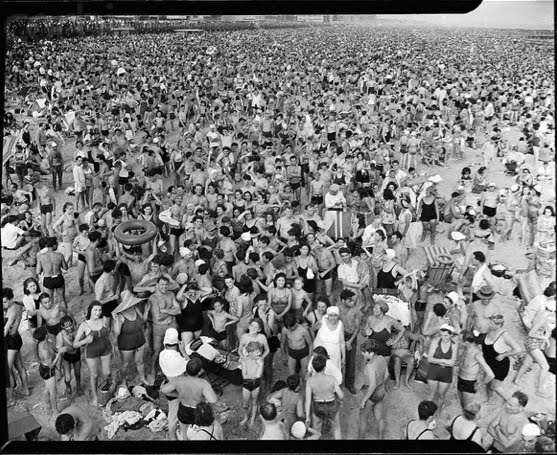
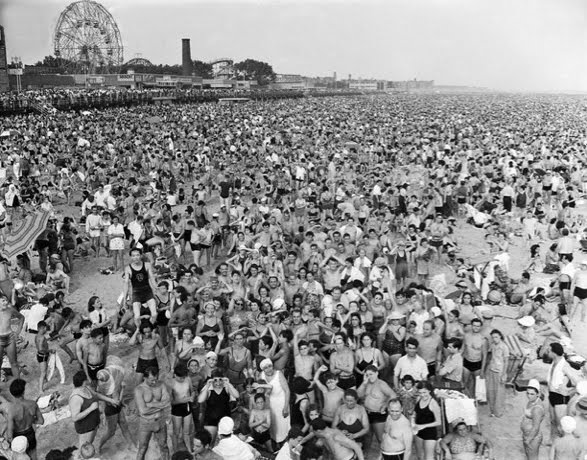

Weegee’s photos of the crowd at Coney Island, presumably made on July 21, 1940 (perhaps in chronological order)…
The number of variants, or number of exposures, or photos that Weegee made of the same scene is something that interests us a great deal. The version of this photo that was published in PM on July 22, 1940, is not the same photo that appears in the all of the Weegee books, from Naked City to Weegee’s World… A prominent photo agency (Corbis) has a number of variations on their web site…
An early “version” of, or attempt at, this photo was published in PM on June 17, 1940, in a trial or test version of the paper, a day before PM started publishing, a day before Volume one, Number one…
Perhaps today marks the 70th anniversary of the publication of Naked City. To commemorate this historic event… Starting with what might be the first “rave notice” in print:

PM, July 18, 1945
LETTERS From the Editor
Rave Notice
“There’s a new book in the stores today by Weegee, who bills himself as “the famous” – and is.
It’s a book of pictures – pictures such as you’ve never seen before, except maybe in PM. It is called Naked City, published by Essential Books, sells for $4 – and is worth it.
I’ve been through my copy now three times, and every trip there’s something new.
The book is a collection of the better pictures Weegee has taken in the years he has spent as a freelance photographer, mostly of murders and fires, but sometimes of love. Many of them have appeared as news pictures in PM, and you’ll remember some of them – certainly the ones of Joe McWilliams, the Nazi lover, with the rear end of his horse, and Mrs. George Washington Kavanaugh with the late Lady Decies and their jewels at the opera.
It is unfair to use a single illustration as typical, but I’m using the one in the next column of the Bowery floozy’s gam because I like it, and because I like Weegee’s caption: Ladies keep heir money in their stockings…
Weegee is a rumpled, heavy-set, cigar-smoking man with a camera who lives with one ear at a police radio. He rather likes to pass himself off as a character. He is, but not exactly the same one.”
-John P. Lewis
PM, July 18, 1945, p. 19
Naked City by the numbers:
Inspired by the quote: “Many of them have appeared as news pictures in PM” and being naturally curious, we decided to investigate the publication history of the photos in Naked City.
Naked City: 246 pages with 247 photos
Photos published before their publication in Naked City:
78 photos were published in PM
6 significant variant photos were published in PM
4 photos were published in The New York Daily News
3 photos were published in Life
2 photos were published in The New York Post
1 photo was published in The New York Herald Tribune
The earliest photo that we could conclusively date in a publication is “Balcony Seats at a Murder,” published in the New York Post, on Nov. 17, 1939.
The latest photo that we could conclusively date in a publication is “Opening Night at the Opera,” published in PM, on December 3, 1944.
To be continued…


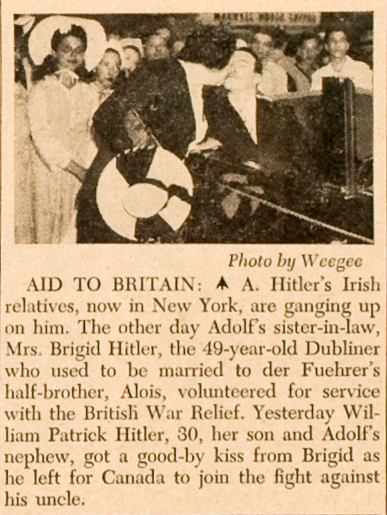
PM, June 30, 1941 (74 years ago yesterday.)
The Record of a New York Day
A freak, mid-afternoon electrical storm came, went and left the city still hot and perspiring. The hottest temperature was 88 degrees, and, according to the Weather Bureau, it ought to be about the same today. A woman, Ida Bogart, 25, was killed yesterday at Nanuet Lake, N.J. when lightening struck a tree under which she had taken shelter.
Luckily for resorts, the rain was restricted mostly to the Bronx and Washington Heights. There wasn’t even a drizzle at Coney Island, which drew 1,000,000 visitors. Despite the heat, only 75,000 of Coney’s million went into the water. The remaining 925,000, however, found other forms of amusement.
ATTEMPTED HOLDUP: Just about a half-hour before this picture was taken, Michael Reilly, 23-year-old paroled convict, shown here with Patrolman Thomas Henry, was standing up. According to the police, Reilly, who still “owes” eight years at Danemora [Danemora! That’s a coincidence…] for a previous hold up, tried yesterday to hold up a bartender at a tavern at 750 Tenth Ave., near 54th Street. While Reilly brandished two guns, a patron slipped out and called patrolman Henry, attached to the 54th Street station. The policeman shot the bandit in the chest. Photo by Weegee
AID TO BRITAIN: A. Hitler’s Irish relatives, now in New York, are ganging up on him. The other day Adolf’s sister-in-law, Mrs. Brigid Hitler, the 49-year-old Dubliner who used to be married to der Fueherer’s half-brother, Alois, volunteered for service with the British War Relief. Yesterday William Patrick Hitler, 30, her son and Adolf’s nephew, got a good-by kiss from Brigid as he left for Canada to join the fight against his uncle. Photo by Weegee

PM, June 21, 1940 (drawings by Mervin Jules)
“20,000 Homeless Crowd Parks”
“In Union Square Park scores of men, with no beds of their own, sleep, talk, think. Inscription above them reads: ‘How little do my countrymen know what precious blessings they are in possession of and which no other people enjoy.'”


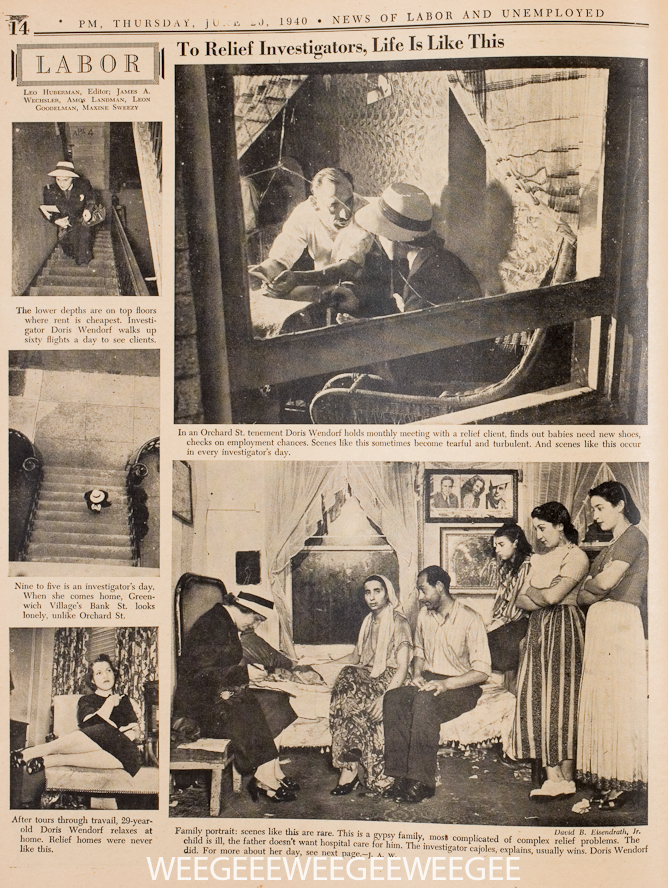


PM, June 20, 1940 (photos by David B. Eisendrath, Jr)
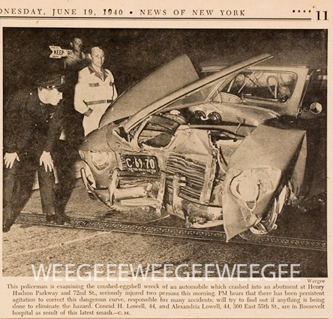
PM, June 19, 1940
“This policeman is examining the crushed-eggshell wreck of an automobile which crashed into an abutment at Henry Hudson Parkway and 72nd St., seriously injured two persons this morning. PM hears that there has been persistent agitation to correct this dangerous curve, responsible for many accidents; will try to find out if anything is being done to eliminate the hazard. Conrad H. Lowell, 44 and Alexandria Lowell, 44, 360 East 55th St., are in Roosevelt hospital as a result of this latest smash – C.M.”
Perhaps the first Weegee photo in PM (excluding the preview issues)…
This photo is republished in PM on July 21, 1940:
“I also hated automobile accidents, but about those I did something. There was a real death trap on the West Side Highway at Seventy-second Street. Cars would hit the abutments, and some would come crashing down into the streets below. I made a series of pictures of the accidents there, and the newspaper PM ran a whole page and started a campaign. Finaly, the city put red lights on the unmarked abutments, and the accidents stopped. This work I consider my memorial.” Weegee by Weegee, pp. 68-69
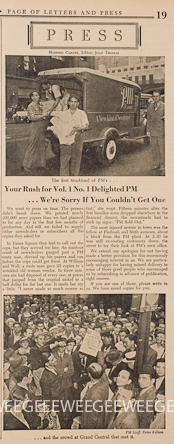
PM, June 19, 1940 (Photos by Peter Killian)
Your Rush for Vol. 1 No.1 Delighted PM
… We’re Sorry If You Couldn’t Get One
We went to press on time. The presses didn’t break down. We printed nearly 200,000 more papers than we had planned to for any day in the first few months of production. And still we failed to supply either newsdealers or subscribers all the copies they asked for.
In Times Square they had to call out the cops, but they arrived too late. An insistent crush of newsdealers ganged past a PM route man, divvied up his papers and ran before the cops could get there. At William and Wall, a route man gave 25 copies to a wrinkled old woman vendor. In three minutes she had disposed of every one, at prices that jumped from the original nickel to a half dollar for the last one. It made her cry a little “I never made so much money so fast,” she wept. Fifteen minutes after the first bundles were dropped elsewhere in the financial district, the newsstands had to stick up signs: “PM Sold Out.”
The most injured newsie in town was the fellow at Flatbush and Sixth avenues, about a block from the PM plant. At 2:30 he was still re-routing customers down the street to try their luck at PM’s own office.
We extend our apologies for not having made a better provision for this enormously encouraging interest in us. We are particularly unhappy for having missed delivery to some of those good people who encouraged us by subscribing in advance of publication, sight unseen.
If you are one of those, please write to us. We have saved copies for you.

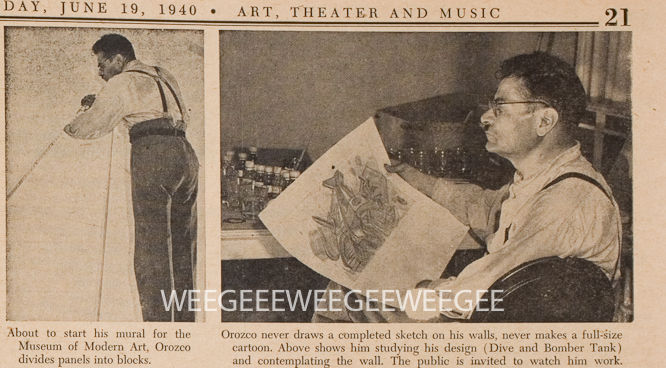
“About to start his mural for the Museum of Modern Art, Orozco divides panels into blocks.
Orozco never draws a completed sketch on his walls, never makes a full-size cartoon. Above shows him studying his design (Dive and Bomber Tank) and contemplating the wall. The public is invited to watch him work.”
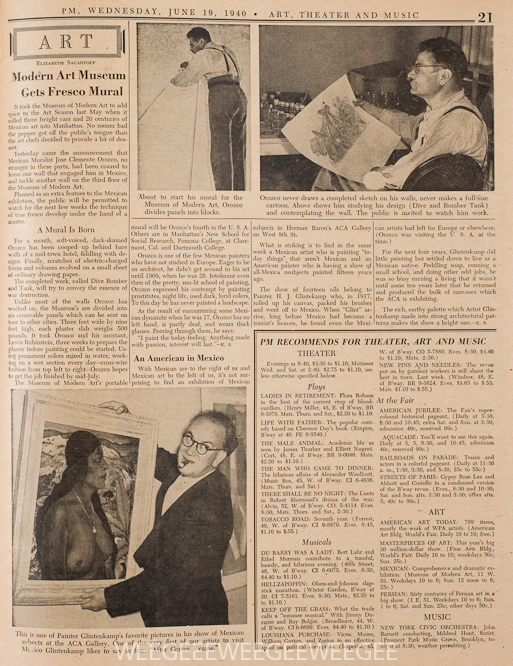


PM, June 19, 1940
PM, WEDNESDAY, JUNE 19, 1940
ELIZABETH SACARTOFF
Modern Art Museum
Gets Fresco Mural
It took the Museum of Modern Art to add spice to the Art Season last May when it rolled three freight cars and 20 centuries of Mexican art into Manhattan. No sooner had the pepper got off the public’s tongue than the art chefs decided to provide a bit of dessert.
Yesterday came the announcement that Mexican Mura1ist Jose Clemente Orozco, no stranger in these parts, had been coaxed to leave one wall that engaged him in Mexico, and tackle another wall on the third floor of the Museum of Modern Art.
Planned as an extra feature to the Mexican exhibition, the public will be permitted to watch for the next few weeks the technique of true fresco develop under the hand of a master.
A Mural Is Born
For a month, soft-voiced, dark-skinned Orozco has been cooped up behind bare walls of a mid-town hotel, fiddling with designs. Finally, scratches of electric-charged forms and volumes evolved on a small sheet of ordinary drawing paper.
The completed work, called Dive Bomber and Tank, will try to convey the essence of war destruction.
Unlike most of the walls Orozco has worked on, the Museum’s are divided into six removable panels which can be sent on tour to other cities. Three feet wide by nine feet high, each plaster slab weighs 500 pounds. It took Orozco and his assistant, Lewis Rubinstein, three weeks to prepare the plaster before painting could be started. Using permanent colors mixed in water, working on a wet section every day – cross-wise fashion from top left to right – Orozco hopes to get the job finished by mid-July.
The Museum of Modern Art’s portable mural will be Orozco’s fourth in the U. S. A. Others are in Manhattan’s New School for Social Research, Pomona College, at Claremont, Cal. and Dartmouth College.
Orozco is one of the few Mexican painters who have not studied in Europe. Eager to be an architect, he didn’t get around to his art until 1909, when he was 26. Intolerant even then of the pretty, sun-lit school of painting, Orozco expressed his contempt by painting prostitutes, night life, used dark, lurid colors. To this day he has never painted a landscape.
As the result of encountering some Mexican dynamite when he was 17, Orozco has no left hand, is partly deaf, and wears thick glasses. Peering through them, he says:
“I paint the today feeling. Anything made with passion, interest will last.”- E. S.

PM, June 18, 1940 (drawings by William Sharp)
“A PM Artist Views a Murder, Inc. Trial”
 WEEGEEWEEGEEWEEGEE