Weegee’s ULAN, from getty.edu

“Weegee used a 4×5 Speed Graphic press camera and flash exclusively throughout his career; and is not known for his printing virtuosity, but for the elements of social critique in his photographs.” Perhaps the most interesting sentence and it could be updated…

Every word below is copied from this website:

http://www.getty.edu/vow/ULANFullDisplay?find=weegee&role=&nation=&prev_page=1&subjectid=500032312

Weegee (American photographer, 1899-1968, born in Poland)

Note: American photographer, active in New York City and Hollywood. Arthur Fellig, known as Weegee professionally, is noted for his photographs depicting crime and other newsworthy events, usually taken at night. His early career was spent as a freelance press photographer. He prided himself on his ability to arrive at the scene of a crime before the police, and derived his name from the phonetic pronunciation of the Ouija board. He sold his images to tabloid newspapers from 1935 through the 1940s, and published his first book, Naked City in 1945, followed by Weegee’s People in 1946. Naked City was a commercial success and guaranteed his income. At this point he began taking portraits of celebrities and figures in the entertainment industry. He used a variety of trick lenses to distort and manipulate these images, and often exposed or exagerrated the imperfections of his subjects. He experimented with infrared film and flash to make exposures in darkness, particularly of people in darkened movie theaters. Weegee used a 4×5 Speed Graphic press camera and flash exclusively throughout his career; and is not known for his printing virtuosity, but for the elements of social critique in his photographs. He was a flamboyant character, and revelled in his own notoreity and mythology.

Names: Weegee (preferred,V,display,LC) Fellig, Arthur H. (V) Fellig, Arthur (V) Weegee the Famous (V) Fellig, Usher (V) Weejee (U) Vig’i (U) Felig, Artur (U) Felig, Asher (U) פליג, אשר (U)

Nationalities:
American (preferred)
Polish
Eastern European
Central European
undetermined

Roles:
artist (preferred)
photographer

Gender: male

Birth and Death Places:
Born: Złoczew (Łódzkie voivodship, Poland) (inhabited place)
Died: New York City (New York state, United States) (inhabited place)

Biographies:

(American photographer, 1899-1968, born in Poland) ….. [VP Preferred]
(American (b. Poland), 1899-1968) ….. [JPGM]
(American photographer, 1899-1968) ….. [BHA]
(American photographer, 1899-1968) ….. [Grove Art]
(artist, 1899-1968) ….. [GRL]
(artist, active 20th century) ….. [GRISC]

Whitney Museum, August 7, 2016

A pair of Weegee distortions hanging out with the cool kids in the “Price of Fame” area in the “Human Interest: Portraits from the Whitney’s Collection” exhibition…
(Perhaps coincidentally, four out of four of the not-living-anymore, and four out of six of all the photographers on that wall, died in New York, NY…)

“Human Interest: Portraits from the Whitney’s Collection
April 2, 2016 – April 2, 2017”
“Human Interest: Portraits from the Whitney’s Collection offers new perspectives on one of art’s oldest genres. Drawn entirely from the Museum’s holdings, the more than two hundred works in the exhibition show changing approaches to portraiture from the early 1900s until today. Bringing iconic works together with lesser-known examples and recent acquisitions in a range of mediums…”
from Whitney website: whitney.org


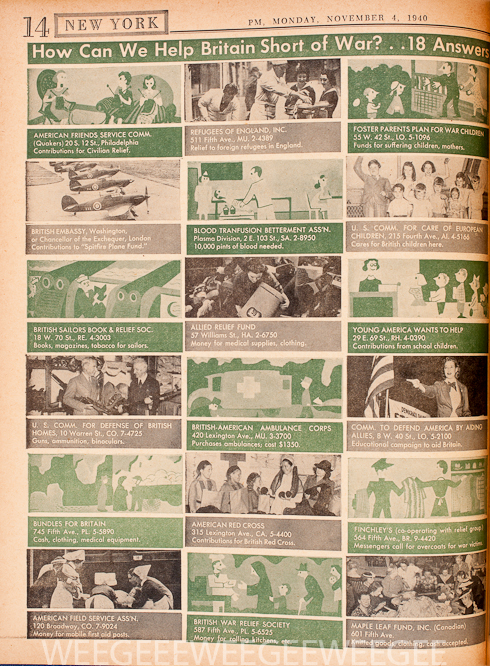
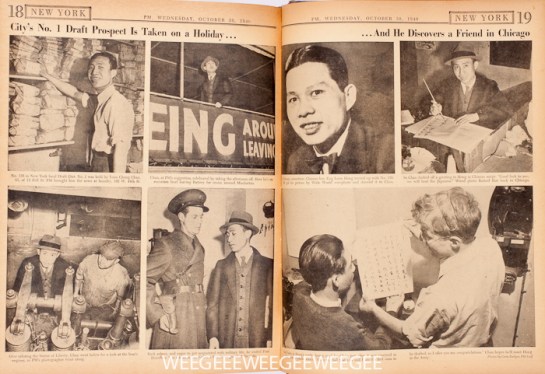
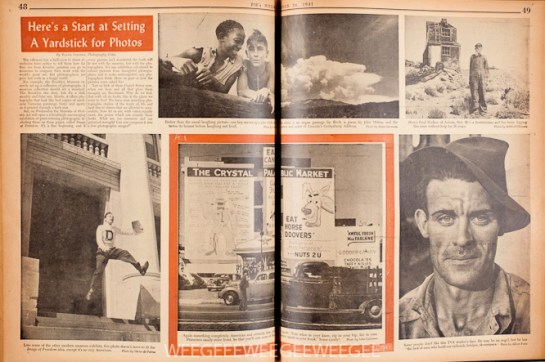
PM, August 17, 1942, pp. 8-9

Weegee Passes Up a Movie for a Holdup Alarm… And Gets This Group Portrait of Five Prisoners
“by Weegee”
“I was on the way to the Fifth Ave. Playhouse to see the movie, “Sins of Bali,” strictly a cheesecake affair, when I picked up a signal on my police radio for a holdup car. I went chasing after the car instead of going to the movie…”

“…Arrest didn’t dampen the spirits of Lillian and Pauline, 16 and 18, when they posed for this picture. Their companions, left to right, are Steve Samanek, 27, Raffael Martini, 18, and Baspay Cabrera, 23. Cabrera and girls worked outside, police say.”

(One of our favorite PM spreads. PM ran the better photo…)

IMG_8042

IMG_8043

IMG_8040b

New York Daily News, August 17, 1942
Stickup Quintet and Burglars: “These five youngsters have admitted that they are the stickup quintet that had police on the jump for a week. They’ve confessed to 20 robberies in the last seven days, which netted $1,500 in loot. Rear: Steve Samanek, Raffael Martini, Gaspay Cabrera,” Lillian Hornyak and Pauline Hornyak.”

“Sins of Bali,” “strictly a cheesecake affair…”
sins-of-bali2
North Tonawanda NY Evening News, November 1942

IMG_8215
Unknown Weegee

IMG_8219-2
Berinson book

(A slightly edited re-post.)

Our summer interns have been busy, they just created a Naked City map…

NAKED CITY. Photographs and Text by “Weegee.” New York: Essential Books. (246 pages with 247 photos.)

“Weegee by Weegee” at Fundación Foto Colectania
Barcelona, Spain
July 5, 2017 – November 5, 2017

110 Weegee photos…

“Weegee by Weegee”
Presentation of Weegee, the celebrated chronicler of New York’s darkest 1930s and 40s

The Weegee exhibition, produced by Foto Colectania and Banc Sabadell Foundation, brings together over one hundred photographs from one of the best photography collections in the world, M. + M. Auer from Switzerland, in a careful selection structured around Weegee’s books and press publications.

In the New York convulsion of the 30s and 40s, Weegee was a freelance graphic reporter who published in all the major newspapers and who turned crime into spectacle. Always alert, he carried in his car a radio tuned to the frequency of the police that allowed him to arrive the first to the scene of the crime. His technique, with hard backlights, gave the photos an aura of verismo and drama that continues to impact the viewer.

In his biography, Weegee explains: “My car became my home. It was a two-seater, with an extra large trunk. I saved everything there, an extra camera, flashlight bulbs, a typewriter, firefighter boots, cigar boxes, salami, infrared film to shoot in the dark, a change of underwear, uniforms, costumes and extra shoes and socks. (…) Since then I was no longer attached to the teletype of the police headquarters. I had wings. I no longer had to wait for the crime to come to me; I could go after him. Police radio was my way of life. My camera… my life and my love… it was my Aladdin lamp.”

The exhibition presents a careful selection of his work, showing images that range from crimes, fires or accidents to scenes of social and popular events, such as the conglomerations at Coney Island beaches or other leisure places of the New Yorkers of the time. Weegee could photograph a corpse, but also a masked ball or a solitary child; there is darkness in his photographs, but also tenderness. Nevertheless, one of the unique features of the exhibition is the display of original materials. Along with photographs by Weegee, the show will exhibit original materials such as newspapers and magazines in which Weegee’s photographs were published, like the original edition of “Naked City”, which was published in 1945 and immediately become a best seller…

Almost a century after his first photographs, Weegee’s work continues to excite both the public and the critic, thanks to his harsh and dramatic style, that he managed to reflect the society and nightlife of a city he knew better than anyone else.
Source: fotocolectania.org

For more info: fotocolectania.org


Inauguración de la exposición Weegee by Weegee. Colección M. + M. Auer

(Weegee talk from 18:39 – 26:00… A summary: L. Stettner trades 500 Weegee photos (and the work of other photographers, like Brassaï and Faurer) for one of Auer’s houses in Paris – “to exchange stones for paper” – at the end of the 1980s…)