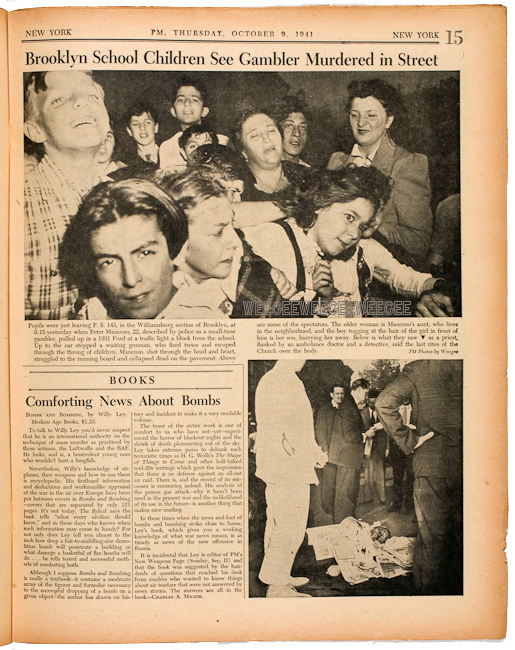
PM, October 9, 1941 p.15

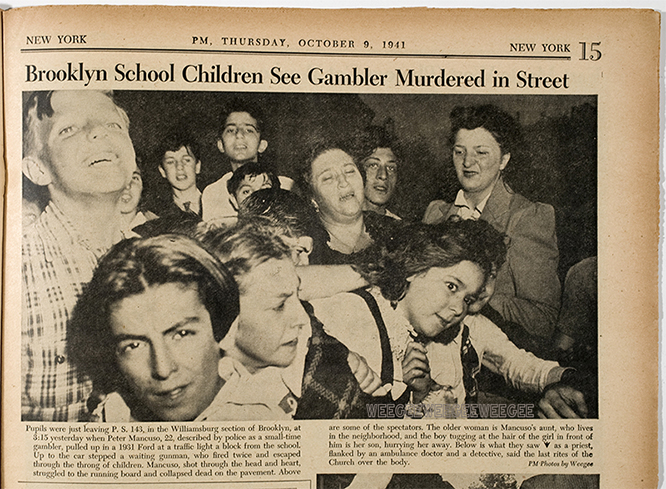
Brooklyn School Children See Gambler Murdered in Street

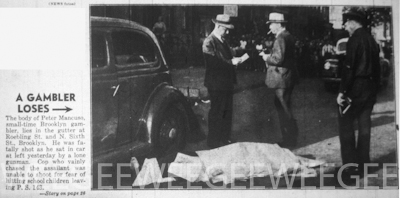
Pupils were just leaving P.S. 143, in the Williamsburg section of Brooklyn, at 3:15 yesterday when Peter Mancuso, 22, described by police as a small-time gambler, pulled up in a 1931 Ford at a traffic light a block from the school. Up to the car stepped a gunman, who fired twice and escaped through the throng of children. Mancuso, shot through the head and the heart, struggled to the running board and collapsed dead on the pavement. Above are some of the spectators…
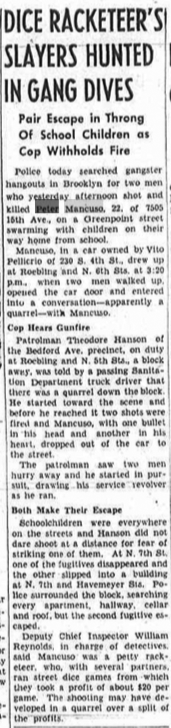

Brooklyn Eagle, October 9, 1941, p.3
IMG_7785-2

IMG_7797-2

IMG_7801-2
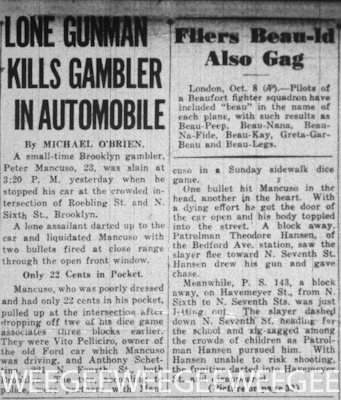
New York Daily News, October 9, 1941

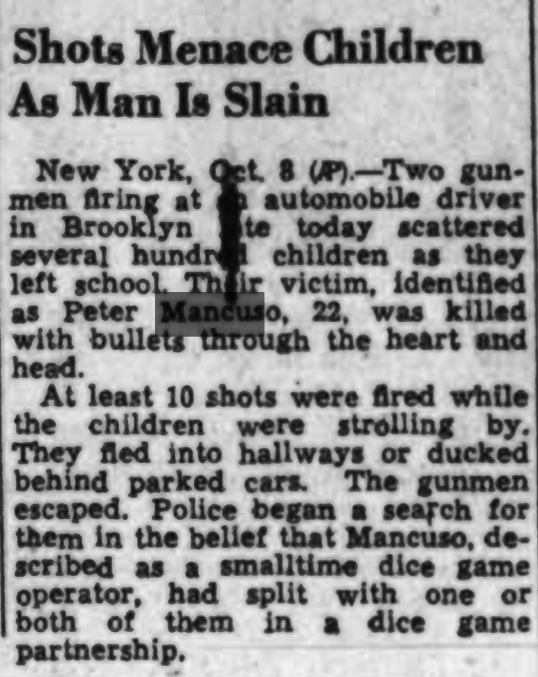
LONE GUNMAN KILLS GAMBLER IN AUTOMOBILE

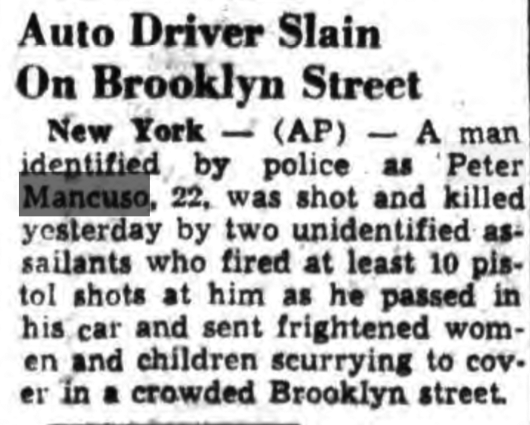
A small-time Brooklyn gambler, Peter Mancuso, 23, was slain at 3:20 P.M. yesterday when he stopped his car at the crowded intersection of Roebling St. and N. Sixth St., Brooklyn.

A lone assailant darted up to the car and liquidated Mancuso with two bullets fired at close range through the open front window…

One bullet hit Mancuso in the head, another in the heart. With a dying effort he got the door of the car open and toppled into the street…

Meanwhile, P.S. 143, a block away, on Havermeyer St., was just letting out. The slayer dashed down N. Seventh St. heading for the school and zig-zagged among the crowds of children… the fugitive darted into Havermeyer St. and disappeared.
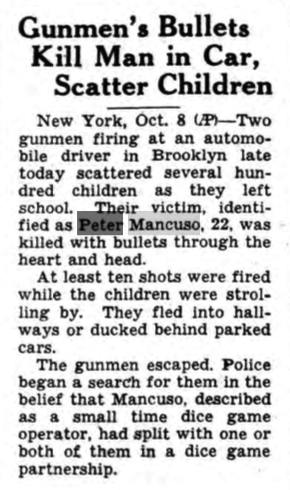

Buffalo Courier Express, October 9, 1941, p.1

Washington Post, October 9, 1941

The Knickerbocker News, October 9, 1941, p.9


“I Know Why (And So Do You)”; Carl Hoff and his Orchestra; Tony Russell; Gordon; Warren; Okeh (6478); Publication date: October 9, 1941


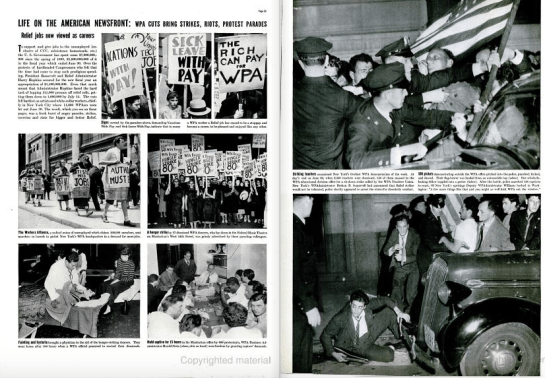
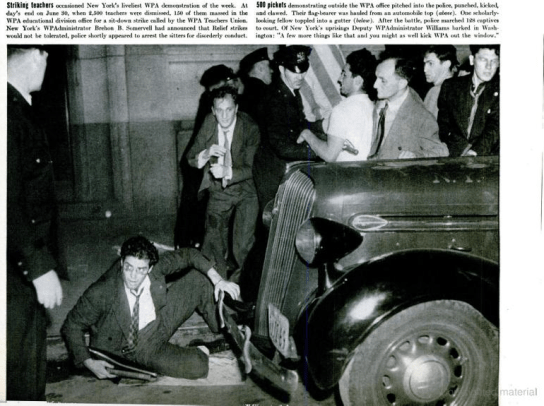
Life, August 23, 1937, p. 24

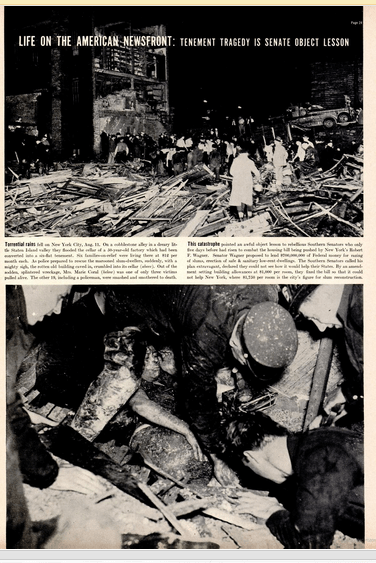
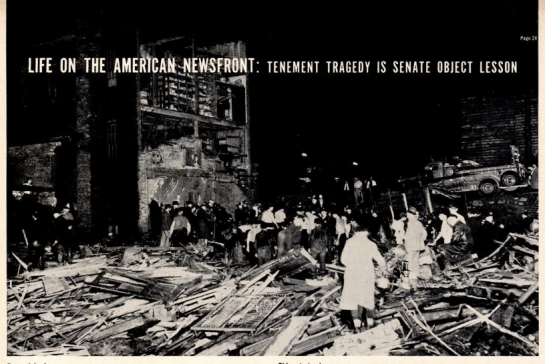
Life on the American Newsfront: Tenement Tragedy is Senate Object Lesson

Torrential rains fell on New York City, Aug. 11. On a cobblestone alley in a dreary little Staten Island valley they flooded the cellar of a 50-year-old factory which had been converted into a six-flat tenement….
Life, August 23, 1937, p. 24


"Atlantic Jump"; Charlie Barnet and His Orchestra; Bennett; Apollo (1065); Publication date: August 12, 1946


Life, August 12, 1946, pp. 8-10

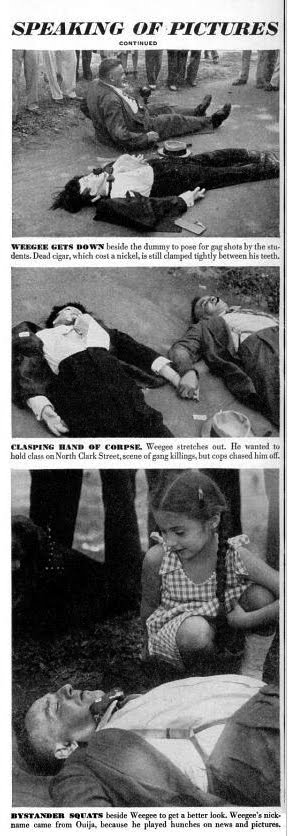
Speaking of Pictures…

…Weegee Shows How To Photograph A Corpse

As part of a six-week photographic seminar at Chicago’s Institute of Design, the stubby, untidy, cigar-chewing Manhattan photographer who calls himself Weegee and who is famous for his pictures of mayhem and murder recently enlivened his course in spot-news photography by showing students how to photograph a corpse…
Life, August 12, 1946


“Bunny”; Charlie Barnet and His Orchestra; Bennett; Gibson; Apollo (1065); Publication date: August 12, 1946


“Let’s Go Home”; Charlie Spivak and his Orch.; S. Williams; Holland; Burke; Okeh (6366); Publication date: August 5, 1941


PM, August 5, 1941, pp.18-20

The Rise and Fall of Lepke Buchalter
Climax of O’Dwyer War on Murder, Inc.; One of City’s Biggest Racketeers on Trial
PM, August 5, 1941, p.18


PM, August 5, 1941, p.20 (PM Photo by Weegee)

Spring Scene And here’s what happened to Sidney (Shimmy) Shales last April. Shimmy was on the lam from a federal indictment linking him to 14 Lepke-ites. Early in the evening he was sauntering up Fifth Avenue when a bullet plowed into his thigh. The marksman then bent over him, jammed his gun against Shimmy’s temple and fired four more shots. None of the hundred who crowded around the corpse would say he had seen the killer. And Shimmy couldn’t.


“To Your Heart’s Content (Acercate Mas)”; Charlie Spivak and his Orch.; Farres; Okeh (6366); Publication date: August 5, 1941


PM, July 22, 1940, pp.16-17

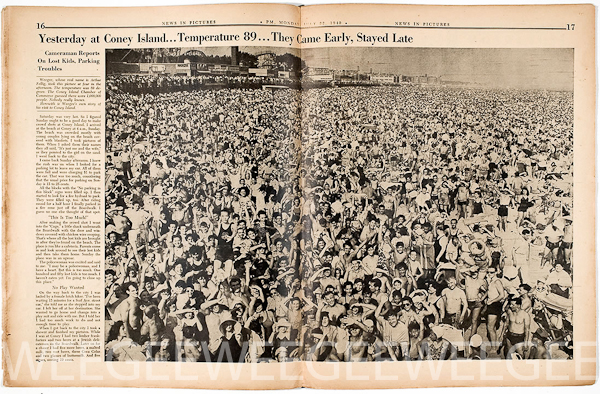
Yesterday at Coney Island… Temperature 89… They Came Early, Stayed Late

Cameraman Reports on Lost Kids, Parking Troubles

Weegee, whose real name is Arthur Fellig, took this picture at four in the afternoon. The temperature was 89 degree. The Coney Island Chamber of Commerce guessed there were 1,000,000 people. Nobody really knows.

Herewith is Weegee’s own story of his visit to Coney Island.

Saturday was very hot. So I figured Sunday ought to be a good day to make crowd shots at Coney Island. I arrived at the beach at Coney at 4 a.m., Sunday. The beach was crowded mostly with young couples lying on the beach covered with blankets. I took pictures of them. When I asked them their names they all said, “It’s just me and the wife,” as they pointed to the girl on the sand. I went back to the City.

I came back Sunday afternoon. I knew the rush was on when I looked for a parking lot to leave my car. All of them were full and were charging $1 to park the car. That was too much, considering that the usual price for parking on Sunday is 15 to 25 cents.

All the blocks with the “No parking in this block” signs were filled up. I then started to look for a fire hydrant to park. They were filled up, too. After riding round for a half hour I finally parked in a fire zone just off the Boardwalk. I guess no one else thought of that spot.

“This Is Too Much!”

After making the crowd shot I went into the “Cage,” a little shack underneath the Boardwalk with the door and windows covered with chicken wire cooping. That’s where all the lost kids are brought in after they’re found on the beach. The place is run like a cafeteria. Parents come in and look around to see their lost kids and then take them home. Sunday the place was in an uproar.

The policewoman was excited and said to me: “I may be a policewoman, and I have a heart. But this is too much. One hundred and fifty lost kids is too much. I haven’t eaten yet. I’m going to close up this place.”

No Play Wanted

On the way back to the city I was hailed by a female hitch hiker. “I’ve been waiting 15 minutes for a Surf Ave. street car,” she told me as she stepped into my car. I left her off at her destination. She wanted to go home and change into a play suit and ride with me. But I told her I had too much work to do and not enough time to play.

When I got back to the city I took a shower and finished my pictures. While I was at Coney I had two kosher frankfurters and two beers at a Jewish delicatessen on the Boardwalk. Later on for a chaser I had five more beers, a malted milk, two root beers, three Coca Colas and two glasses of buttermilk. And five cigars, costing 19 cents.

PM, July 22, 1940