“Happy Birthday”; Eddie Davis and his Orchestra; Sittin’ In With (520); 1949

PM, March 2, 1941


“Happy, Happy Birthday Baby”; The Tune Weavers; Frank Paul’s Orch.; M. Sylvia; G. Lopez; Checker (872); 1957

PM, March 9, 1941

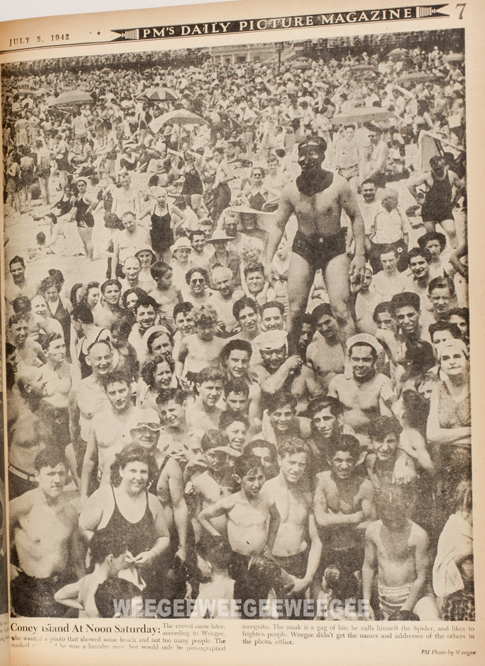
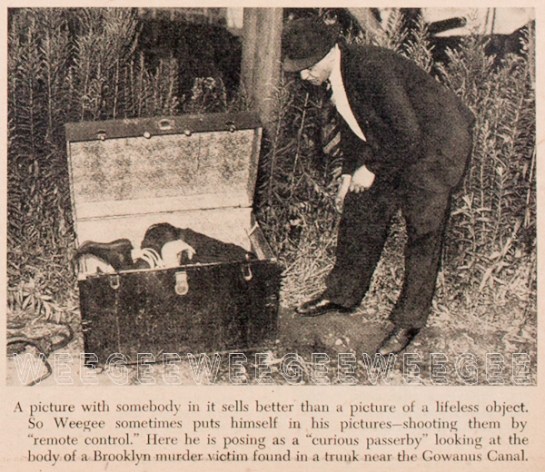
A picture with somebody in it sells better than a picture of a lifeless object. So Weegee sometimes puts himself in his picture-shooting them by “remote control.” Here he is posing as a “curious passerby” looking at the body of a Brooklyn murder victim found in trunk near the Gowanus Canal.
PM, March 9, 1941


“Happy Birthday To You”; Raymond Scott and his New Orchestra; Clyde Burke; M. J. Hill; Columbia (35864); November 29, 1940


“Happy Birthday”; Craven Edwards And his Lazy K-Ranch Boys; Len Stokes; Hill; Diamond (2007-A); June 1946


PM, March 9, 1941

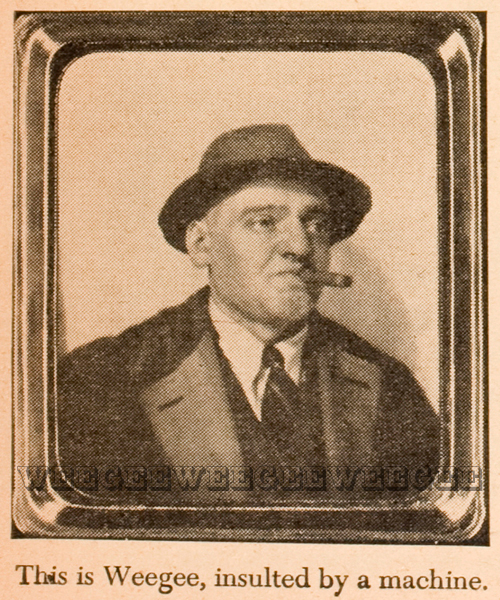
Weegee makes friends readily. On a Chinatown assignment he got this New Year’s lucky wish from a Chinese girl. He has a photo of her painting it pinned above his bed (see picture on next page). It is characteristic of him to have his picture taken this way. The cigar is standard equipment.
PM, March 9, 1941


“Today Is Your Birthday”; The Enchanters; Buddy Lucas and his Band of Tomorrow; Bernstein; Levine; Odom; Geritz; Jubilee (5072); 1952


“Happy Birthday Father (From)”; Harry Tush and his Society Orchestra; Rondoliers; Avalon (502A)


PM, March 9, 1941

Weegee’s room shows his devotion to his job. On top of his regular radio is a police short-wave radio and a loudspeaker attached to it dangles over his bed. On the floor are his special “murder shoes” – at left – and his “snow shoes.” He keeps his “fire shoes” in his car. The wall decorations are examples of his work and certificates of awards for prize-winning pictures. The cardboard boxes at the extreme right are his disorderly “files.” The typewriter is his latest acquisition. He has recently taken up writing – a field in which he shows rather startling talent. We don’t know what the Flit is for.
PM, March 9, 1941


“Birthday Party”; Sil Austin; J. Collins; Mercury (71027); December 25, 1956

Happy Birthday Weegee…


“One O’clock Jump,”; Harry James and his Orchestra; Basie; Columbia (36232); March 6, 1939


Life, May 10, 1943, pp. 34-35 (Photos by Weegee and George Karger)

JITTERBUGS JAM JAMES’S JIVE JAG

News pundits find war phenomenon

…The newspaper PM devoted several scholarly disquisitions to the Harry James jitterbugs…


“Two O’clock Jump,”; Harry James and his Orchestra; James; Basie; Goodman; Columbia (36232); March 6, 1939


Billie Holiday, Joe Guy, her trumpeter-husband, and Mister, her dog, photographed in Billie’s dressing room at the Downbeat Club. Photo by Skippy Adelman.

Billie Holiday singing Strange Fruit. Billie says: “It depresses me every time I sing it. It reminds me of how Pop died. But I have to sing it. Things are still going on in the south.
PM, 1945, Photos by Skippy Adelman.

PM, 1945, Photos by Skippy Adelman.

“One of the these days things will get better,” she sighed. “They’ll get better for everybody. We’ll all have a chance to eat and sleep in peace. I just know it will come about. It will take a long time, but it will come about. It won’t be in my lifetime, though. Oh, no, I’ll never profit by it.” PM, 1945.

Billie Holiday (April 7, 1915 – July 17, 1959).


“Blues for Brando”, Leith Stevens’ All Stars; Leith Stevens, Decca, 1954


PM, September 4, 1947

Marlon Brando has been signed…

Born 100 years ago today…


“The Wild One”, Leith Stevens’ All Stars; Leith Stevens, Decca, 1954


Jim Bishop, The Mark Hellinger Story, 1952, pp. 330-331

…He showed the producer a new picture book of New York City entitled The Naked City. The author of it was Weegee, a fat little cigar-smoking photographer who literally slept in his car near a short-wave radio. He picked up all the police calls and, because he was already on the road when an exciting call came in, Weegee very often was at the scene of a crime before the police. His book of photos was stark and hard…

…When Hellinger decided to use it he phoned Weegee. He explained that there was no value in the book, as such, for a motion picture. But that he liked the title. Instead of buying the name outright, Mark said, he’d put Weegee on the payroll at a hundred a week as still photographer for the period during which the picture was being shot. Weegee accepted. Hellinger explained that the photographer wouldn’t be expected to give up his regular daily work at all; in sum, the hundred [$100 in April 1947 had the same buying power as $1,408.30 in January 2024] a week would be side money…
Jim Bishop, The Mark Hellinger Story, 1952, pp. 330-331

Mark Hellinger (March 21, 1903 – December 21, 1947)