Great uncredited and ferruginous Weegee photo of Dylan Thomas on the BBC website: “Dylan Thomas: Rock ‘n’ roll poet”
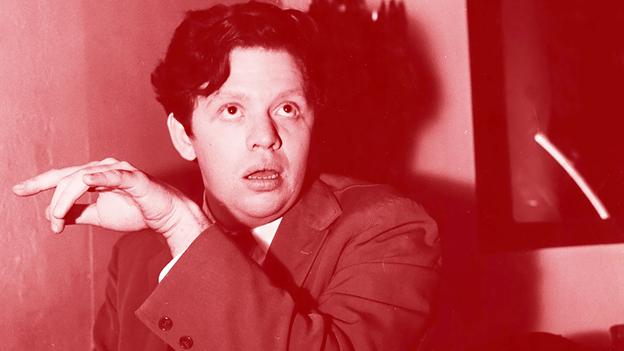
Weegee, [Dylan Thomas],


(Photos from BBC website)
(TO BE CONTINUED…)

Great uncredited and ferruginous Weegee photo of Dylan Thomas on the BBC website: “Dylan Thomas: Rock ‘n’ roll poet”
Weegee, [Dylan Thomas],
(Photos from BBC website)
(TO BE CONTINUED…)

PM, October 13, 1944
‘Sunday, Monday and Always’
These pictures were taken yesterday inside the Paramount Theater where Frank Sinatra was in the second day of a personal appearance engagement. Enough said, we think. Photos by Weegee, PM”

PM, October 12, 1944
“Explanation: Sinatra Opened at the Paramount”
“Frank Sinatra began an engagement at the Paramount Theater here yesterday. He reached the theater at 6 a.m. yesterday, but by that time, a long line – about 1,000 kids, mostly bobby sox girls – had already been waiting for hours in the chill air of morning. While they waited and Sinatra rehearsed inside the empty theater with Raymond Paige and his orchestra. Rehearsal lasted until 8 a.m. and at 8:30, the doors of the theater were thrown open to the madly rushing, crowding, shoving, elbowing followers of The Voice. They had been playing cards, eating sandwiches from paper bags, and drinking hot coffee from thermos bottles while they waited. Some of the girls refused to have their pictures taken, covered their faces with their hands. They were playing hookey from school and jobs, and planned to stay in the Paramount all day and all night to see each of Sinatra’s five appearances on stage.”
“While he rehearsed and his followers waited, weary-eyed Sinatra drank milk, learned his cues, went through his paces at the mike with out singing, relaxed as much as he could.”
“Outside, meanwhile, the lines grew longer as the Bobby Sox Brigade converged on 43d St. and Broadway. At 7 a.m., when this picture was made, the line extended halfway to Eighth Ave.”
“Although 25 City policemen were on duty to keep the kids in order, special New York guards had their hands full keeping the entrance to the Times building on 43d St. clear.”
“After the doors were thrown open at 8:30, and the kids had been seated, and the feature picture had been run (during which the kids screamed “We want Frankie”), Sinatra brought ecstasy…”
“…to his legion of patient admirers. Photos by Weegee, PM”
Great post and responses on thefranksinatra.com: “Frank Sinatra at Paramount Theater”
From the NY Daily News
BY DAVID HINCKLEY NEW YORK DAILY NEWS Sunday, October 31, 2004,
IF THEY had to do it over again, the managers of Times Square’s Paramount Theater perhaps would not have arranged for Frank Sinatra’s $25,000-a-week engagement in the fall of 1944 to begin on Wednesday the 11th of October, which was the day before Columbus Day, a date on which Sinatra’s teenage fans were unencumbered by the obligation to attend school, and 30,000 of them headed for the theater, where their sheer mass literally broke the box office. Moreover, once the lucky few thousand got inside, they proved so exuberant that the stage band had to strike up “The Star-Spangled Banner” in the futile hope that this might cool them down for a few minutes. “Sinatramania,” cried the newspapers. Sinatrauma. Swoonatra. Long buried were the rumors that this skinny Jersey kid didn’t have any real fans at all, just girls who were slipped a few bucks by a savvy press agent to act as if they cared. That might have worked with 30 girls. Not 30,000. Whatever it was called and whatever its genesis, all this bubbling excitement caused some concern for the New York Police Department, which hastily redeployed hundreds of officers from the Columbus Day Parade to monitor squealing bobbysoxers around Seventh Ave. and 43rd St. Sinatra himself was not wholly displeased by the turnout, as a display of public adoration on this scale can have very helpful implications for a singer so ambitious as himself. BY OCTOBER 1944, Sinatra was already the kind of sensation unseen since Rudolph Valentino or Bing Crosby, and maybe not even then, and he wanted to be even bigger. He had been a star since the night of Dec. 30, 1942, when, after putting in several years with the Harry James and Tommy Dorsey bands, he appeared at the Paramount as an “extra added attraction” on a bill topped by Benny Goodman and filled out by four other acts and the patriotic film “Star-Spangled Rhythm,” which starred Crosby. Still young and humble, Sinatra was so thrilled by this big-time, $150-a-week engagement that he traveled to Times Square at 7:30 the morning of Dec. 30 to make sure his name was really on the marquee. He was still nervous hours later when Goodman announced to the crowd: “And now, Frank Sinatra.
” They answered that with a roar that nearly bowled Goodman over. “What the hell was that?
” he blinked. These 22 months later, America was getting a little closer to answering Goodman’s question, though many remained puzzled at exactly how this skinny guy with the oversize bow ties and the wise-guy twinkle in his blue eyes was driving hundreds of thousands of young women into unladylike frenzies. “He knows his feminine audience,” observed Down Beat magazine, “and fires romance – moonlight moods – at them with deadly aim.
” When Sinatra arrived for rehearsal on opening day, more than 1,000 girls had been waiting on the Paramount line since the wee small hours, defying Mayor Fiorello LaGuardia’s nighttime curfew for juveniles and cutting school to boot. When the doors opened, 3,600 fans tumbled in and screamed so loudly that Sinatra threatened to leave the stage if they didn’t pipe down. The next day, more than 10,000 fans had queued up before the first show. Then 20,000 more began to arrive. Besides the 700 cops on the street, the Paramount had put in 50 extra ushers, who proved no match for teenage hormones. The ticket booth was pushed in, windows smashed. Here was nothing less than a teen riot. Only in Sinatra’s lifetime had his primary audience, teenagers, become a factor in the popular music equation. Through the 1920s, a radio or a phonograph was a major investment, purchased as a living room centerpiece with its programming controlled by the family breadwinner. Therefore, popular music was designed for adults. But when the Depression hit, record companies introduced budget lines, which opened the market to kids, and by 1935 they were showing their clout by jitterbugging so happily to Goodman’s music that they launched the Big Band Era. So when Sinatra went solo in 1942, the teenagers were there. The Paramount riot of October 1944 made it clear how thoroughly so many observers had miscalculated when they assumed earlier that Sinatra had “passing fad” tattooed all over his bony forehead. Just because his fans were teenagers, it turned out, didn’t mean that in two weeks they’d be back swallowing goldfish. In fact, by the time Johnny came marching home from the war a year later, solo vocalists like Sinatra were the stars and teenagers like the Paramount bobbysoxers were increasingly whom they sang for. MUCH OF popular culture would take note of this. What the hell was that, indeed.
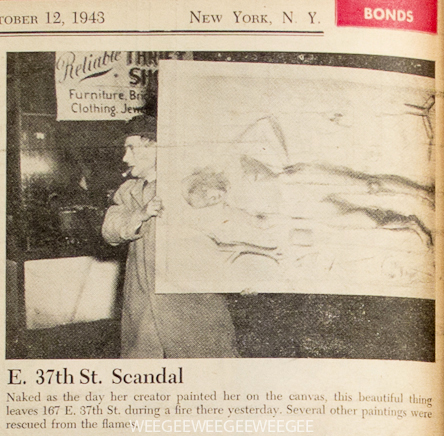
PM, October 12, 1943
“E. 37th St. Scandal
Naked as the day her creator painted her on canvas, this beautiful thing leaves 167 E. 37th St. during a fire there yesterday. Several other paintings were rescued from the flames.”
(This is an obscure one, don’t think this is in too many catalogue raisonnés.)

Reliable Thrift Shop, 760 2nd Ave.


167 E. 37th St.
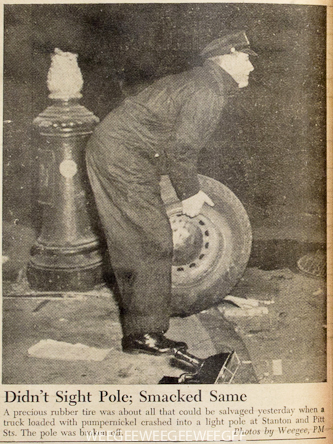
PM, October 12, 1943
“Didn’t Sight Pole; Smacked Same
A precious rubber tire was about all that could be salvaged yesterday when a truck loaded with pumpernickel crashed into a light pole at Stanton and Pitt Sts. [Perhaps about a block from a former Fellig family home.] The pole was broken off.”
(This is an obscure one, don’t think this is in too many catalogue raisonnés.)
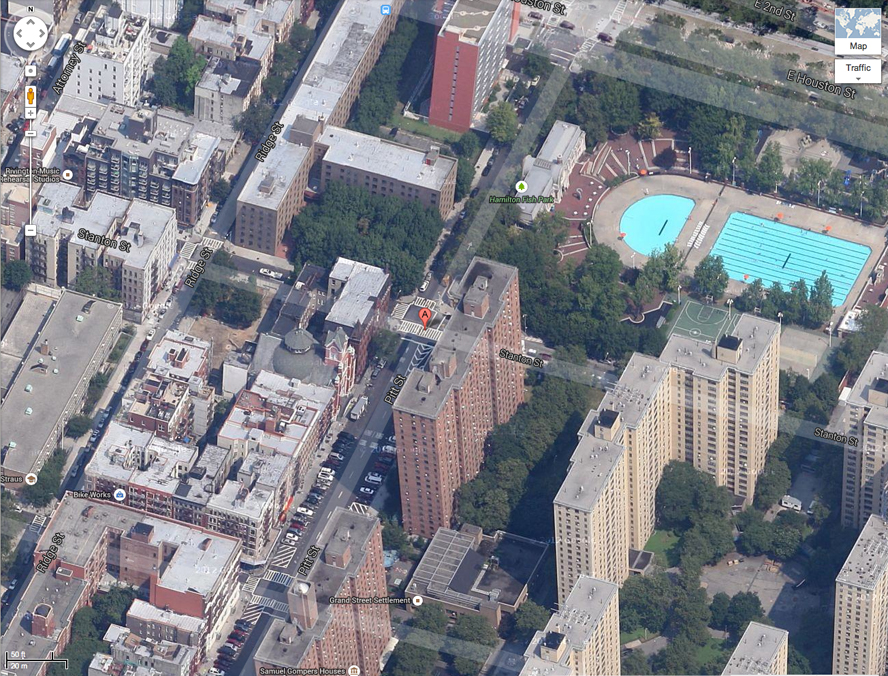
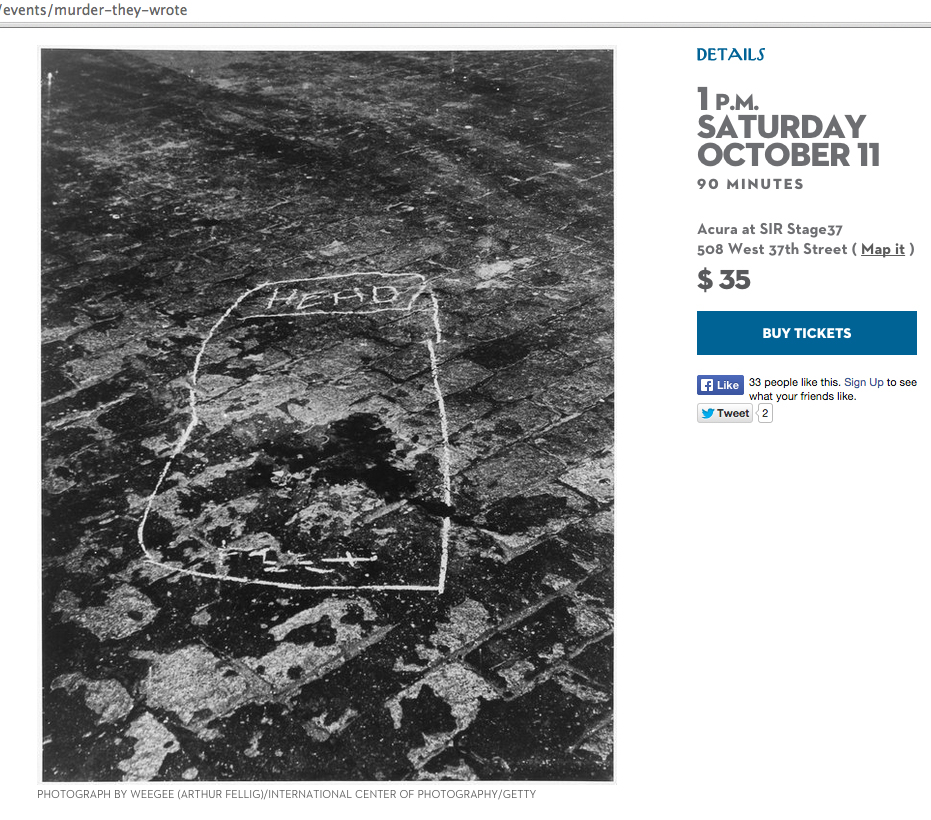
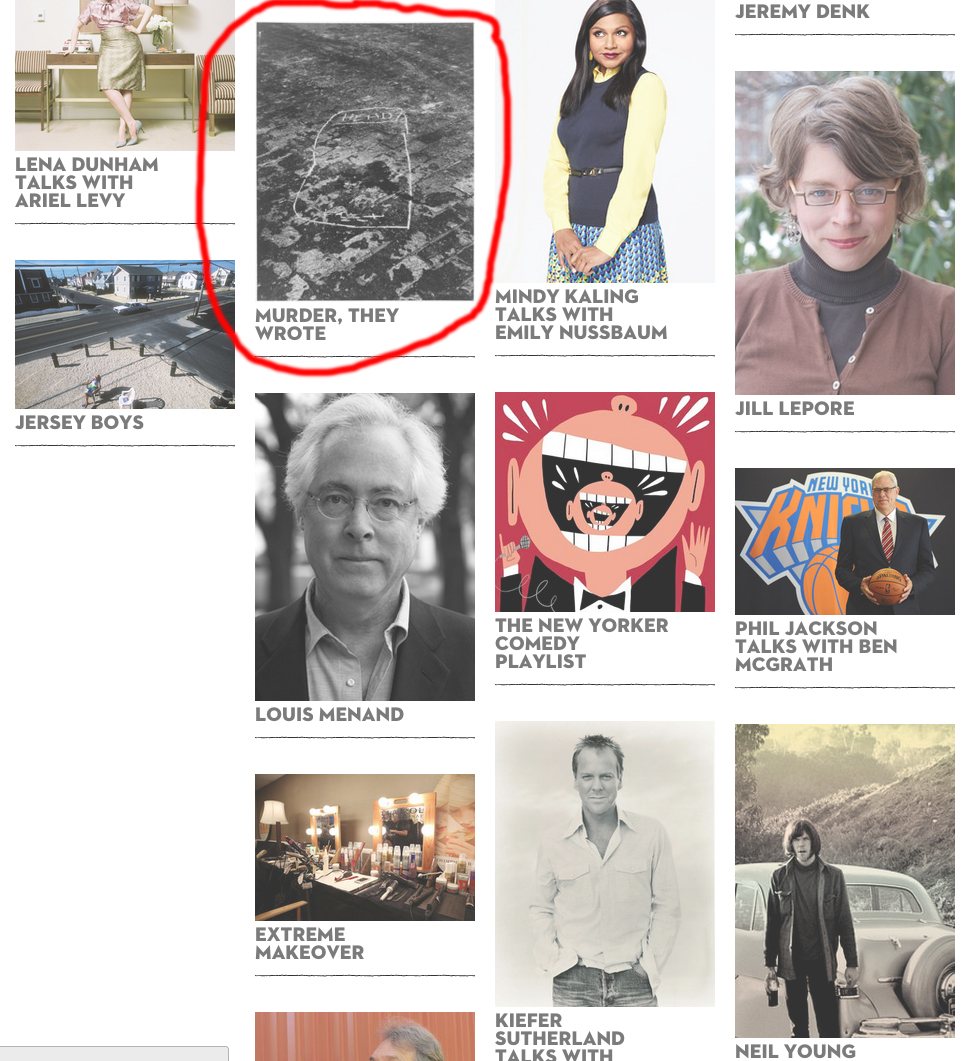
Screen shots from the New Yorker festival website, 10/2014
“Murder, they wrote. Dark thoughts.”
Perhaps the only time this cast of characters, including Lena Dunham, Mindy Kaling, Jill Lepore, Phil Jackson, Neil Young and Weegee will be on the same (web) page…

PM, September 29, 1940, pp50-51
“Artists Mourn a Fascinating Model: Manhattan Els”
by Elizabeth Sacartoff
“Early in October, they expect to start junking the 72-year-old Ninth Ave. El. Later in the month, the Board of Transportation hopes to get rid of the 60-year-old Second Ave. El between 59th and 129th Sts. With the Sixth Ave. El already gone and the fate of the Third Ave. line practically sealed, Manhattan’s homeliest landmarks soon will have vanished…”
(Els didn’t figure prominently in Weegee’s photos. Perhaps there are only a few Weegee photos with or about elevated subways: Joy of Living, cake box murder (perhaps), street car crash on the Bowery, and the shadow of the El (in Naked City), also on the Bowery, all under an El…)

PM, September 29, 1940, pp.52-53
“Eisenstein Film, Lost 8 Years Comes to N.Y.”
“Time in the Sun…” [Or, ¡Qué viva México!]


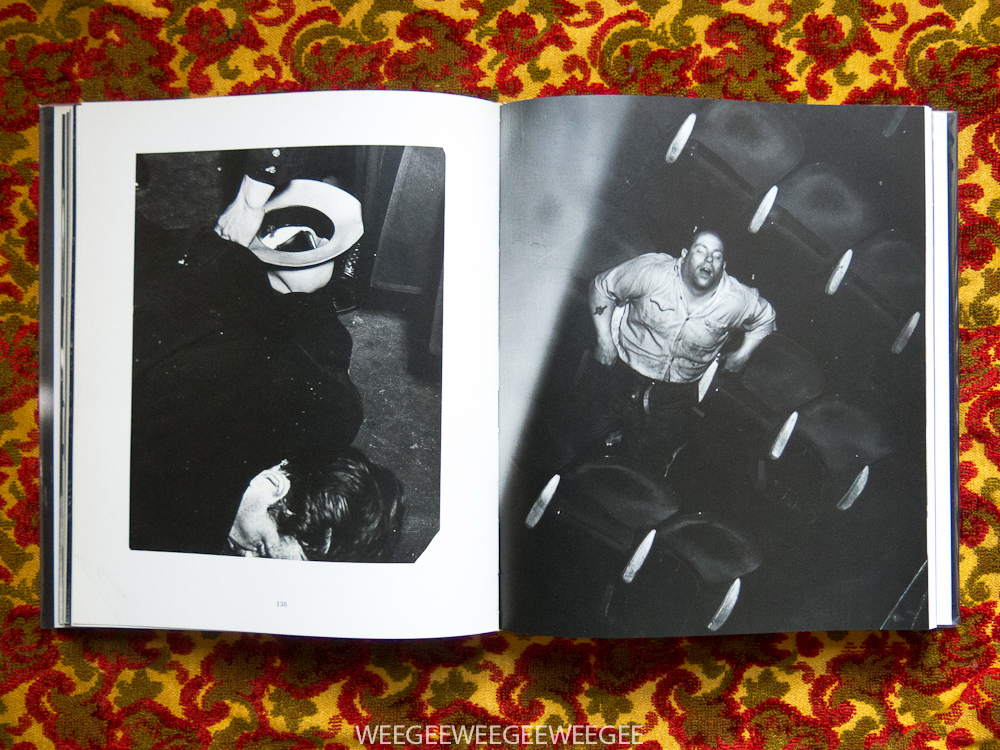


The New York School Photographs 1936-1963, by Jane Livingston, 1992
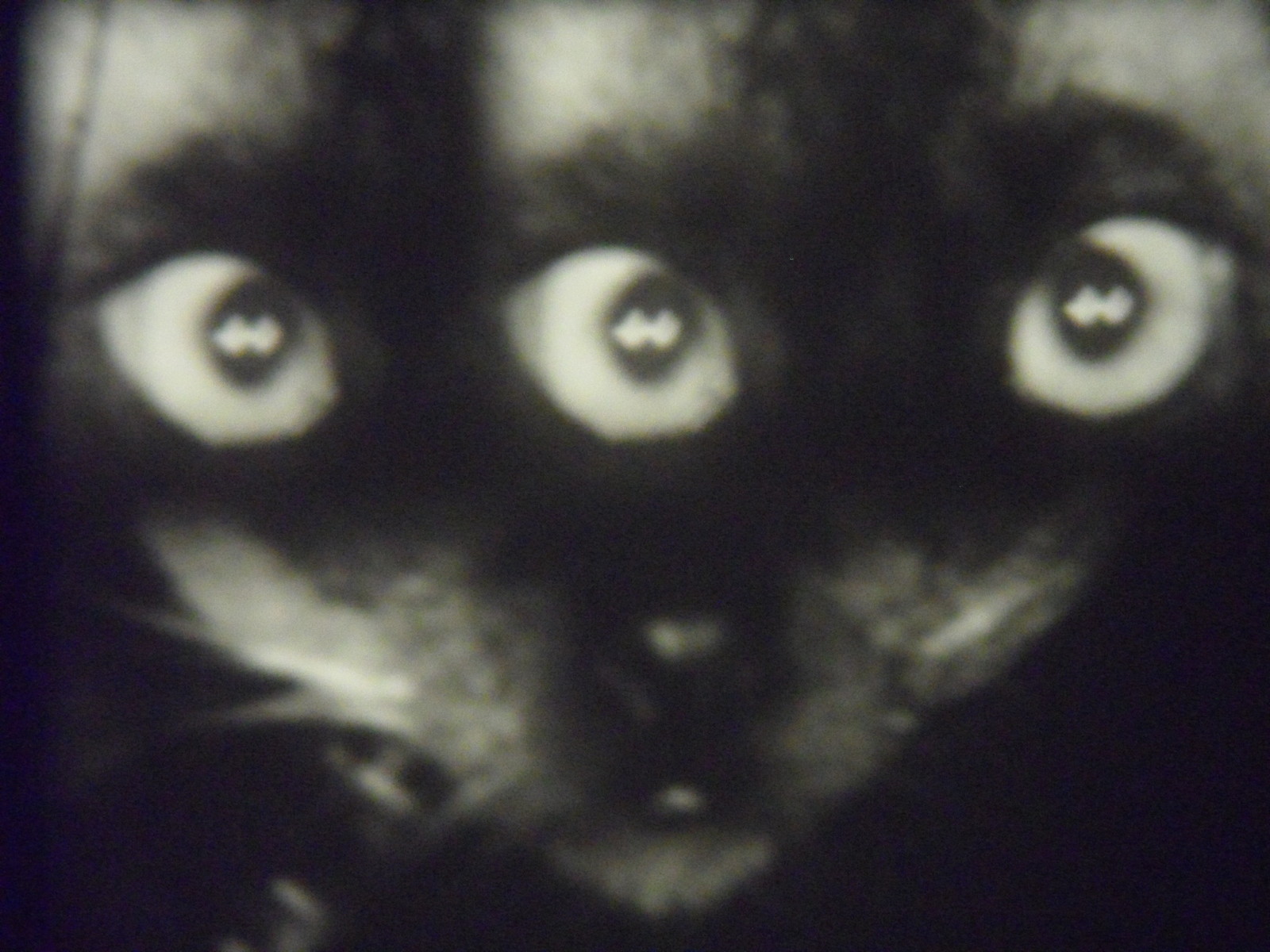
“Weegee’s Camera Magic,” ca. 1960
Anyone who wanders into Weegee’s world, is curious and looks closely, notices that there is often a bit of ambiguity, confusion and obfuscation (perhaps even misinformation) surrounding the facts of Weegee’s photos. (Even the cats have three eyes.) The most obvious examples of this are the titles and dates of Weegee’s most famous photos, for example, “Summer, Lower East Side” ca. 1937, was made in the Upper West Side, perhaps around 1945. (More, and incomplete, info about “Summer, Upper West Side” is here.) “Weegee’s Camera Magic” is another example:
“Weegee’s Camera Magic,” color, ca. 1960, (image from the Internet)
There is a Castle Film called “Camera Magic,” it’s #806. (It was made or released from 1945-1953?) Perhaps the filmmaker is anonymous.
There is a Castle Film called “Weegee’s Camera Magic,” it’s #1016 in black and white, and #9021 in color. It was copyrighted in 1960. (And released between 1960-1966?)
We think “Camera Magic” and “Weegee’s Camera Magic” are two different films.
(Interestingly Weegee’s film is in both color and black and white. And in way, perhaps Weegee continued his work with Universal.)
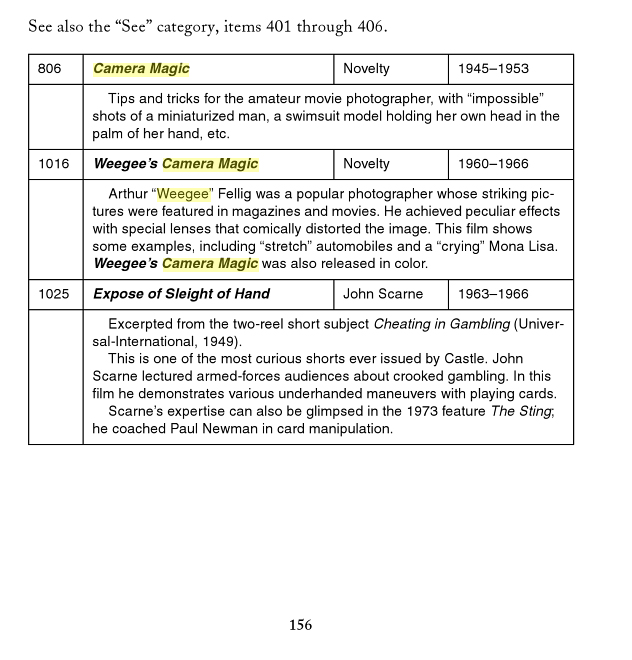
Page 156 of “Castle Films: A Hobbyists’s Guide” by Scott MacGillivray, the google books version is here.
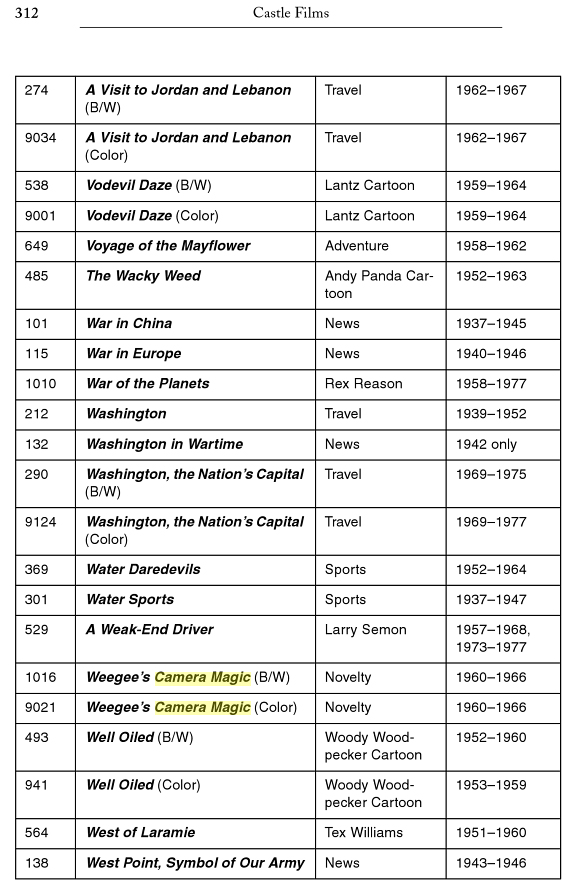
Page 312 of “Castle Films: A Hobbyists’s Guide” by Scott MacGillivray, the google books version is here.
A useful, informative, great book: “Castle Films: A Hobbyists’s Guide” by Scott MacGillivray.
This is “Weegee’s Camera Magic”
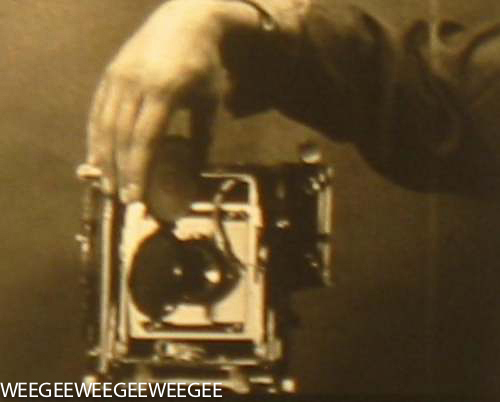


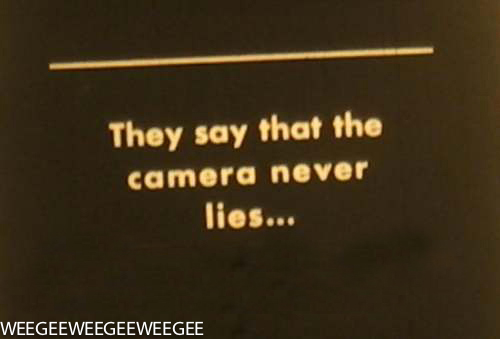

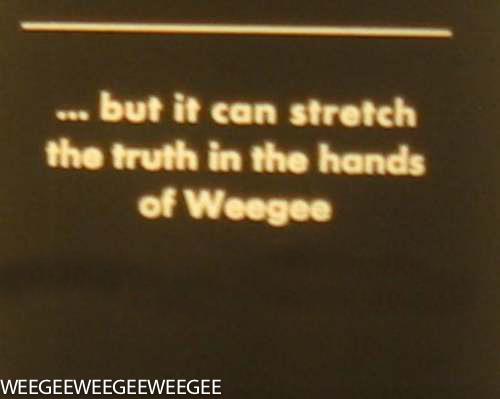
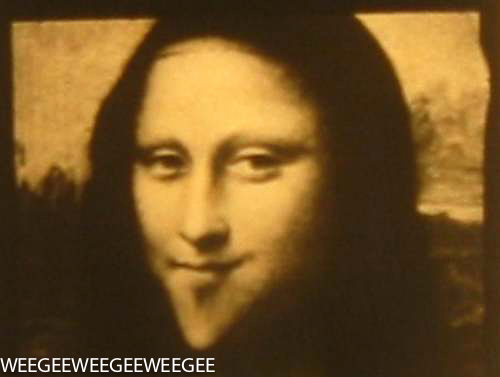
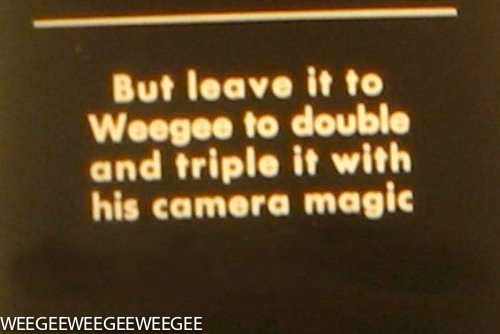
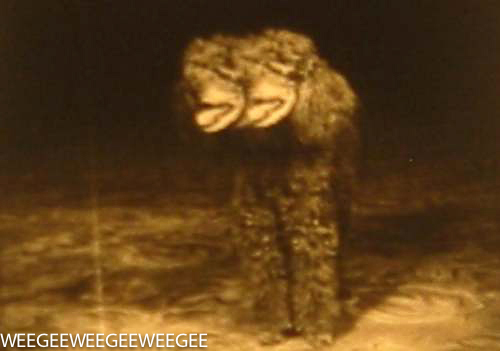
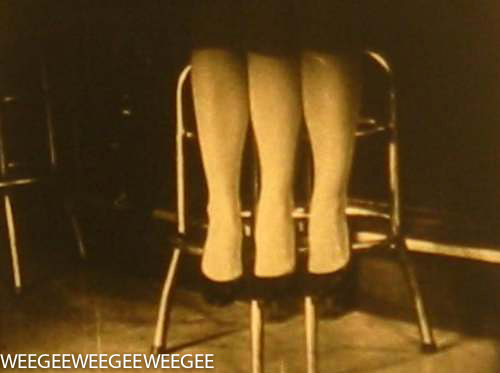
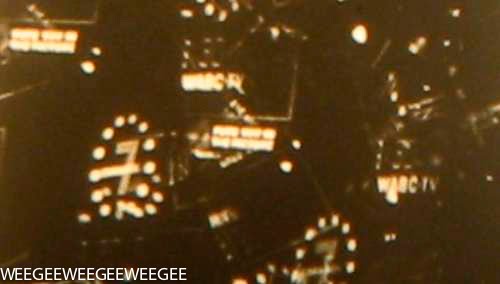
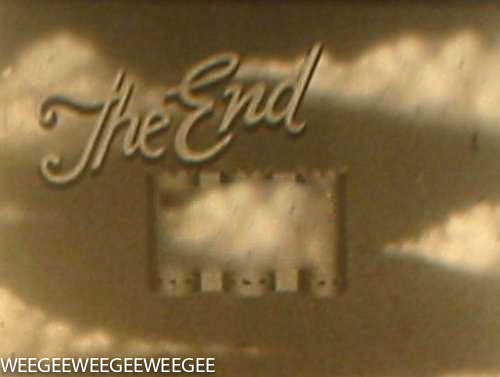
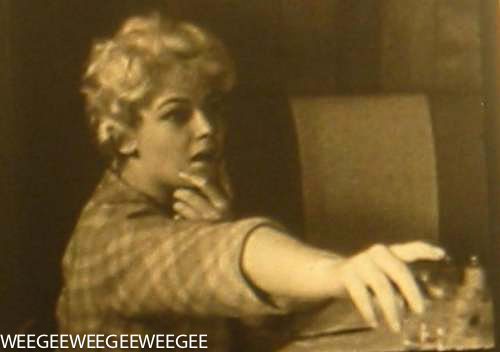
Images from the Internet
This is “Weegee’s Camera Magic”
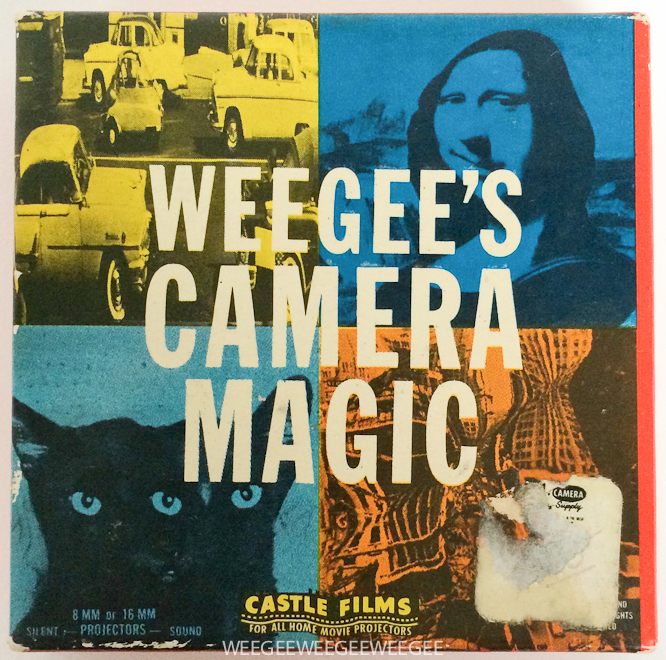
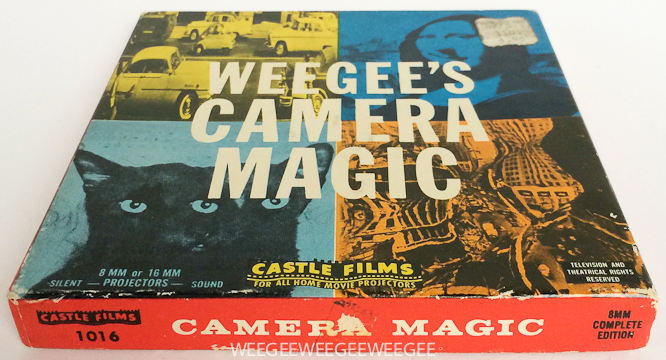
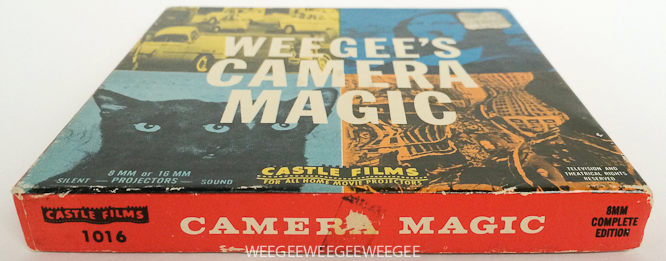
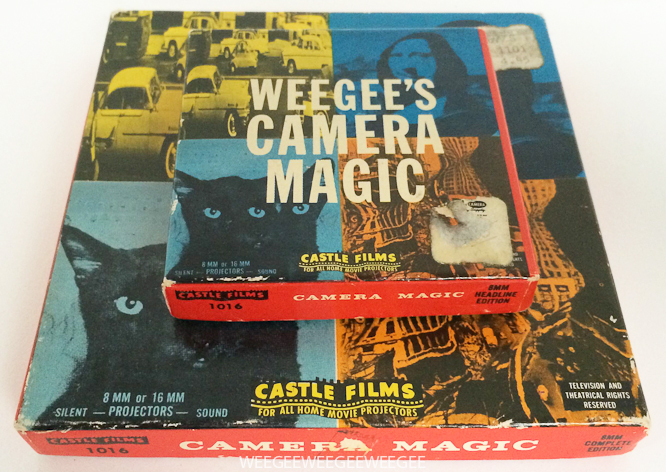
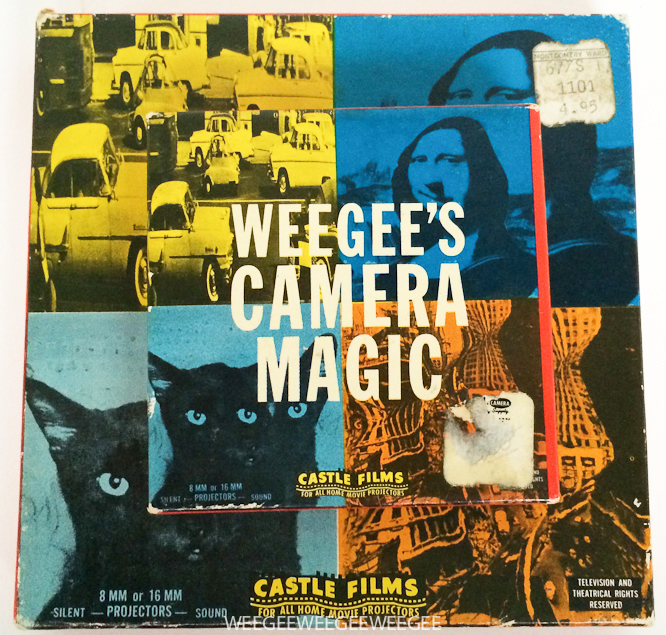
“Weegee’s Camera Magic,” 8mm, complete and headline editions, catalogue number 1016.
This is not Weegee’s Camera Magic:
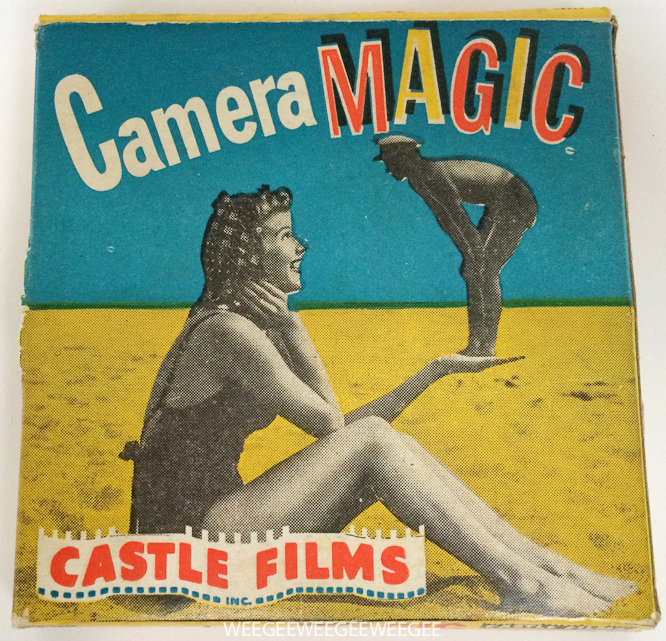

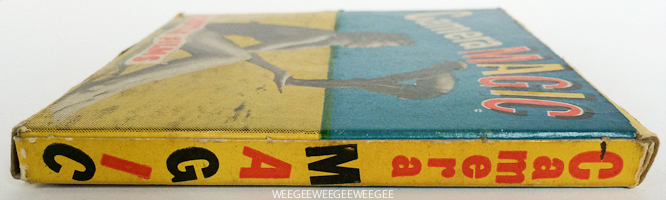
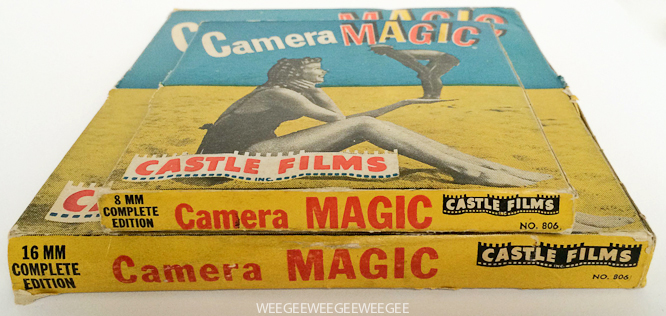
“Camera Magic,” 8 and 16mm, catalogue number 806.
CAMERA MAGIC DVD Converted From Original Black and White by Arthur Weegee
* Historically Important Special Effects Revealed *
Please understand you are purchasing a DVD of the original print of the black and white – 16mm – sound version of this production. You will not be receiving any film product.
A documentary using camera techniques and found objects to allow the amateur film maker or enthusiast to create special effects. That would be interesting enough, but this was made by WEEGEE – the most famous TABLOID photographer in America – the man who created the genre in the 1930’s and 40’s. What might have been routine in the hands of another cinematographer takes on a new, weird and carnival-like flavor. WEEGEE roams the streets of New York City, and we get to tag along, seeing different camera tricks as we go. The techniques include shooting with a special 90 degree lens that lets you film people surreptitiously, shooting past angled mirrors to create kaleidoscope-like effects, and using reflective sheets with other tricks to achieve effects such as a woman with two heads. A great DVD for anyone with an interest in WEEGEE, a New York film collection or interest in the origins of the “light shows” of the psychedelic 60s.
Some of the scenes include: On Water or Dry Land, Bearded Lady of the Circus, Handsome Man in the Palm of Your Hand, The Girl Who Lost Her Head, Impossible Physical Contortions, The Human Fly, Split Stage (matting film), Goose Step, Horse That Can’t Make Up His Mind, Fish that Jump out of Lake into Boat, Preventing Accidents / Staging Accidents, Making Dollies, Dissolving in Two Figures, Optical Painting – Use of Prisms.
The DVD was carefully / optically produced, retaining the highest quality of the visual and audio information provided. Entertaining in a 9 minute DVD.
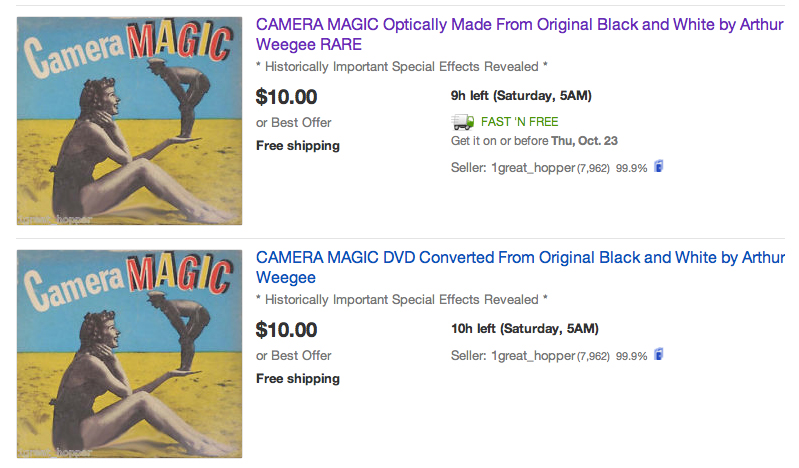
Not Weegee’s Camera Magic
The above is a current eBay auction:
For $10.00 you can buy a DVD of a film that was not made by Weegee, but is allegedly made by “Arthur Weegee.”
This is not Weegee’s Camera Magic.
(Not Weegee’s Camera Magic can also be seen here.)
To be continued…
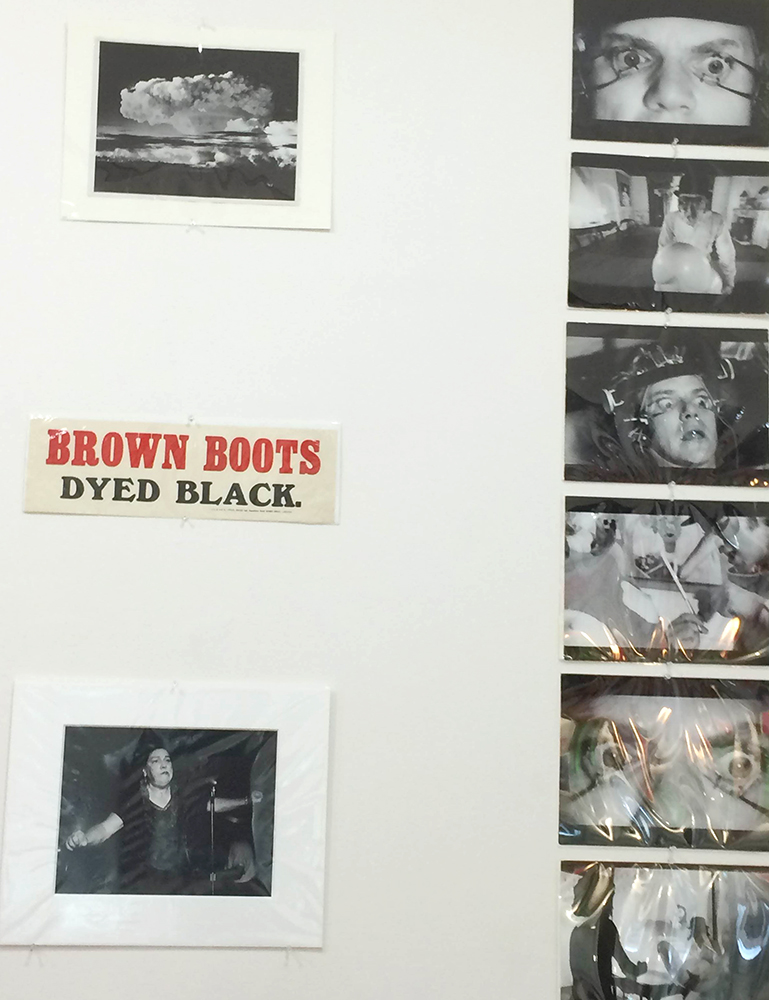
Weegee at the NY Art Book Fair, 09/24/2014
 WEEGEEWEEGEEWEEGEE