
PM, August, 15, 1946
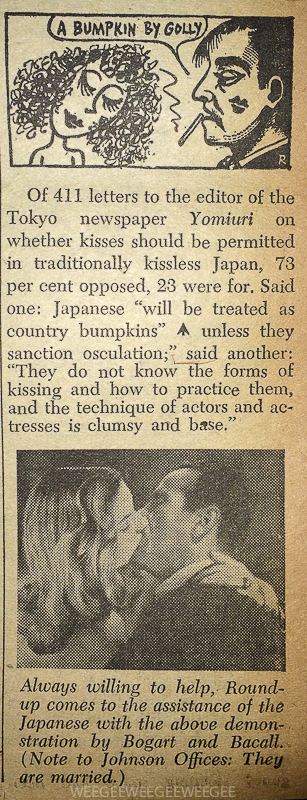
“Of 411 letters to the editor of the Tokyo newspaper Yomiuri on whether kisses should be permitted in traditionally kissless Japan, 73 per cent opposed, 23 were for. Said one: Japanese “will be treated as country bumpkins” unless they sanction osculation;” said another: “They do not know the forms of kissing and how to practice them, and the technique of actors and actresses is clumsy and base.”
“Always willing to help, Round-up comes to the assistance of the Japanese with the above demonstration by Bogart and Bacall. (Note to Johnson Offices: They are Married.”

PM
“Bogart and Bacall in Bucolic Bridal”

PM, May 22, 1945
“It Happened in the U.S.A.
Bogart and Bacall in Bucolic Bridal”
“Bromfield Adds Snapdragons and Rustic Setting
At Mansfield, O., Humphrey Bogart, the movie tough guy, and Lauren Bacall, known as The Look, were married at the home of Louis Bromfield, the farmer, in as quiet a ceremony as possible considering that there were Hollywood press agents all over the place. Arriving from Chicago with Miss Bacall’s mother, the couple got their license from Probate Judge S. H. Cramer, who pointed out that Ohio law required that at least one party to an Ohio marriage be an Ohio resident. This hurdle was crossed when Miss Bacall swore that she was a resident of Lucas, O., after which the party adjourned to the Bromfield manse, where Bogart grabbed a few Martinis to soothe his nerves. Municipal Judge H. H. Shettler performed the ceremony in a rustic setting in the entrance hall, decked with snapdragons and shrubs. He worked from a loose-leaf notebook, explaining that he had typed out an improvised service for this special occasion, “combining a little of everything.” Miss Bacall, born Betty Joan Perske in the Bronx, wore what was described as a simple doeskin beige dress adorned with a big orchid; Bogart, a plain gray suit and a dark maroon necktie.”

“How to Draw Political Cartoons” – 70 Years Ago Today…

PM, April 2, 1944
“How to Draw Political Cartoons by Ad Reinhardt
Memo to editors: This solution to the problem of preparing the daily (any day) political cartoon is offered to relieve any paper, any metal or manpower shortages. This solution can be mastered by anyone in the four easy stages shown below. Send in for more complete instructions any time.”
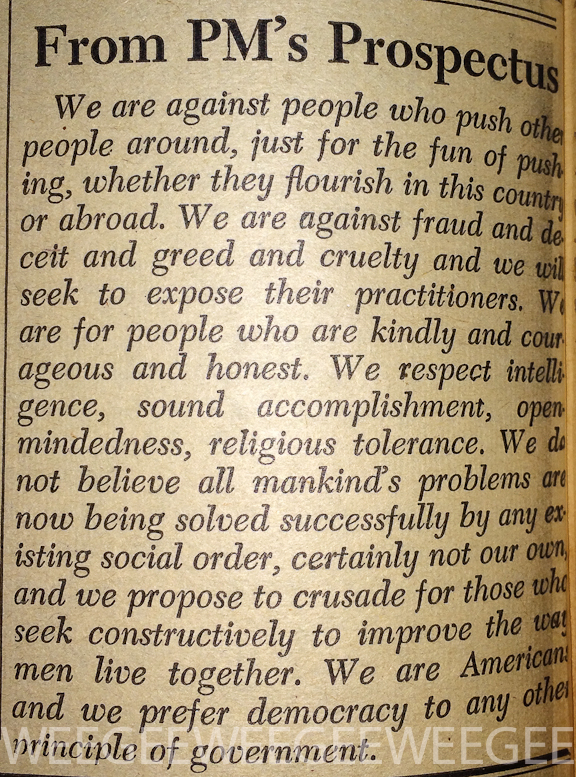
“We are against people who push other people around…”
PM, March 17, 1943
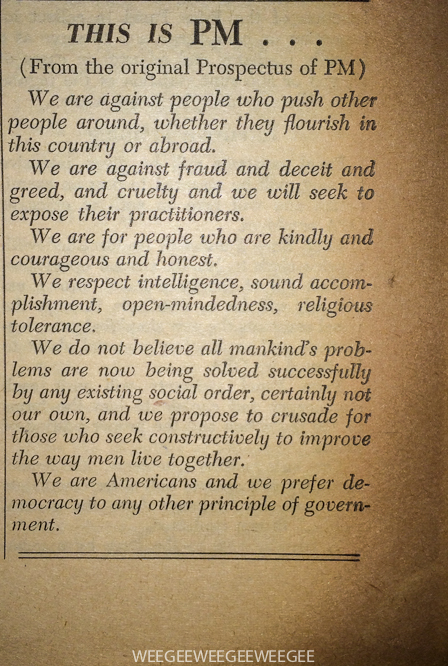
THIS IS PM…
(From the original Prospectus of PM)
We are against people who push other people around, whether they flourish in this country or abroad.
We are against fraud and deceit and greed, and cruelty and we will seek to expose their practitioners.
We are for people who are kindly and courageous and honest.
We respect intelligence, sound accomplishment, open-mindedness, religious tolerance.
We do not believe all mankind’s problems are now being solved successfully by any existing social order, certainly not our own, and we propose to crusade for those who seek constructively to improve the way people live together.
We are Americans and we prefer democracy to any other principle of government.
67 Years Ago Today… PM Darkroom Developer Revealed


PM, March 16, 1947
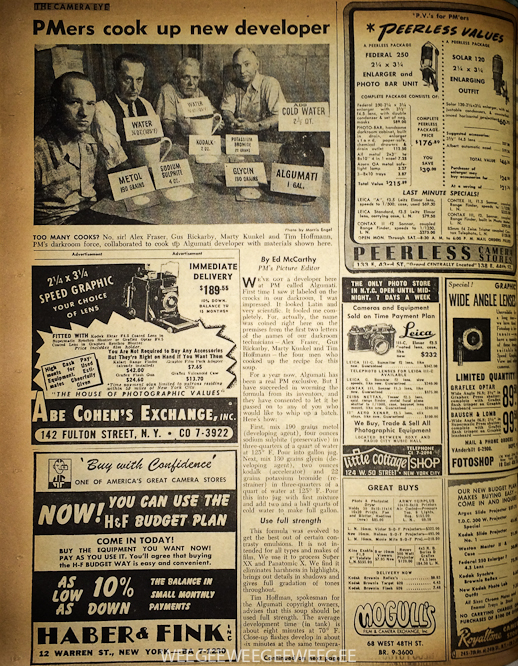
Photo by the great Morris Engel; his archive is here…
In March 1947, “PM’s darkroom force” consisted of: Alex Fraser, Gus Rickarby, Marty Kunkel, Tim Hoffmann…
The Camera Eye
By Ed McCarthy
PM’s Picture Editor
PMers Cook Up New Developer…
We’ve got a developer here at PM called Algumati. First time I saw it labeled on the crocks in our darkroom, I was impressed. It looked Latin and very scientific. It fooled me completely. For, actually, the name was coined right here on the premises from the first two letter of the names of our darkroom technicians – Alex Fraser,Gus Rickarby, Marty Kunkel and Tim Hoffmann -the four men who cooked up the recipe for this soup.
For a year now, Algumati has been a real PM exclusive. But I have succeeded in worming the formula from its inventors, and they have consented to let it be passed on to any of you who would like to whip up a batch.
Here’s how:
First mix 190 grains metal (developing agent), four ounce sodium sulphite (preservative) in three-quarters of a quart of water at 125 F. Pour into gallon jug. Next, mix 130 grains glycin (developing agent), two ounces kodalk (accelerator) and 22 grains potassium bromide (restrainer) in three-quarters of quart of water at 125 F. Pour this into jug with first mixture and add two and a half quarts o cold water t0_ make full gallon.
Use full strength
This formula was evolved to get the best out of certain contrasty emulsions. It is not intended for all types and makes of film. We use it to process Super XX and Panatomic X. We find it eliminates harshness in highlights, brings out details in shadows and gives full gradation of tones throughout.
Tim Hoffman, spokesman for the Algumati copyright owners, advises that this soup should be used full strength. The average development time (in tank) is about eight minutes at 70 F. Close-up flashes develop in about six minutes at the same temperature. Algumati is effective at temperatures ranging to 75 F. That makes it a swell developer for summer use.
During development, says Tim, the film should be agitated six to eight times for best results. He believes agitation is especially important in the first two minutes of development. That goes not only for Algumati, but any developer.
190 grains metol
4 oz. sodium sulphite
3/4 qt. water
130 grains glycin
2 oz. kodalk
22 grains potassium bromide
73 Years Ago Today…March 9, 1941… “If You Want to Know How Weegee Gets Pictures Like These…”

PM, March 9, 1941
“If You Want to Know How Weegee Gets Pictures Like These See Ralph Steiner’s Story on Next Page”
[Obviously the greatest and most important story, photographs, and text in PM’s history… Ink on paper has never been better used throughout the history of the printed word…]
Monday by a nose…
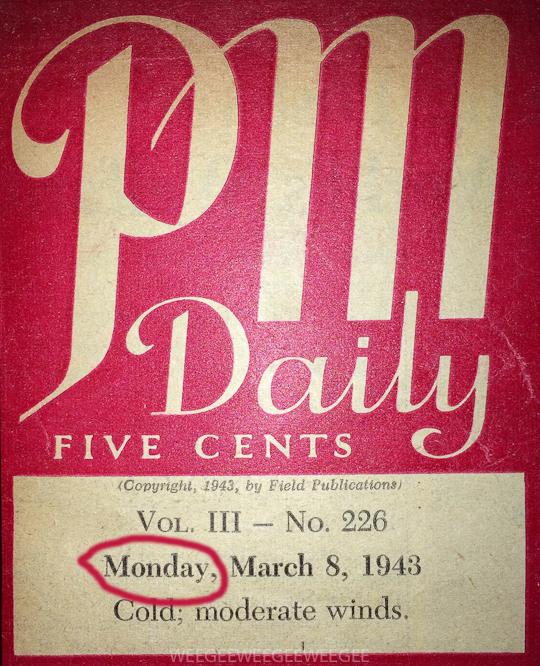
Have you ever asked what days of the week did Weegee have photos published in PM? Well, our Winter interns have been crunching the numbers all year, and here are the results:
Monday – 79 photos
Tuesday – 42 photos
Wednesday – 35 photos
Thursday – 41 photos
Friday – 52 photos
Sunday – 75 photos
Monday, followed closely by Sunday and a distant Friday, were the most common days of the week that Weegee published photos in PM…
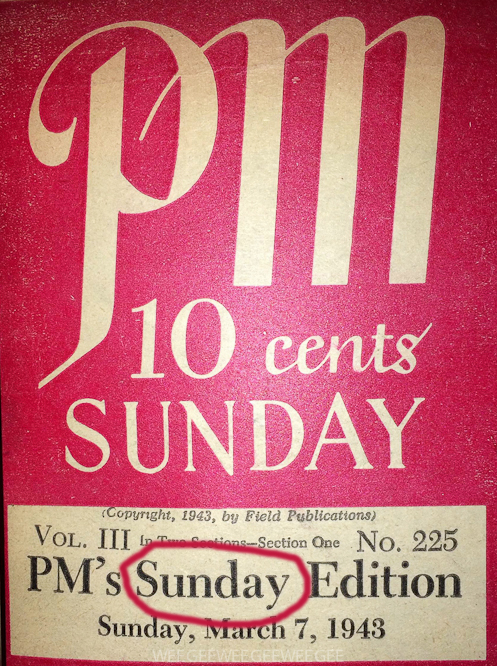
“… masquerades as progressive. You can’t fool all of the people…” On the media, 73 years ago today…

PM, February 13, 1941
“We are against fraud and deceit and greed and cruelty…”
PM,
HISTORY OF PM (part 2)
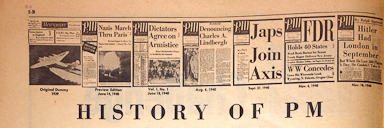
“Early in the Spring of 1940, the first raw recruits for Task Force PM gathered in a loft in Brooklyn, a few blocks away from the Long Island R.R.’s Flatbush Avenue station, and began their training for the invasion of New York with a new kind of newspaper. By the first week in June they had translated the prospectus on which the money to pay them had been raised into copy for the first prepublication issues-and these had been printed a mile and a half away on presses that had been leased from the BROOKLYN DAILY EAGLE.”
 WEEGEEWEEGEEWEEGEE